Introduction
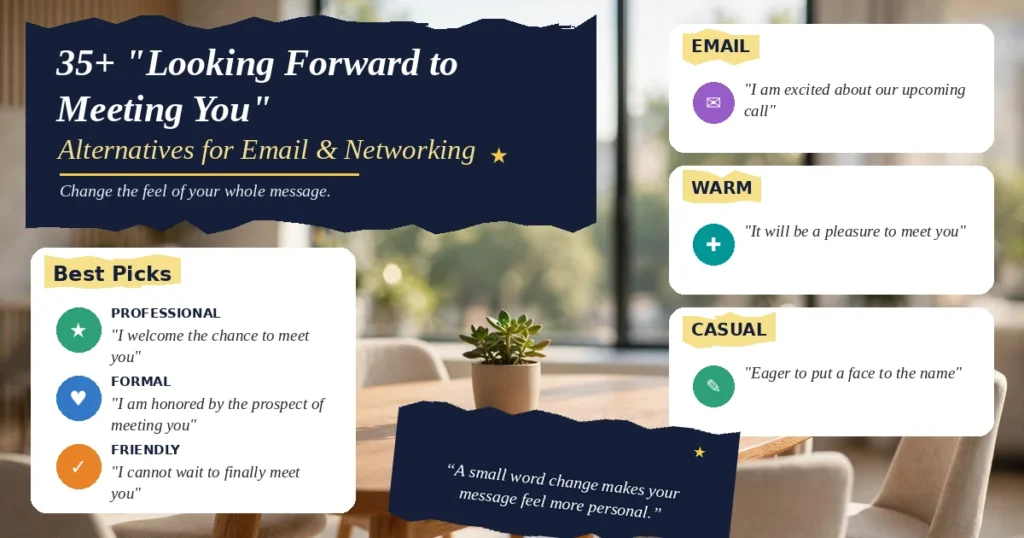
Finding other ways to say looking forward to meeting you can change the feel of your whole message. The classic line is polite, but it appears in almost every business email today. When everyone uses the same words, your message stops standing out. A fresh phrase shows care, effort, and real interest in the other person.
Think about the last email you received that closed with “looking forward to meeting you.” You probably skimmed past it. Now imagine a line that says “I am eager to connect with you in person.” That small change adds warmth and energy. It tells the reader that you are genuinely interested, not just copying a template.
This guide gives you 35 alternatives grouped by tone: professional, formal, friendly, email, and workplace. You will learn what the phrase means, when to use it, common mistakes to avoid, and how different cultures read it. Each alternative comes with a short example so you can copy the style into your own writing. By the end, you will never run out of fresh ways to express the same kind message.
Meaning
The phrase “looking forward to meeting you” means you feel happy and hopeful about a future meeting. It expresses positive expectation. You are telling the other person that you value the meeting and expect something good to come from it.
The phrase comes from the verb “look forward to,” which means to feel excited about something that will happen. When you add “meeting you,” you make it personal. You are not just excited about the event. You are excited about the person.
People use it in emails, letters, video call invites, and event invitations. It works as a warm closing line. It also works in the body of a message when you confirm plans. The tone is polite and hopeful, which is why it fits almost any business setting.
One thing to notice: the phrase focuses on the future. It points the reader toward the meeting ahead. That is why alternatives that keep this future focus feel natural as replacements. Lines like “I anticipate our upcoming discussion” keep the same forward-looking energy with different words.
Professional usage
In professional settings, “looking forward to meeting you” signals respect and readiness. Managers use it when hiring. Sales teams use it before client calls. Founders use it when meeting investors. It sets a cooperative tone before the conversation even starts.
Use it when the meeting is confirmed but has not happened yet. A recruiter might write it after scheduling an interview. A vendor might write it after a prospect accepts a demo. The timing matters. Saying it too early, before plans are set, can feel pushy. Saying it after the meeting is a mistake, since the moment has passed.
You can place the phrase in the closing paragraph of your email, right before your sign-off. You can also use it early in the message to show enthusiasm from the start. Both placements work. The closing placement is more traditional. The early placement feels more personal and energetic.
Pair it with a clear next step for best results. For example, after expressing your excitement, confirm the date and time. You might say you are eager to meet and that you will send the agenda soon. This combination shows both warmth and organization. If you need another way to promise a follow-up, you can explore other ways to say I will let you know to keep your emails fresh and clear.
In very formal industries like law or finance, choose a more reserved alternative. In creative fields, you can be more expressive. Match your words to your audience, and the phrase will always land well.
Alternatives
Here are 35 alternatives to “looking forward to meeting you,” organized into five tone groups. Each entry includes the phrase in bold, a note on tone and best use, and a short example sentence. Pick the one that fits your relationship and setting.
Professional
- I am eager to connect with you in person : professional and warm, best for first meetings with clients or partners, works well in meeting invitations. Example: “I am eager to connect with you in person at the summit.”
- I anticipate our upcoming discussion : professional and calm, shows respect for the agenda, fits consulting emails. Example: “I anticipate our upcoming discussion on the Q3 roadmap.”
- I welcome the chance to meet you : professional with gentle warmth, ideal for replies to introductions. Example: “I welcome the chance to meet you next Tuesday.”
- I am pleased to have the opportunity to meet you : professional and slightly elevated, best for senior-level contacts. Example: “I am pleased to have the opportunity to meet you at the gala.”
- I look ahead to our meeting with enthusiasm : professional and energetic, great for event outreach. Example: “I look ahead to our meeting with enthusiasm after reading your report.”
- I am keen to meet you face to face : professional and direct, carries a friendly British tone, good for sales conversations. Example: “I am keen to meet you face to face at the expo.”
- It will be a pleasure to meet you : professional and gracious, works in cold outreach replies. Example: “It will be a pleasure to meet you at the conference.”
Formal
- I await our meeting with great anticipation : formal and traditional, fits diplomatic or academic letters. Example: “I await our meeting with great anticipation this autumn.”
- I am honored by the prospect of meeting you : formal and deeply respectful, use with executives or dignitaries. Example: “I am honored by the prospect of meeting you, Professor Hale.”
- I regard our upcoming meeting with pleasure : formal and measured, suits official correspondence. Example: “I regard our upcoming meeting with pleasure and confidence.”
- I am delighted at the thought of meeting you : formal with elegant warmth, works in thank-you replies. Example: “I am delighted at the thought of meeting you in Geneva.”
- I anticipate the privilege of your acquaintance : formal and very courteous, best for high-stakes introductions. Example: “I anticipate the privilege of your acquaintance at the ceremony.”
- Our meeting is something I greatly anticipate : formal with quiet emphasis, fits legal or corporate letters. Example: “Our meeting is something I greatly anticipate after the review.”
- I am most gratified by the chance to meet you : formal and old-school, use in ceremonial contexts. Example: “I am most gratified by the chance to meet you at the awards dinner.”
Friendly
- I cannot wait to finally meet you : friendly and relaxed, great for networking events. Example: “I cannot wait to finally meet you after all these Zoom calls.”
- I am so excited to meet you in person : friendly and upbeat, fits casual meetups. Example: “I am so excited to meet you in person this weekend.”
- It is going to be great to meet you : friendly and confident, works with peers. Example: “It is going to be great to meet you at the workshop.”
- I have been wanting to meet you for ages : friendly and personal, use when you admire the person. Example: “I have been wanting to meet you for ages after your talks.”
- I am counting down the days until we meet : friendly and playful, fits conference plans. Example: “I am counting down the days until we meet in Chicago.”
- I am really looking forward to our meetup : friendly and relaxed, good for informal chats. Example: “I am really looking forward to our meetup on Friday.”
- It will be awesome to finally shake your hand : friendly and human, fits creative industries. Example: “It will be awesome to finally shake your hand at the hackathon.”
- I am excited about our upcoming call : natural email opener, use when confirming video meetings. Example: “I am excited about our upcoming call on Thursday morning.”
- I look forward to speaking with you : polite and classic, works in cold emails. Example: “I look forward to speaking with you about the role.”
- Eager to put a face to the name : concise and human, fits LinkedIn outreach. Example: “Eager to put a face to the name at the trade show.”
- I am happy we are finally connecting : warm email tone, use after long email threads. Example: “I am happy we are finally connecting after months of emails.”
- Anticipating a great conversation : short and positive, good near the end of an email. Example: “Anticipating a great conversation when we sit down next week.”
- I cannot wait for our scheduled chat : friendly and professional, fits follow-up emails. Example: “I cannot wait for our scheduled chat about the launch.”
- Thrilled at the prospect of meeting : expressive and bold, use for dream contacts. Example: “Thrilled at the prospect of meeting you at the summit.”
Workplace
- I am keen to discuss this with you directly : action-focused, use before one-on-ones. Example: “I am keen to discuss this with you directly in our session.”
- I value the chance to meet the team : team-oriented, fits onboarding emails. Example: “I value the chance to meet the team on my first day.”
- I welcome our sit-down next week : casual-professional, good for internal notes. Example: “I welcome our sit-down next week to review the sprint.”
- I am glad we found time to meet : appreciative tone, use when calendars finally align. Example: “I am glad we found time to meet before the deadline.”
- I look forward to collaborating in person : teamwork focus, fits project kickoffs. Example: “I look forward to collaborating in person at the offsite.”
- It is a real pleasure to be meeting you : gracious greeting, use at office visits. Example: “It is a real pleasure to be meeting you after your keynote.”
- I am enthusiastic about our meeting tomorrow : upbeat and simple, fits daily standups. Example: “I am enthusiastic about our meeting tomorrow and the demo.”
Quick comparison
Use this table to pick the right alternative at a glance.
| Phrase | Tone | Best setting |
|---|---|---|
| I am eager to connect with you in person | Professional | Client meetings |
| I await our meeting with great anticipation | Formal | Official letters |
| I cannot wait to finally meet you | Friendly | Networking events |
| Eager to put a face to the name | LinkedIn outreach | |
| I am keen to discuss this with you directly | Workplace | One-on-ones |
| It will be a pleasure to meet you | Professional | Conferences |
| I am honored by the prospect of meeting you | Formal | Executive introductions |
| I am counting down the days until we meet | Friendly | Conferences |
| I look forward to speaking with you | Cold emails | |
| I look forward to collaborating in person | Workplace | Project kickoffs |
Email examples
Here are full email examples that use the alternatives naturally. Notice how each email stays short and pairs the phrase with a clear next step.
Example 1: Meeting confirmation
Subject: Confirming our meeting on Thursday
Hi Sarah,
Thank you for setting this up. I am eager to connect with you in person on Thursday at 10 a.m. I have attached the agenda for our talk. Please let me know if anything needs to change.
Best,
David
Example 2: Job interview reply
Subject: Re: Interview invitation
Dear Ms. Carter,
Thank you for the invitation. I anticipate our upcoming discussion about the marketing role. I will arrive ten minutes early and bring printed copies of my portfolio.
Kind regards,
Amir
Example 3: Cold outreach
Subject: Quick hello before the conference
Hi James,
I noticed you will attend the same panel next month. I look forward to speaking with you about your work on remote teams. Would you be open to a short coffee chat after the session?
Warmly,
Priya
Example 4: Client follow-up
Subject: Looking ahead to our call
Hi Maria,
I am excited about our upcoming call on Friday. I have prepared the proposal we discussed last week. If you want to add any topics to the agenda, just reply to this email.
Best regards,
Tom
Example 5: Internal team note
Hi team,
I value the chance to meet the team on my first day. I will join the standup at 9 a.m. and then meet each of you briefly. I am excited to start this journey together.
Thanks,
Lisa
Example 6: Networking message
Hi Alex,
We have emailed for months, and I am happy we are finally connecting. When you reach out to me with a time for the call, I will make room in my calendar. I cannot wait to hear more about your project.
Cheers,
Nina
If the meeting happens by phone instead of in person, you might enjoy these other ways to say looking forward to your call for your next phone-based greeting.
Common mistakes
Even a simple phrase can go wrong. Watch out for these mistakes.
Using it after the meeting. The phrase looks to the future. Saying it after you already met the person makes no sense. After the meeting, switch to thanks. You can find fresh thank-you lines through these other ways to say thank you for the clarification when the talk resolved a question.
Adding “very much” in formal writing. Lines like “I am very much looking forward to meeting you” sound heavy and old-fashioned. Keep it clean. One clear adjective is enough.
Using it with strangers you will never meet. The phrase promises a meeting. If there is no real plan, it feels empty. Only use it when a meeting is likely or scheduled.
Repeating it twice in one email. Some writers open with it and close with it. That repetition weakens both uses. Pick one strong placement and commit to it.
Mixing it with negative news. Do not write “We cannot offer you the job, but I look forward to meeting you.” The mix feels strange. Keep the phrase for positive or neutral contexts. When the tone is delicate, softer lines like these other ways to say I understand keep the message kind.
Forgetting the “to.” A common grammar slip is “I look forward to meet you.” The verb after “to” needs the -ing form: “meeting.” This small detail matters in professional writing.
Related phrases
These phrases share the same spirit and work in nearby situations.
- Looking forward to hearing from you: use when you wait for a reply, not a meeting. It closes emails that need an answer.
- Excited to work with you: use when a project starts. It focuses on the partnership, not a single meeting.
- Glad we could connect: use after a first call or chat. It celebrates a meeting that just happened.
- Hope to see you soon: casual and warm, best for people you already know well.
- Eager to learn more: use when you want information. It shows curiosity rather than excitement about a meeting.
- Appreciate your time: use at the end of a request. It respects the other person’s schedule. If you want more thank-you options, these other ways to say I appreciate it give you plenty of choices.
- Thanks for your patience: use when a delay happened before the meeting. It acknowledges the wait with grace. For more patient phrasing, see these ideas on how to say please be patient with warmth.
Each of these phrases solves a slightly different problem. Keep them in your toolkit and pick the one that matches your exact situation.
Phrase comparison
“Looking forward to meeting you” is the most common version, but close cousins serve different needs. Here is how the main ones compare.
“Looking forward to meeting you” vs “I am excited to meet you.” The first is polite and standard. The second is more emotional and personal. Use the first in formal business. Use the second with people you already like or admire.
“Looking forward to meeting you” vs “I look forward to speaking with you.” The first promises a face-to-face meeting. The second fits phone or video calls. Choose based on how you will actually meet. Saying “meeting” for a phone call can confuse the reader.
“Looking forward to meeting you” vs “Eager to put a face to the name.” The first is a complete, safe sentence. The second is a short, casual fragment. The second works on LinkedIn or in chat. The first works everywhere, including formal letters.
“Looking forward to meeting you” vs “I cannot wait to meet you.” “Cannot wait” sounds stronger and more casual. It can feel too intense for a first email to a senior executive. Save it for friendly contexts or people you know.
“Looking forward to meeting you” vs “Anticipating a great conversation.” The first focuses on the person. The second focuses on the talk itself. The second is a smart choice when you have never heard of the person but care about the topic.
The pattern is simple. Formal settings need the full, calm version. Friendly settings welcome the shorter, warmer ones. When in doubt, pick the calmer phrase. You can always warm up later in the conversation.
Cultural usage
Different cultures read this phrase in different ways. In the United States and the United Kingdom, it is a normal, friendly business line. Nobody finds it strange. It is as common as “best regards.”
In many Asian business cultures, including Pakistan, India, and Japan, the phrase carries extra weight. It can signal respect for hierarchy. A junior employee who writes “I am honored by the prospect of meeting you” to a senior leader shows proper respect. The formal alternatives in this guide fit these cultures well.
In Germany and the Netherlands, business writing tends to be direct. A simple “I look forward to our meeting” may work better than flowery versions. Skip the most emotional alternatives there. Keep it factual and warm.
In Middle Eastern business culture, warmth and hospitality matter a lot. Phrases like “It will be a pleasure to meet you” match the local tone. People expect personal connection before business talk. A warm line builds that bridge.
In Latin American cultures, personal warmth is also valued. Friendly versions like “I cannot wait to finally meet you” feel natural. Business relationships there grow through personal trust, so a warmer tone helps.
One global rule: match the other person’s energy. If their emails are short and formal, stay formal. If they use emojis and exclamation marks, you can relax. Reading the room across cultures is a skill, and your word choice is part of it.
Frequently asked questions
What does “looking forward to meeting you” mean?
It means you feel happy and hopeful about a meeting that will happen in the future. It tells the other person that you value the meeting and expect it to go well. The phrase is polite, positive, and widely used in business emails.
Is “looking forward to meeting you” too formal?
No, it is not too formal. It sits in the middle range of politeness, which is why so many people use it. It works for job interviews, client emails, and networking messages. If your setting is very casual, you can switch to a friendlier version like “I cannot wait to finally meet you.”
Can I say “looking forward to meeting you” in a job interview email?
Yes, it is a safe and professional choice for interview emails. Recruiters expect polite enthusiasm. You can also use alternatives like “I anticipate our upcoming discussion” to stand out from other candidates. Keep the tone respectful and confident.
What is the difference between “looking forward to meeting you” and “looking forward to seeing you”?
“Meeting you” is for people you have not met in person before. “Seeing you” is for people you already know. Using “meeting” with an old friend sounds odd. Using “seeing” with a stranger is a small mistake. Pick the word that matches your history with the person.
How do you respond when someone says “looking forward to meeting you”?
Reply with matching warmth. You can say “Likewise, I am eager to meet you too” or “The pleasure will be mine.” Keep it short and positive. You can also confirm the plan, for example: “Same here. See you Thursday at 10.”
Is it correct to say “I am looking forward to meeting you”?
Yes, that version is fully correct. Adding “I am” makes it a complete sentence, which feels slightly more personal. The shorter version without “I am” is also fine and very common in emails. Both are grammatically correct.
Can I use this phrase for a video call?
Yes, but a small tweak helps. For video calls, “I look forward to speaking with you” is more accurate. The word “meeting” suggests being in the same room. If you say “meeting” for a video call, most people will still understand you, so it is not a big problem.
What should I write instead of “looking forward to meeting you” in a formal letter?
Choose one of the formal alternatives from this guide. “I await our meeting with great anticipation” and “I am honored by the prospect of meeting you” both fit formal letters. They keep the same meaning with a more elevated tone.
Is “can’t wait to meet you” unprofessional?
It depends on the setting. With a friendly contact or a creative team, it is fine and warm. With a senior executive you have never emailed, it can feel too casual. When in doubt, pick a calmer phrase and save the casual ones for later messages.
How many times can I use this phrase with the same person?
Once per conversation is enough. Repeating it in every email feels robotic. After the first use, switch to related phrases or simple confirmations. Variety keeps your writing fresh and human.
Should the phrase go at the start or end of an email?
Both placements work. At the end, just before your sign-off, it is the classic closing line. Near the start, it shows enthusiasm early and feels more personal. Avoid using it in both places in the same email.
What is a good alternative for LinkedIn messages?
“Eager to put a face to the name” is perfect for LinkedIn. It is short, human, and fits the platform’s casual-professional tone. “I am happy we are finally connecting” also works well after a long message thread.
Can I use these alternatives in a cover letter?
Yes, the professional and formal groups suit cover letters. “I welcome the chance to meet you” and “I anticipate our upcoming discussion” both sound strong. Avoid the casual ones in a cover letter, since the tone should stay polished.
Does the phrase work in group emails?
Yes, you can use it when addressing a group. Just make the grammar plural if needed, for example: “I look forward to meeting you all.” The workplace alternatives like “I value the chance to meet the team” are built for exactly this case.
What is the most polite way to say you want to meet someone?
“I am honored by the prospect of meeting you” is the most polite option in this guide. It shows deep respect and works for dignitaries, senior leaders, and professors. For everyday business, “It will be a pleasure to meet you” is polite without being heavy.
Conclusion
You now have 35 fresh ways to say the same warm thing. The best choice depends on your audience, your setting, and your relationship with the reader. Formal letters need calm, elevated words. Friendly networking needs short, human lines. Emails need something in between that still sounds like you.
Start by replacing the phrase in your next email. Pick one alternative from the group that fits your tone. Notice how a small word change makes your message feel more personal. Over time, rotate through the list so your writing never sounds like a template.
The habit is simple: match the energy, keep the future focus, and add one clear next step. If you want to check the exact dictionary sense of the key word in this phrase, see the definition of meeting for a quick reference. Then go write an email that people actually enjoy reading.