Introduction
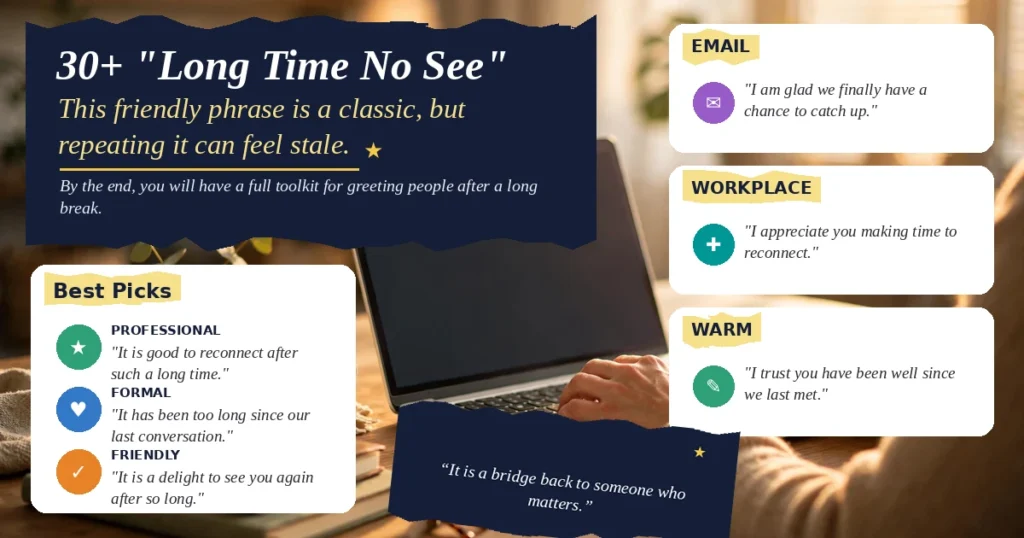
If you are looking for other ways to say long time no see, you are not alone. This friendly phrase is a classic, but repeating it can feel stale. Many people want fresh words when they reconnect with someone after months or years apart. Whether you are writing an email, meeting an old friend, or greeting a former colleague, the right words set a warm tone from the start. This guide gives you 30+ thoughtful options organized by tone and situation. You will learn when each phrase fits best, what mistakes to avoid, and how to show you missed someone without sounding awkward. By the end, you will have a full toolkit for greeting people after a long break.
Meaning
“Long time no see” is a casual greeting that means you have not seen or spoken to someone for a long period, and you are happy to reconnect now. It works best with friends, family, and relaxed acquaintances. The phrase signals warmth, surprise, and pleasure at meeting again. It is common in American English and widely understood around the world.
Literal meaning: A long period has passed since you last saw this person. The sentence is not grammatically standard, but everyone accepts it as friendly slang.
Tone: Casual and cheerful. It carries energy and a light sense of surprise. It is not formal, so avoid it in serious or ceremonial settings.
Purpose: It bridges the gap between two people. It acknowledges the silence, shows you noticed the absence, and opens the door to catch up. You can use it in person, by phone, or in a message.
Examples:
- “Long time no see! How have you been?”
- “Long time no see, Sarah. I was just thinking about you yesterday.”
- “Hey, long time no see! What have you been up to these days?”
Professional usage
In work settings, “long time no see” can sound too casual. The words below help you reconnect with polish. Each H3 shows how to greet people after a long gap in different professional moments.
Emails
Open with a polite greeting before you state your reason for writing. Try “I hope this message finds you well. It has been a while since we last spoke.” This line feels respectful and sets a professional mood. It also works when you need to reach out after a quiet period without sounding too familiar.
Workplace
When you meet a coworker after a long absence, keep it friendly but brief. “Great to see you again after such a long time” works well in hallways and meetings. Smile, keep eye contact, and move the conversation forward.
Clients
With clients, warmth plus professionalism wins. Say “It is a pleasure to reconnect after all this time.” This phrase shows you value the relationship and respect the gap. It avoids slang while still sounding human.
Networking
At events, a confident greeting makes you memorable. Try “It has been ages since we last met.” Then add one detail about where you met before. That detail proves you remember them, which builds trust fast.
Customer service
If a customer returns after months away, greet them like an old friend with manners. “Welcome back! It is wonderful to see you again” keeps things warm and professional. Never ask why they left. Just make the return feel good.
Alternatives
Here are 30 alternatives in 5 tone groups. Each entry includes the bold phrase, a tone and best-use note, and one example sentence.
Professional
- It is good to reconnect after such a long time. Polished and confident; best for business calls and meetings. Example: “It is good to reconnect after such a long time. I have been meaning to call you.”
- It is a pleasure to speak with you again. Formal-friendly; best for calls and video meetings with partners. Example: “It is a pleasure to speak with you again, Mr. Harris.”
- I trust you have been well since we last met. Courteous and warm; best for senior contacts and long-gap clients. Example: “I trust you have been well since we last met in Chicago.”
- I am glad we finally have a chance to catch up. Positive and forward-looking; best for resuming stalled projects. Example: “I am glad we finally have a chance to catch up on the launch plan.”
- It has been too long since our last conversation. Honest and warm; best for industry peers you respect. Example: “It has been too long since our last conversation at the summit.”
- I appreciate you making time to reconnect. Grateful and respectful; best for busy decision-makers. Example: “I appreciate you making time to reconnect this quarter.”
Formal
- It is a delight to see you again after so long. Elegant and graceful; best for ceremonies and senior events. Example: “It is a delight to see you again after so long, Ambassador.”
- I am pleased to welcome you back. Dignified and official; best for formal introductions and hosting. Example: “I am pleased to welcome you back to our annual dinner.”
- It has been far too long. Classic and dignified; best for distinguished guests. Example: “It has been far too long, Professor. Your lecture inspired me.”
- What a pleasure to meet again. Simple and refined; best for receptions and galas. Example: “What a pleasure to meet again after all these years.”
- I am honored to see you once more. Very respectful; best for elders and honored guests. Example: “I am honored to see you once more, sir.”
- Allow me to say how good it is to see you again. Courtly and careful; best for diplomatic or official settings. Example: “Allow me to say how good it is to see you again.”
Friendly
- It has been ages! Cheerful and light; best for old friends you greet with a smile. Example: “It has been ages! We need to grab coffee soon.”
- Wow, look who it is! Playful and excited; best for surprise meetings with buddies. Example: “Wow, look who it is! You have not changed a bit.”
- Where have you been hiding? Teasing and warm; best for close friends with a fun bond. Example: “Where have you been hiding? I missed our lunch chats.”
- I was just thinking about you. Sweet and personal; best when you want to show you care. Example: “I was just thinking about you. How is the new job going?”
- This is such a nice surprise. Warm and genuine; best for unexpected reunions. Example: “This is such a nice surprise. I did not expect to see you here.”
- Look at you! How long has it been? Lively and curious; best for school reunions and parties. Example: “Look at you! How long has it been, five years?”
- It has been a while since we last connected. Neutral and safe; best for professional email openers. Example: “It has been a while since we last connected. I wanted to share an update.”
- I hope all is well with you. Classic email greeting; best for any long-gap business email. Example: “I hope all is well with you. We have some exciting news to share.”
- Long time since our last conversation. Direct and polite; best for follow-up emails. Example: “Long time since our last conversation. Did you get a chance to review the proposal?”
- It is great to be back in touch. Upbeat and professional; best for restarting conversations. Example: “It is great to be back in touch. I would love to hear your thoughts.”
- I was thinking of you and wanted to reach out. Personal and sincere; best for soft check-ins. Example: “I was thinking of you and wanted to reach out before the holidays.”
- I am delighted to reconnect with you. Warm and professional; best for emails to former partners. Example: “I am delighted to reconnect with you after the conference.”
Workplace
- Great to see you again. Simple and professional; best for office hallways and team meetings. Example: “Great to see you again. How was your parental leave?”
- Welcome back! Short and upbeat; best when a coworker returns from leave. Example: “Welcome back! The team missed your energy.”
- It is so good to have you back. Warm and team-spirited; best for returning team members. Example: “It is so good to have you back on the project.”
- I have missed working with you. Honest and kind; best for colleagues you enjoyed working with. Example: “I have missed working with you. Let us catch up over lunch.”
- It feels like forever since we last worked together. Friendly and relaxed; best for former teammates. Example: “It feels like forever since we last worked together on the Dubai project.”
- Good to see a familiar face around here. Casual and warm; best for office reunions after transfers. Example: “Good to see a familiar face around here after the reorganization.”
Quick comparison
| Alternative | Tone | Best Use |
|---|---|---|
| It is good to reconnect after such a long time. | Professional | Business calls and meetings |
| It is a delight to see you again after so long. | Formal | Ceremonies and senior events |
| It has been ages! | Friendly | Old friends and reunions |
| It has been a while since we last connected. | Professional email openers | |
| Great to see you again. | Workplace | Office hallways and meetings |
| I trust you have been well since we last met. | Professional | Senior contacts and clients |
| What a pleasure to meet again. | Formal | Receptions and galas |
| I was just thinking about you. | Friendly | Personal check-ins |
| It is great to be back in touch. | Restarting conversations | |
| Welcome back! | Workplace | Coworkers returning from leave |
Email examples
Short, copy-ready email openers for long-gap greetings in common work situations.
Client
Subject: Good to be in touch again
Hi Daniel,
It is a pleasure to reconnect after all this time. I hope business has been kind to you. I am writing because we have launched a new service that fits your goals. Would you be open to a quick call next week?
Best regards,
Maria
Manager
Subject: Catching up after a while
Hi Ms. Thompson,
I trust you have been well since we last met. It has been a busy year, and I wanted to update you on my progress. I would love your advice on my next steps. Are you free for a short meeting?
Thank you,
James
Colleague
Subject: Long time, no updates
Hi Priya,
It is great to be back in touch! I saw your post about the new role, and I am so happy for you. Let us catch up over coffee soon. I would love to hear everything.
Cheers,
Tom
Customer
Subject: Welcome back!
Hi Anna,
Welcome back! It is wonderful to see you again. We have missed you, and we have added some new products you might love. Here is a small discount as a thank-you for returning.
Warmly,
The Store Team
Networking
Subject: Great meeting you again
Hi Robert,
It has been ages since we last met at the tech conference. I enjoyed our talk about startups. I would love to stay connected and hear what you are working on now. Let us schedule a virtual coffee.
Best,
Lisa
Meeting follow-up
Subject: Following up after today
Hi Kevin,
I am glad we finally had a chance to catch up today. Your ideas on the budget plan were very helpful. I will send the notes by Friday. Please let me know if you need anything from my side.
Regards,
Nina
Common mistakes
1. Using it with a complete stranger
This phrase implies you met before. With a new person it sounds confusing. If you never met, just introduce yourself warmly.
2. Saying it to someone you saw yesterday
The phrase needs a real time gap. Using it after a short break sounds like a joke. Save it for weeks or months apart.
3. Writing it in a formal business letter
It is too casual for contracts, legal notes, or board reports. Use “It is a pleasure to reconnect” in formal writing instead.
4. Pairing it with bad news
Do not open with a warm greeting and then deliver criticism. The shift feels fake. If you need to make a clarification or discuss a problem, choose a neutral opener.
5. Repeating it twice in one conversation
One greeting is enough. Saying it again later sounds odd. After the greeting, move to real conversation.
6. Using a sarcastic tone
Some people say it with a cold tone to guilt the other person. That turns a friendly phrase into a weapon. Keep it warm or do not say it.
7. Forgetting to ask about them
A greeting without a follow-up question feels empty. Add “How have you been?” to show real interest.
8. Overusing it in emails
Starting every email with a long-gap greeting looks lazy. Vary your openers so each message feels personal.
Related phrases
- It has been ages means a very long time has passed; cheerful tone. Example: “It has been ages since we went hiking together.”
- Where have you been all my life is playful exaggeration for someone you instantly like. Example: “Where have you been all my life? This pasta is amazing!”
- Fancy seeing you here shows pleasant surprise at an unexpected meeting. Example: “Fancy seeing you here! Do you shop at this market too?”
- What a small world expresses surprise that you met someone unexpectedly. Example: “What a small world! I did not know you worked in this building.”
- It has been a minute is casual slang for “it has been a while.” Example: “It has been a minute since we played games together.”
- It has been too long shows you regret the gap and want to reconnect. Example: “It has been too long. We should plan a dinner.”
- I have not seen you in forever is warm exaggeration for good friends. Example: “I have not seen you in forever! You look great.”
- It has been a while is the most versatile neutral version of the phrase. Example: “It has been a while. What is new with you?”
- Good to see you again is safe for work and friendly settings alike. Example: “Good to see you again at the training session.”
- I was just thinking about you adds a personal, thoughtful touch. Example: “I was just thinking about you when you called!”
- What have you been up to invites the other person to share their news. Example: “What have you been up to since you moved to London?”
- Catch me up is a casual way to ask for all their news at once. Example: “Sit down and catch me up on everything.”
- We should not wait so long next time is a warm promise to stay in touch. Example: “We should not wait so long next time. Let us meet monthly.”
Phrase comparison
“Long time no see” is the casual champion. It is short, cheerful, and instantly understood. But its charm has limits. In formal rooms it can sound careless, and in writing it can look lazy. The phrase works when warmth matters more than polish.
Alternatives solve different problems. “It is a pleasure to reconnect” keeps the warmth but adds professionalism, which makes it the safest choice for clients. “It has been ages” keeps the energy and adds playfulness, so it fits friends better. Email openers like “It is great to be back in touch” strike a middle path for written communication. Each alternative trades a little of the original’s punch for better tone control.
At the end of the day, choose the phrase that matches the relationship. Close friends deserve the playful versions. Bosses and clients deserve the polished ones. The goal is always the same: make the other person feel glad you met again. The words are just the wrapping.
Cultural usage
US English
Americans use “long time no see” very freely. It is common among friends, neighbors, and coworkers in casual offices. In the United States, a big smile and an exclamation mark often come with it. People also shorten it to “long time!” in texts.
UK English
British speakers understand the phrase but use it less often. They often prefer “It has been ages” or “Lovely to see you again.” Understatement is valued in British culture, so the greeting may come with a calm tone rather than loud excitement.
Corporate communication
In global companies, casual slang can confuse non-native speakers. Many corporate teams prefer clear phrases like “It is good to reconnect.” This keeps the message warm while staying easy to translate and understand across cultures.
Customer service
Service teams use warm reunion greetings to build loyalty. “Welcome back” is the standard choice because it is short, positive, and safe. If you understand a returning customer well, add their name for a personal touch.
Networking
At networking events, your greeting is your first impression. A confident “It has been too long” plus a specific memory beats a generic hello. People remember those who remember details.
Frequently asked questions
What does “long time no see” mean?
It means you have not seen someone for a long time, and you are happy to see them now. It is a casual and friendly greeting. People use it with friends, family, and relaxed acquaintances.
Is “long time no see” grammatically correct?
Not exactly. The standard grammar would be “I have not seen you for a long time.” But “long time no see” is an accepted idiom in casual English. Everyone understands it, and no one expects perfect grammar in a friendly greeting.
Where did “long time no see” come from?
Many experts believe it came from Chinese Pidgin English in the 1800s and entered American English through trade and immigration. It may be a direct translation of a Chinese phrase. Today it is fully naturalized in English.
Is “long time no see” rude or offensive?
No, it is not rude when said warmly. Some people dislike it because of its unusual grammar or unclear origin, but most native speakers use it without any negative intent. Tone matters more than the words.
Can I use “long time no see” in a professional email?
It is better to avoid it in professional emails. The phrase is too casual for most business writing. Use “It is great to be back in touch” or “I hope you have been well” instead.
What is a formal alternative to “long time no see”?
“It is a pleasure to reconnect after such a long time” is a strong formal choice. “I am pleased to see you again” also works well. Both sound respectful and polished in serious settings.
How do you respond when someone says “long time no see”?
Smile and return the warmth. Say “I know, right? How have you been?” or “It really has been! What is new with you?” Then ask a follow-up question to keep the conversation going.
What is a funny alternative to “long time no see”?
Try “Where have you been hiding?” or “Wow, look who crawled out of the woodwork!” with close friends. Keep the humor light and kind. Never use teasing humor with people you do not know well.
Can I say “long time no see” in a text message?
Yes, it works great in texts. It is short, friendly, and fits the casual tone of messaging. Pair it with an emoji or a question like “How have you been?” for extra warmth.
What should I say instead of “long time no see” to a client?
Use “It is a pleasure to reconnect after all this time.” This keeps the warmth while sounding professional. Add a sentence about their business to show genuine interest.
Is “long time no see” used in British English?
Yes, British people understand and use it, but less often than Americans. Many prefer “It has been ages” or “Lovely to see you again.” In formal British settings, choose the more polished options.
What is the difference between “long time no see” and “it has been a while”?
“Long time no see” is more cheerful and playful. “It has been ages” is more neutral and works in more settings. The second phrase is safer with colleagues and in writing.
How long should the gap be before saying “long time no see”?
There is no strict rule, but it usually means weeks, months, or years apart. If you saw the person last week, the phrase sounds like a joke. Save it for real gaps.
What is a short alternative to “long time no see”?
“It has been ages!” is short and cheerful. “Missed you!” works for close friends. Both fit easily in texts and quick hellos.
Should I apologize for losing touch when I say it?
A light apology can help. Saying “Sorry we lost touch” or “I should have called sooner” shows you care. But do not over-apologize. If you know they are busy, keep it simple and move the conversation forward.
Conclusion
Best picks by tone: Professional: “It is good to reconnect after such a long time” and “I am glad we finally have a chance to catch up.” Formal: “It is a delight to see you again after so long” and “It has been far too long.” Friendly: “It has been ages!” and “I was just thinking about you.” Email: “It has been a while since we last connected” and “It is great to be back in touch.” Workplace: “Great to see you again” and “Welcome back!”
Every reunion is a small gift. The person in front of you chose to stop, smile, and share a moment, and your greeting decides how that moment feels. Pick words that fit the relationship, say them with real warmth, and let the conversation grow from there. A friendly greeting is never just a habit. It is a bridge back to someone who matters.