Introduction
If you are looking for other ways to say when it comes to, you are in the right place. The phrase is useful, but it shows up in almost every conversation. You hear it in meetings. You read it in emails. You see it in articles and reports. After a while, it starts to feel flat and overused.
The good news is that English gives you many fresh options. You can sound sharp in a boardroom. You can sound warm in a friendly chat. You can sound clear in an email that needs a fast answer. The right swap keeps your message strong and keeps your listener interested.
This guide gives you 30 smooth alternatives in five tone groups: professional, formal, friendly, email, and workplace. You will learn the meaning of the phrase, see how professionals use it, study real email examples, and avoid the most common mistakes. Each alternative comes with a simple example so you can start using it right away.
And if you often reach out to people first, this skill will help there too. The way you open a sentence shapes how people respond to you. A small change in wording can turn a dull line into one that earns attention.
Meaning
The phrase when it comes to introduces the topic you are about to discuss. It tells the listener which part of a subject matters next. You use it to shift focus, share an opinion, or start an example. It keeps sentences clear and helps the conversation move smoothly from one idea to the next.
That is the whole idea in one short definition. Now let us break it down a little more so you can use the phrase with total confidence.
Literal meaning. The words point to a topic the way a road sign points to a town. You say the phrase, then you name the subject. Nothing tricky hides inside it. It is a simple signpost for the listener.
Tone. The tone stays neutral by default. It does not sound angry, excited, or cold. That is why it works in so many settings. The tone shifts a little depending on what follows it. A kind sentence after it feels kind. A strict sentence after it feels strict.
Purpose. The purpose is focus. It tells the reader or listener where to look next. It also buys you a tiny pause, which helps in speaking. You use it when you move from a general point to a specific one.
Examples.
- When it comes to cooking, my brother is the real expert.
- When it comes to saving money, small habits matter most.
- When it comes to deadlines, our team never misses.
Each example follows the same pattern: the phrase names the topic, and the rest of the sentence delivers the point. Once you see the pattern, you will spot it everywhere.
Professional usage
In professional settings, this phrase acts like a calm signpost. It guides the reader from one topic to another without sudden turns. It works in reports, meetings, pitches, and day-to-day messages. Here is how it fits into common work situations.
Emails
In emails, the phrase opens a topic gently before the main point. It softens a direct statement. You can write, “When it comes to the revised budget, I recommend we cut travel costs first.” The line reads clear and polite. A quick thank you for the clarification note before your main point builds goodwill, and then the phrase steers the reader to what matters.
Workplace
In the workplace, the phrase helps you give feedback without sounding harsh. You might tell a teammate, “When it comes to data entry, accuracy matters more than speed.” The words point at the task, not the person. That small shift keeps the mood positive and keeps the message professional.
Clients
With clients, the phrase shows care and focus. It tells them you are thinking about their needs. You can say, “When it comes to your goals, our plan puts you first.” The sentence sounds attentive and confident. It keeps the spotlight on the client instead of on you.
Networking
In networking, the phrase starts topics smoothly. It works well when you meet someone new. You can say, “When it comes to marketing, what has worked best for you?” The question opens a door. It invites the other person to share, which builds a real connection fast.
Customer service
In customer service, the phrase pairs well with empathy. When a client is upset, start by saying you understand their frustration before you move to the topic. Then add, “When it comes to fixing this, I will personally handle it.” The sentence promises action and builds trust in one breath.
Alternatives
Here are 30 alternatives, grouped by tone. Each one shows the best setting for it and one short example. Pick the ones that match your voice, and rotate them so no single phrase wears out.
Professional
- Regarding – Formal and direct; works well in reports, emails, and documents. Example: Regarding the new policy, I have a few suggestions to share.
- As far as … is concerned – Confident and steady; great for sharing a clear opinion. Example: As far as our timeline is concerned, we remain on schedule.
- In terms of – Clean and measured; ideal for analysis and comparison. Example: In terms of cost, the second option fits our budget best.
- When discussing – Neutral and focused; perfect for meeting notes and reviews. Example: When discussing next quarter, we must plan for slower growth.
- With respect to – Polished and respectful; strong in formal emails. Example: With respect to your request, I have attached the full report.
- Speaking of – Smooth and natural; links two topics gracefully. Example: Speaking of customer feedback, the scores improved this month.
Formal
- With regard to – Very formal; suits legal writing and official letters. Example: With regard to the contract, please review section four with care.
- Concerning – Crisp and businesslike; fits memos and short updates. Example: Concerning the delay, we have put a new plan in place.
- In relation to – Precise and careful; good for detailed research reports. Example: In relation to the survey results, several clear trends stand out.
- As regards – Classic and proper; works in formal correspondence. Example: As regards your invoice, the payment went out this morning.
- On the subject of – Respectful and clear; steers a meeting topic politely. Example: On the subject of hiring, we have shortlisted three strong candidates.
- As to – Short and sharp; fits fast bullet-style updates. Example: As to the budget request, finance will reply by Friday.
Friendly
- About – Simple and warm; fits almost any casual sentence. Example: About the trip, I think we should book the tickets soon.
- On – Very short and natural; keeps everyday chat flowing. Example: On the snacks front, I will bring extra this time.
- For – Light and easy; states a topic in the simplest way. Example: For the movie night, Friday works best for me.
- Now – Conversational and lively; adds a friendly nudge to the line. Example: Now, this is the idea I want us to fund first.
- Talking of – Casual and upbeat; common in relaxed daily talk. Example: Talking of weekend plans, are you free on Saturday?
- As for – Relaxed and tidy; separates one topic from the next. Example: As for the gift, I wrapped it last night.
- Touching on – Brief and polite; great for smooth email transitions. Example: Touching on the agenda, I would like to add one item.
- Turning to – Smooth and steady; moves the reader between two points. Example: Turning to the design draft, the team loved the new look.
- In reference to – Direct and courteous; common in subject lines. Example: In reference to our call yesterday, here are the notes you asked for.
- Referring to – Clear and professional; works well in follow-up emails. Example: Referring to the invoice, the amount looks correct now.
- On the topic of – Friendly but work-ready; good for long email threads. Example: On the topic of deadlines, can we extend this one by a day?
- Circling back to – Warm and natural; ideal for follow-up messages. Example: Circling back to the proposal, have you had a chance to review it?
Workplace
- Dealing with – Practical and active; fits daily task updates. Example: Dealing with the outage, the tech team is working around the clock.
- Handling – Strong and capable; shows clear ownership of a task. Example: Handling the launch, I will keep everyone posted each day.
- Looking at – Analytical and calm; great for honest reviews. Example: Looking at the numbers, we are ahead of last month.
- When we talk about – Open and team-minded; invites others to join in. Example: When we talk about growth, training plays a big role.
- Where … is involved – Precise and steady; suits policy and safety talk. Example: Where safety is involved, we follow every rule without exception.
- In the matter of – Formal and workplace-safe; fits HR and admin notes. Example: In the matter of your leave request, it has now been approved.
Quick comparison
Use this table to pick the right alternative in seconds. Scan the tone column, then match it to your setting.
| Alternative | Tone | Best Use |
|---|---|---|
| Regarding | Professional | Reports, emails, documents |
| In terms of | Professional | Analysis, comparisons, budgets |
| With regard to | Formal | Legal writing, official letters |
| Concerning | Formal | Memos, short status updates |
| About | Friendly | Everyday conversation |
| Talking of | Friendly | Casual chat with friends |
| Circling back to | Follow-up messages | |
| Touching on | Smooth topic transitions | |
| Looking at | Workplace | Reviews, data discussions |
| Handling | Workplace | Task updates, ownership |
Email examples
Real snippets show the alternatives in action. Copy the structure, change the details, and make each one your own.
Client email
Subject: Regarding the project timeline
Hi Sarah,
Touching on the timeline we discussed, the design phase will finish by the 15th. In terms of next steps, the build phase starts right after. Please let me know if the dates work for you.
Best,
Dan
Manager email
Hi team,
Looking at this week’s numbers, we are ahead of target. Handling the launch, I will share daily updates in this thread. Turning to the new hires, please welcome Ali and Sara at tomorrow’s standup.
Thanks,
Maya
Colleague email
Hi Jake,
Circling back to the budget sheet, I added the missing rows. As far as the client meeting is concerned, we are still set for Thursday. Let me know if you need anything else.
Cheers,
Rita
Customer email
Hi Mr. Brown,
Referring to your order, the replacement ships today. With respect to the delay, I am sorry for the trouble. If you need further help, just reply to this email.
Kind regards,
Tom
Networking email
Hi Nina,
It was great meeting you at the summit. When we talk about content strategy, your talk gave me fresh ideas. On the topic of your newsletter, I would love to subscribe. If you need to keep me posted, here are other ways to say you will let someone know that I always appreciate: a short note or a quick call both work fine.
Best,
Sam
Meeting follow-up email
Hi all,
Thank you for today’s session. On the subject of action items, each one now has an owner and a date. In reference to the slides, I have attached the deck. Our next check-in is Friday at ten.
Thanks,
Lena
Common mistakes
Even small slips can weaken a good sentence. Watch for these five mistakes and fix them fast.
1. Using the phrase twice in one paragraph
Repeating the phrase in back-to-back sentences sounds lazy. Use it once, then switch to an alternative. Your writing will feel sharper and more varied.
2. Pairing it with a weak main point
The phrase only introduces the topic. The rest of the sentence must carry the value. Do not hide behind the opener. Put your strongest point right after it.
3. Choosing a formal swap in casual chat
“With regard to” sounds stiff at a dinner table. Save formal picks for formal settings. Match the tone of your alternative to the room you are in.
4. Starting every paragraph the same way
When three paragraphs open with the same phrase, the reader gets bored. Rotate your alternatives. Variety keeps the reader’s eyes moving down the page.
5. Forgetting the comma after the opener
An opener like this needs a comma before the main clause. Write “When it comes to sales, we lead the market.” The comma keeps the sentence clear and easy to read.
Related phrases
These expressions carry a similar job. Each one starts a topic or frames a point, so they pair well with the alternatives above.
- As for the rest – Means everything left over; use it to wrap up a list. Example: As for the rest, the team will handle the details.
- On a related note – Means a new but connected idea; use it to bridge two topics. Example: On a related note, the deadline moved to Monday.
- That said – Means a contrast follows; use it to add a twist. Example: That said, we still need more testers.
- Having said that – Means the same as that said; use it in longer formal sentences. Example: Having said that, the risks remain low.
- In other words – Means a simpler restatement follows; use it to clarify. Example: In other words, we need more time.
- To put it simply – Means a plain version follows; use it for tough ideas. Example: To put it simply, sales must grow.
- Speaking from experience – Means you have lived through it; use it to add weight. Example: Speaking from experience, early testing saves money.
- From my perspective – Means your personal view follows; use it to soften a strong take. Example: From my perspective, the plan needs one more round.
- In my opinion – Means a personal judgment follows; use it in debates. Example: In my opinion, this design wins.
- The way I see it – Means your reading of the facts follows; use it in discussions. Example: The way I see it, we are ready to launch.
- If you ask me – Means your honest answer follows; use it in friendly debate. Example: If you ask me, the blue logo looks better.
- Bottom line – Means the key point follows; use it to end a long update. Example: Bottom line, we need ten more sign-ups.
- At the end of the day – Means the final truth follows; use it to close a debate. Example: At the end of the day, the customer decides.
- When all is said and done – Means the final result follows; use it in reflective talks. Example: When all is said and done, effort beats luck.
- Be that as it may – Means a fact stands despite a point; use it in polite disagreement. Example: Be that as it may, the budget stays fixed.
- All things considered – Means a balanced view follows; use it in reviews. Example: All things considered, the event was a win.
Phrase comparison
The original phrase, “when it comes to,” is the friendly all-rounder. It suits almost any setting, and that is also its weakness. It blends in. In a formal report, it can feel too relaxed. In a legal letter, it can feel too soft. It introduces a topic well, but it adds no color and no authority of its own.
“Regarding” and “in terms of” are the professional upgrades. They keep the same job but dress it better. “Regarding” feels direct and official, which suits documents and formal emails. “In terms of” feels analytical, which suits budgets, data, and comparisons. Both sound sharper than the original in a workplace, yet neither feels cold.
The formal group, led by “with regard to” and “concerning,” raises the bar further. These carry weight in legal and official writing. They tell the reader that the matter is serious. But that weight makes them clumsy in friendly chat. Use them when the document demands respect, not when you are texting a friend.
The friendly group, with picks like “about” and “talking of,” does the opposite. These feel warm and quick. They suit daily talk, family messages, and relaxed team chats. They would feel thin in a contract or a formal proposal. Their power is speed and comfort, not authority.
Email picks such as “touching on” and “circling back to” are the specialists. They do more than name a topic. They also tell the reader why you are writing now. “Circling back to” says you are following up. “Touching on” says you are moving through a list. The original phrase cannot do that extra work, which is why these swaps shine in long threads.
Workplace picks like “looking at” and “handling” add action. They do not just frame a topic. They show someone doing the work. That makes them stronger in updates and reviews, where progress matters more than style.
The smart rule is simple. Match the alternative to the room. Formal room, formal word. Friendly room, friendly word. When in doubt, “regarding” and “in terms of” are the safest professional picks, because they work in more places than the original phrase.
Cultural usage
English varies by place and by setting. The phrase itself travels well, but the best alternative changes with the culture around you.
US English
In the United States, direct and upbeat language wins. “As far as I am concerned” and “looking at” sound confident and clear. Americans often shorten openers in speech, so “about” and “on” feel natural in daily talk.
UK English
In the United Kingdom, politeness shapes word choice. “With regard to” and “as regards” appear more often in British business writing. In casual talk, “talking of” and “as for” are very common and sound perfectly natural.
Corporate communication
In corporate communication, clarity beats charm. “Regarding,” “concerning,” and “in relation to” rule here. They keep messages short, serious, and easy to scan. Avoid friendly picks in memos, because they can make a serious note feel careless.
Customer service
In customer service, warmth matters most. Open with empathy, then use gentle framers like “on the topic of” or “when we talk about.” Harsh formal picks can sound cold to a worried customer. Keep the tone human and the words simple.
Networking
In networking, the goal is connection, not correction. “Speaking of” and “on the subject of” open topics without pressure. They invite the other person to share. A stiff formal opener can close the door before the talk begins.
Frequently asked questions
1. What does “when it comes to” mean?
It means you are about to name the topic or angle that matters next. It works like a signpost that points the listener to a specific subject. You will hear it in daily talk, work emails, and news articles alike.
2. Is “when it comes to” formal or informal?
It sits in the middle. It is not rude, but it is not very formal either. It fits casual talk and normal work messages. For formal writing, swap it for “with regard to” or “concerning.”
3. Can I use “when it comes to” in a job application?
You can, but a stronger pick will help you stand out. Try “regarding” or “in terms of” in cover letters. They sound sharper and more professional to a hiring manager.
4. What is the best professional alternative?
“Regarding” is the top pick for most work settings. It is short, clear, and respected in business writing. “In terms of” is a close second when you discuss numbers or comparisons.
5. What is the best casual alternative?
“About” is the simplest and warmest swap for daily talk. It fits almost any sentence without sounding stiff. “Talking of” is another lively option for friendly chats.
6. How do I start an email without saying “when it comes to”?
Use “touching on” or “turning to” to move between points smoothly. For follow-ups, “circling back to” feels natural and polite. Each one tells the reader why this topic comes up now.
7. Is it wrong to repeat the phrase in one email?
It is not wrong, but it is weak. Repeating any opener makes writing feel flat. Use the phrase once, then rotate through the alternatives in this guide for a cleaner result.
8. What is the difference between “regarding” and “concerning”?
Both are formal, but “regarding” feels a bit more neutral and modern. “Concerning” can sound slightly heavier, which suits serious memos. In most emails, “regarding” is the safer default choice.
9. Can “about” replace “when it comes to” every time?
In casual talk, yes, most of the time. But “about” is too simple for formal reports or legal letters. Check your setting first, then pick the tone that matches it.
10. Is “as for” rude?
No, “as for” is not rude. It is relaxed and clear, and it works well in daily conversation. Just avoid it in very formal documents, where it can feel too light.
11. Which alternative works best in meetings?
“On the subject of” is excellent for meetings because it steers topics politely. “When discussing” also works well in notes and reviews. Both keep the flow calm and professional.
12. How can I sound more confident in writing?
Swap vague openers for direct ones like “regarding” or “in terms of.” Put your main point right after the opener. Short sentences and active verbs add even more strength. If you are unsure how to word a correction, these other ways to say just to clarify can help you fix it fast.
13. What should I avoid when using these alternatives?
Avoid mixing a formal swap into casual chat, because it sounds stiff. Avoid piling two openers together, like “Regarding, when it comes to the budget.” One clean opener per sentence is always enough.
14. Do these alternatives work in academic writing?
Yes, several of them do. “In relation to,” “with regard to,” and “concerning” fit essays and research papers well. Skip the friendly group in academic work, since it reads too informal there.
15. How do I remember which alternative to use?
Think about the room first. Formal room, formal word. Friendly room, friendly word. With practice, the right pick will come to you in seconds. Sometimes you only need other ways to say I understand to keep a fast discussion moving while you pick your opener.
Conclusion
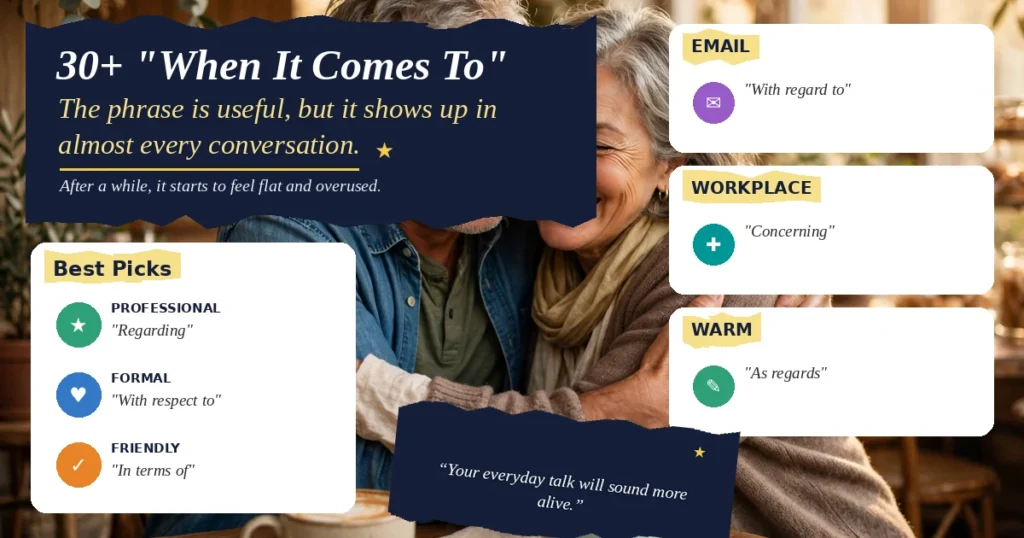
Here are the best picks, two per tone group:
- Professional: Regarding and In terms of
- Formal: With regard to and Concerning
- Friendly: About and Talking of
- Email: Touching on and Circling back to
- Workplace: Looking at and Handling
Words shape how people hear you, and small swaps carry real power. The next time you reach for the old phrase, pause for one second and pick a fresher one. Your emails will read sharper. Your meetings will flow better. Your everyday talk will sound more alive. Keep this list close, rotate the picks, and watch your confidence grow with every sentence you write. For one more polished option, the Cambridge Dictionary entry on “regarding” shows how the word works in real usage.