Introduction
Learning ways to say please let me know if you need anything helps you sound warm, helpful, and professional in almost any conversation. People use this phrase when they want to offer help without pushing it on someone. It works in work emails, messages to friends, and notes to people going through a hard time. The trouble is that the same sentence can start to feel flat when you use it again and again. Readers may skim past it because they have seen it so many times before. That is why having a set of fresh alternatives matters. A small change in wording can make your offer feel more personal, more sincere, and better matched to the situation. In this guide, you will find 40 alternatives grouped by tone, plus email examples, common mistakes, and answers to the questions people ask most about this phrase. By the end, you will know exactly which version to use with a boss, a client, a coworker, or a close friend.
Meaning
The phrase “please let me know if you need anything” is a polite offer of help. On the surface, it tells the other person that you are available. Underneath, it carries a second message: you care about their comfort, and you do not want them to struggle alone. The word “please” softens the offer so it feels like an invitation rather than an order. The words “if you need anything” keep the offer open, so the other person can decide what kind of help, if any, they actually want. This open style is useful because it respects the other person’s independence. It says that help is ready, but it does not assume that help is wanted right now. The phrase also works as a closing line. It gives a conversation a kind ending and leaves the door open for future contact. In short, it combines kindness, respect, and availability in a single sentence. That combination explains why it shows up so often in emails, cards, and messages of support.
Professional usage
At work, this phrase does a lot of quiet work. Managers use it to show that they support their team without micromanaging. Customer service teams use it to close a conversation on a friendly note. Colleagues use it when they hand over a task or finish a project together. The key is to match the version you choose to the relationship you have with the reader. A short, casual version suits a teammate you talk to every day. A formal version suits a new client or a senior leader. Timing matters too. The phrase works best after you have already given useful information, such as a summary, a file, or a next step. Placed at the end of an email, it feels like a natural close. Placed in the middle of a message with no context, it can feel empty. When you reach out first with a clear offer, the message lands better, and a guide on how to say I am reaching out to you can help you open that kind of note with confidence. You should also avoid using the phrase as a substitute for real help. If someone clearly needs something specific, name it. Offer the document, the introduction, or the extra time directly instead of hiding behind a general offer.
Alternatives
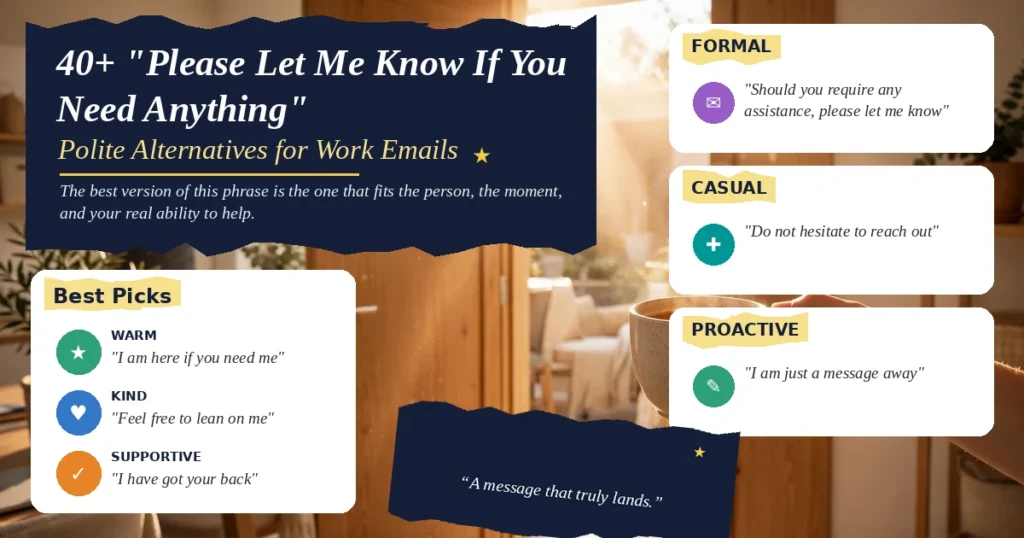
The 40 alternatives below fall into five tone groups. Pick the group that fits your relationship and the situation, then pick the phrase that sounds most like you. Each entry includes a short note on tone and a quick example.
Warm and friendly
- I am here if you need me — Warm and personal, best for friends and close coworkers. Example: “Take your time with the move. I am here if you need me.”
- Do not hesitate to reach out — Friendly and open, best for everyday messages. Example: “Do not hesitate to reach out if the instructions feel unclear.”
- I am just a message away — Casual and reassuring, best for text messages. Example: “I am just a message away if you want a second pair of eyes.”
- Feel free to lean on me — Caring and close, best for people you know well. Example: “This week looks tough. Feel free to lean on me.”
- I have got your back — Loyal and confident, best for teammates and friends. Example: “Do not worry about Friday. I have got your back.”
- Count on me anytime — Strong and dependable, best for close relationships. Example: “Count on me anytime, day or night.”
- I am here for you — Simple and heartfelt, best for emotional support. Example: “I am here for you, whatever you decide.”
- Reach out whenever you need — Relaxed and open, best for ongoing support. Example: “Reach out whenever you need, even if it is just to talk.”
Professional and formal
- Please do not hesitate to contact me — Polite and formal, best for clients and senior leaders. Example: “Please do not hesitate to contact me if you have further questions.”
- Should you require any assistance, please let me know — Very formal, best for official letters and proposals. Example: “Should you require any assistance, please let me know at your convenience.”
- I remain at your disposal — Formal and old-fashioned, best for formal business notes. Example: “I remain at your disposal for the rest of the project.”
- Please feel free to get in touch — Polite and modern, best for work emails. Example: “Please feel free to get in touch if anything comes up.”
- I am available should you need support — Professional and calm, best for managers and service teams. Example: “I am available should you need support during the transition.”
- Kindly let me know if I can help — Courteous and neat, best for first-time contacts. Example: “Kindly let me know if I can help with the setup.”
- Please reach out if anything comes up — Professional but relaxed, best for project emails. Example: “Please reach out if anything comes up before Thursday.”
- Do let me know if you need further help — Polite and direct, best for follow-up emails. Example: “Do let me know if you need further help with the report.”
Short and casual
- Shout if you need anything — Cheerful and informal, best for close coworkers. Example: “Shout if you need anything while I am away.”
- Here if you need me — Brief and warm, best for texts and chats. Example: “Here if you need me this weekend.”
- Just say the word — Playful and ready, best for friends. Example: “Want me to bring food over? Just say the word.”
- I am a call away — Simple and practical, best for quick messages. Example: “I am a call away if the plan changes.”
- Ping me anytime — Modern and casual, best for workplace chat. Example: “Ping me anytime if you get stuck.”
- Let me know if I can help — Short and clear, best for almost any casual note. Example: “Let me know if I can help with the packing.”
- Here to help — Very short and upbeat, best for chat and social messages. Example: “Here to help if you need a hand.”
- Give me a shout — Friendly and informal, best for teammates. Example: “Give me a shout if the file will not open.”
Supportive and caring
- You do not have to handle this alone — Gentle and strong, best for hard times. Example: “You do not have to handle this alone. I am with you.”
- I am happy to help in any way — Generous and open, best for friends and family. Example: “I am happy to help in any way, big or small.”
- Let me carry some of the load — Practical and kind, best when someone is overwhelmed. Example: “Let me carry some of the load while you rest.”
- I am in your corner — Encouraging and loyal, best for someone facing a challenge. Example: “Whatever happens, I am in your corner.”
- Tell me how I can support you — Thoughtful and respectful, best for sensitive situations. Example: “Tell me how I can support you this week.”
- I want to make this easier for you — Kind and practical, best for caregiving notes. Example: “I want to make this easier for you, so just tell me what helps.”
- Lean on me when things get heavy — Warm and honest, best for close friends. Example: “Lean on me when things get heavy. That is what friends are for.”
- I am standing by if you need a hand — Ready and patient, best for ongoing help. Example: “I am standing by if you need a hand with the move.”
Proactive and action-focused
- Tell me what would help most — Direct and useful, best when someone seems stuck. Example: “Tell me what would help most, and I will start there.”
- I can take that off your plate — Practical and confident, best for busy coworkers. Example: “I can take that off your plate until Friday.”
- Let me know which part I can handle — Specific and helpful, best for shared projects. Example: “Let me know which part I can handle this week.”
- I will check in again soon — Caring and active, best for long recoveries or projects. Example: “Rest for now. I will check in again soon.”
- Send me anything you want me to look at — Open and practical, best for work reviews. Example: “Send me anything you want me to look at before you send it out.”
- I can step in whenever you are ready — Patient and ready, best for delicate handoffs. Example: “I can step in whenever you are ready. No rush.”
- Let me know what support looks like for you — Respectful and clear, best for new working relationships. Example: “Let me know what support looks like for you, and I will match it.”
- I am ready to help whenever you say go — Energetic and willing, best for team efforts. Example: “I am ready to help whenever you say go.”
Quick comparison
The table below gives you a fast way to compare the main styles. Use it when you need to pick a phrase in a hurry.
| Phrase style | Tone | Best for | Watch out for |
|---|---|---|---|
| Warm and friendly | Caring, personal | Friends, close coworkers | Can feel too close for new clients |
| Professional and formal | Polite, respectful | Clients, leaders, official notes | Can sound stiff with friends |
| Short and casual | Relaxed, quick | Texts, chats, teammates | Can feel too light for serious news |
| Supportive and caring | Gentle, strong | Hard times, illness, loss | Needs sincerity, not just words |
| Proactive and action-focused | Practical, direct | Busy teams, shared tasks | Only promise what you can deliver |
The main lesson from the table is simple. Tone matters more than the exact words. A formal phrase sent to a grieving friend can feel cold, while a casual phrase sent to a new client can feel careless. Before you send, ask yourself one question: how close am I to this person, and how serious is the moment? The answer will point you to the right group almost every time.
Email examples
Real examples make the choice easier. The notes below show the same offer in different work situations. Notice how each closing line matches the rest of the email.
Example 1: To a new client. “Thank you for sharing the brief. I have attached the first draft for your review. Please do not hesitate to contact me if you have further questions. I look forward to your feedback.” This version is formal, clear, and safe for a first impression.
Example 2: To a teammate. “I finished the slides for Thursday. Ping me anytime if you want me to change the order or add a chart. Happy to help.” The short closing fits a chatty work relationship and keeps the door open.
Example 3: To a manager. “The report is ready in the shared folder. I am available should you need support during the review. Thank you for your guidance on this one.” This tone shows respect without sounding stiff or distant.
Example 4: To a coworker going through a hard week. “I heard about your week, and I wanted to check in. Let me carry some of the load if that helps. I can cover Thursday’s meeting, or anything else you need.” Here the offer is specific, which makes it easier to accept than a general line.
Example 5: A follow-up email. “Just following up on my last note. If it helps, I can send a shorter summary or walk through the steps on a call. When you are ready to move ahead, a note on how to say I will let you know can help you phrase your reply. Do let me know if you need further help.” A follow-up works best when it adds something new instead of repeating the same offer.
Common mistakes
Even a kind phrase can miss the mark. These are the mistakes people make most often, and each one is easy to fix.
Using it as an empty habit. If you end every email with the same line, readers stop believing it. Vary your closing, or skip the offer when no help is actually needed. A message with no offer at all often feels more honest than a copy-paste line.
Being vague when help is clearly needed. When someone says they are overwhelmed, a general offer puts the work back on them. They now have to figure out what to ask for. Name one specific thing you can do instead, such as covering a shift, sending notes, or making a call.
Sounding formal with close friends. A friend who just lost a loved one does not need “should you require any assistance.” They need warmth. Save formal versions for work, and use plain, caring words with people you love.
Forgetting to follow through. An offer is a small promise. If someone takes you up on it and you disappear, the damage is worse than never offering at all. Only offer help you truly have time to give. When things get busy, a patient note that says please be patient is far better than silence.
Adding pressure. Some offers accidentally pressure the other person. Lines like “you must let me help” or “I insist” take away their choice. Keep the offer open. Let them say yes, no, or not yet.
Using it too early. Opening a first message with this offer can feel strange because you have not yet shown what you can do. Give useful information first, then offer more help at the end.
Copying the same line to everyone. A team email that ends with a generic offer feels less personal than a short line written for one person. Even a small detail, like naming the task you can help with, makes the message feel real.
Related phrases
This phrase belongs to a family of polite offers. Knowing its relatives helps you pick the right one for each moment.
Let me know if you need help. This is the shortest cousin. It works when you want to keep things simple and direct. It suits quick messages and casual notes.
I am here to help. This version puts the focus on you as the helper. It sounds confident and works well in customer service and team chats.
Do not hesitate to contact me. This formal cousin suits business emails. It tells the reader that contacting you is welcome, not a burden.
Feel free to ask. This short version suits relaxed settings. It invites questions without making a big deal of the offer.
I am happy to help. This version adds warmth to a simple offer. It works well when someone thanks you, because it turns the offer into a glad response. A sincere note of I appreciate it pairs naturally with this kind of reply.
Let me know how I can help. This version asks the other person to guide the help. It suits sensitive moments because it gives them control over what happens next.
Count on me. This short, strong version suits close friends and loyal teammates. It promises reliability in just three words.
Each of these phrases shares the same heart: help is ready when you want it. The differences sit in tone, length, and formality. Once you know the family, you can switch between members without losing the kind meaning.
Phrase comparison
Comparing the core phrase with its closest cousins shows why small word changes matter so much.
“Please let me know if you need anything” versus “let me know if you need help.” The first version is softer and wider. The word “please” adds politeness, and “anything” covers every kind of need, not just help with a task. The second version is shorter and more direct. It works better in fast chats where every word counts. Choose the longer version for formal notes and the shorter one for quick messages.
“Please let me know if you need anything” versus “I am here to help.” The first version waits for the other person to ask. The second version steps forward and states readiness. “I am here to help” suits customer service, where the helper should take the lead. The core phrase suits personal notes, where waiting feels more respectful.
“Please let me know if you need anything” versus “do not hesitate to contact me.” Both are polite, but the second one focuses on contact itself. It tells the reader that reaching out is fine. The core phrase focuses on needs, which feels warmer. Use the contact version in business emails and the core phrase in caring notes.
“Please let me know if you need anything” versus “tell me how I can support you.” The last version is the most thoughtful of the group. It hands control to the other person and invites them to describe what helps. It suits hard times, when a general offer can feel too vague. The core phrase suits everyday use, when a light offer is enough. Learning to say I understand in these moments also helps, because feeling understood often matters as much as practical help.
The pattern is clear. Longer, softer versions suit formal and caring moments. Shorter, direct versions suit fast and casual moments. Active versions suit service roles. Patient versions suit personal support. Match the version to the moment, and your message will feel right.
Cultural usage
Culture shapes how offers of help are heard. In the United States, direct offers are normal and welcome. People often say exactly what they mean, and a clear offer feels friendly. In the United Kingdom, politeness often comes with extra softening words, such as “please,” “perhaps,” and “if you would like.” A British reader may find a very direct offer a little blunt, so the softer versions in this guide work well there. In many South Asian cultures, including Pakistan and India, hospitality runs deep, and offers of help are frequent and generous. Refusing help at first can be a polite habit, so a second, gentle offer may be needed before someone accepts. In East Asian cultures, direct offers can sometimes feel pushy, because people may not want to burden others. A quiet, indirect offer, such as “I am here if it helps,” often lands better than a strong one. In Middle Eastern cultures, generosity is a point of pride, and offers are often warm and repeated. A sincere, repeated offer shows respect rather than pressure. Across all cultures, one rule holds. Watch how the other person responds, and adjust. If they thank you but change the subject, they may want space. If they ask a small question, they may be testing whether your offer is real. A kind offer, given with patience and respect for local habits, travels well anywhere.
Frequently asked questions
Is “please let me know if you need anything” too formal for friends?
No, it is not too formal, but it can feel a little stiff with very close friends. The phrase is polite rather than formal, so it works fine in most friendships. With a best friend, a warmer version like “I am here for you” usually feels more natural. Save the full phrase for friends you do not know as well, or for written notes such as cards.
Can I use this phrase in a work email?
Yes, it works very well in work emails, especially as a closing line. It shows that you are helpful and open to follow-up questions. For clients and senior leaders, use a formal version such as “please do not hesitate to contact me.” For teammates, a shorter version like “ping me anytime” often fits better.
What is a shorter way to say it?
“Let me know if I can help” is the simplest shorter version, and it keeps the full meaning. “Here if you need me” is even shorter and suits texts and chats. “Just say the word” is playful and works with friends. Pick the short version that matches how casual your relationship is.
How do I say it without sounding generic?
Add one specific detail to the offer, such as the task you can help with or the time you are free. For example, say “I can cover Thursday’s meeting if that helps” instead of only offering in general. Specific offers feel real because they show that you have thought about the person’s situation. A general offer plus one detail beats a long, fancy sentence every time.
Is it okay to say it to someone who is grieving?
Yes, but pair it with a caring action or a specific offer. Grieving people often find it hard to ask for help, so a general offer alone may not be enough. Saying “I can bring food on Tuesday” or “I am here for you” feels more supportive. If you use the core phrase, follow it with a check-in a few days later, since grief lasts longer than one message.
What should I say instead at work?
At work, “please feel free to get in touch” and “I am available should you need support” are strong choices. They sound professional without being stiff. For a project handoff, “let me know which part I can handle” is even better because it is specific. The best work version depends on whether you are writing to a client, a manager, or a teammate.
Does the phrase sound pushy?
No, the phrase itself is gentle because it leaves the choice with the other person. It only feels pushy if you repeat it many times or add pressure words like “you must.” One calm offer is kind, not pushy. If the person does not take you up on it, respect their answer and do not repeat the offer in the same message.
Can I use it in a sympathy card?
Yes, it is a classic sympathy card line, and readers expect it there. To make it feel more personal, add a handwritten sentence about the person or a memory you share. A card that says only the standard line can feel distant, but one extra personal sentence changes the whole tone. You can also promise a specific act of help, such as a meal or a ride.
What is the difference between “anything” and “help” in this phrase?
“Anything” is wider than “help” because it covers emotional support, company, advice, and practical tasks. “Help” points more toward tasks and problems that need fixing. Use “anything” when you want to offer open-ended care, and use “help” when the situation is clearly about a task. Both are polite, but “anything” feels warmer in personal notes.
How often should I use this phrase?
Use it when you genuinely mean it, not as an automatic sign-off. If you end every message with it, readers will stop noticing it. Save it for moments when help is truly on offer, such as after a handoff, during a hard week, or at the end of a client project. Varying your closing lines also keeps each message feeling fresh and honest.
Is “do not hesitate to reach out” the same thing?
It is very close, but not exactly the same. “Do not hesitate to reach out” focuses on making contact easy, while the core phrase focuses on needs of any kind. The first version suits business emails, and the second suits caring notes. Both tell the reader that they are welcome to ask, so you can use either one with confidence.
What do I say if someone accepts my offer?
Thank them warmly and act quickly on what they asked for. A simple reply like “Of course, I am glad to help” keeps the tone kind. Then do the thing you promised, or agree on a clear next step and time. Fast, reliable follow-through turns a polite offer into real trust, which matters more than the words you chose.
Can I use this phrase with a stranger?
Yes, but keep it light and appropriate to the situation. With a stranger, a short version like “let me know if I can help” feels natural, for example when giving directions or helping in a shop. A long, emotional version would feel odd with someone you just met. Match the warmth of your words to how well you know the person.
How do I offer help without sounding like I pity someone?
Focus on teamwork rather than rescue by saying things like “let me carry some of the load” instead of “you clearly need help.” Treat the person as capable, and frame your offer as sharing work, not fixing them. Asking “tell me what would help most” also avoids pity because it gives them control. Respect and equality keep an offer kind instead of patronizing.
What is the most professional version of this phrase?
“Please do not hesitate to contact me” is the most professional version, and it is safe for clients, executives, and formal letters. “Should you require any assistance, please let me know” is even more formal, but it can sound old-fashioned in modern workplaces. For most professional emails today, the first version strikes the best balance between polite and natural.
Conclusion
The best version of this phrase is the one that fits the person, the moment, and your real ability to help. A formal line suits a client, a warm line suits a friend, and a specific offer beats a general one in almost every case. Keep this list close, and you will never have to repeat the same tired closing line again. Try one new version this week, and notice how the other person responds. Small changes in wording can turn a polite habit into a message that truly lands. If you want to check the exact sense of the word at the heart of this phrase, the Cambridge Dictionary entry for need explains it clearly. You can also explore more ways to say if I can be of any help when you want an even softer offer. The goal is simple: offer help that feels real, give the other person room to accept it, and follow through when they do.