Introduction
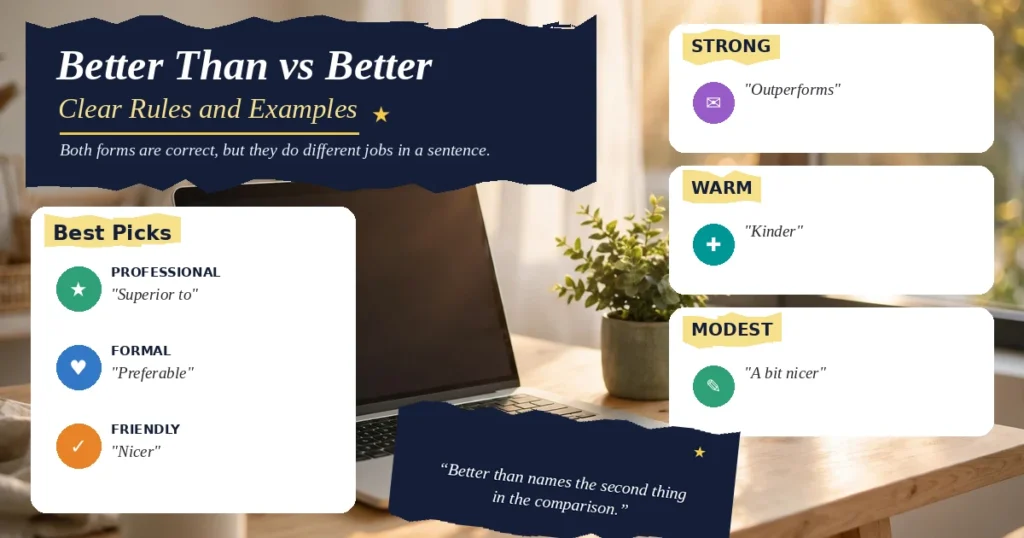
The question of better than vs better trips up many English learners, and even native speakers pause over it in formal writing. Both forms are correct, but they do different jobs in a sentence. “Better” on its own compares one thing with an earlier state or an implied standard. “Better than” names the second thing in the comparison. Once you see that single difference, the choice becomes easy in almost every sentence you write.
This guide explains both forms in plain language. You will learn what each form means, when to use each one, and which mistakes to avoid. You will also find 40 substitutes grouped by tone, email examples you can copy and adapt, and answers to the 15 questions learners ask most often. By the end, you will pick the right form without stopping to think.
The rule is short: use “better” when the comparison is already clear from context, and use “better than” when you need to name what you compare against. The rest of this article shows that rule at work in real sentences, from casual chats to job emails.
Meaning
“Better” is the comparative form of “good” and “well.” As an adjective, it describes a noun that has improved or that ranks above something else. As an adverb, it describes how someone does an action. In both roles, it points to a comparison, but it does not always name the other side of that comparison.
“Better than” is a comparison phrase. The word “than” introduces the second item, person, or standard. When you write “This plan is better than the old plan,” the reader sees both sides at once. The phrase leaves no room for doubt about what you compare.
Here is the key difference in one line: “better” states an improvement, while “better than” states an improvement and names the benchmark. Consider these pairs:
- “I feel better today.” The comparison is with yesterday, but yesterday stays implied.
- “I feel better than I did yesterday.” The sentence names yesterday, so the comparison is explicit.
- “This phone works better.” The reader guesses the standard, perhaps the old phone.
- “This phone works better than my old phone.” The standard is clear.
Both versions are grammatical. The shorter version suits contexts where the reader already knows the benchmark. The longer version suits contexts where clarity matters more than brevity, such as reports, instructions, and first-time explanations.
| Form | Job in the sentence | Example |
|---|---|---|
| Better | Shows improvement against an implied standard | She speaks better now. |
| Better than | Shows improvement against a named standard | She speaks better than her brother. |
One more point matters. “Better” can also work as a noun and a verb in fixed expressions, such as “for the better” and “to better oneself.” Those uses are less common in daily speech, but they show how flexible the word is. In this article, we focus on the adjective and adverb uses, because those are the ones that cause confusion.
Professional usage
At work, the choice between “better” and “better than” affects how clear and how polite your message sounds. In general, professional writing favors the explicit form. A manager who reads “The new schedule works better” may wonder, “Better than what?” A manager who reads “The new schedule works better than the March schedule” has no such question. Clarity saves follow-up emails.
Use “better than” when you present results, compare options, or justify a decision. Examples include “Our response time is better than last quarter” and “This vendor offers better than the current contract terms.” In both cases, the named benchmark makes your claim checkable. A claim without a benchmark can sound like an opinion. A claim with a benchmark sounds like evidence.
Use “better” alone when the benchmark is obvious from the previous sentence. For example: “We fixed the checkout bug. The site loads better now.” The reader knows the comparison is with the site before the fix. Repeating the benchmark would only add words. Short, clear sentences like this keep business writing moving.
Tone also matters. “Better than” can sound competitive when you compare people directly. In feedback, soften it. Instead of “Your report is better than Ali’s report,” write “Your report is stronger this month, with clearer data and tighter conclusions.” The message still praises the work, but it avoids ranking colleagues in public. Save direct person-to-person comparisons for private reviews where the context is fair and clear.
In job applications and cover letters, prefer “better” with a result, not “better than” with a rival. Write “I improved response times by 20 percent” rather than “I am better than other candidates.” Hiring managers value proof over self-ranking. If you must compare, compare your own past and present performance, which is always fair ground.
Alternatives
Sometimes you need a different word for variety, precision, or tone. The 40 options below cover substitutes for both “better” and “better than.” Each entry gives the phrase, a tone note, and a short example. Pick the one that fits your sentence, not just the first one on the list.
Neutral everyday options
- Stronger — neutral tone, best for physical strength or performance. Example: “This new rope is stronger than the old one.”
- Improved — neutral tone, best for things that changed for the good. Example: “The improved version loads in half the time.”
- Finer — neutral tone, best for quality or detail. Example: “This finer fabric feels soft against the skin.”
- Healthier — neutral tone, best for food, habits, and lifestyle. Example: “A healthier lunch keeps my energy steady all afternoon.”
- Faster — neutral tone, best for speed. Example: “The faster route saves us twenty minutes each morning.”
- Clearer — neutral tone, best for explanations and sound. Example: “Her clearer summary helped the whole team follow the plan.”
- Safer — neutral tone, best for risk and security. Example: “The safer crossing sits near the traffic lights.”
- Easier — neutral tone, best for effort and simplicity. Example: “An easier form means fewer mistakes from new users.”
Professional and formal options
- Superior to — formal tone, best for reports and product comparisons. Example: “This model is superior to the previous model in battery life.”
- Preferable — formal tone, best for recommendations and policy. Example: “A morning meeting is preferable for the overseas team.”
- More effective — formal tone, best for results and methods. Example: “The new method is more effective at cutting waste.”
- More efficient — formal tone, best for time, cost, and process. Example: “A shared calendar is more efficient for the whole department.”
- Advantageous — formal tone, best for business and negotiation. Example: “Early booking is advantageous for large groups.”
- Of higher quality — formal tone, best for audits and reviews. Example: “This supplier delivers goods of higher quality.”
- More suitable — formal tone, best for fit and requirements. Example: “The larger room is more suitable for training sessions.”
- Outperforms — formal tone, best for data and benchmarks. Example: “The new system outperforms the old one on every test.”
Friendly and warm options
- Nicer — warm tone, best for casual praise. Example: “This cafe has a nicer garden than the one downtown.”
- Lovely — warm tone, best for pleasant experiences. Example: “We had a lovely walk along the river this morning.”
- Brighter — warm tone, best for mood, rooms, and days. Example: “The brighter kitchen makes breakfast feel cheerful.”
- Cozy — warm tone, best for comfort and home. Example: “Her cozy reading corner beats the cold living room.”
- Smoother — warm tone, best for experiences and plans. Example: “Our smoother trip plan kept everyone relaxed.”
- Happier — warm tone, best for feelings and mood. Example: “He seems happier since he changed jobs.”
- Kinder — warm tone, best for people and actions. Example: “A kinder reply can calm a tense conversation.”
- More enjoyable — warm tone, best for leisure and events. Example: “The evening walk was more enjoyable than the long drive.”
Strong and confident options
- Unmatched — confident tone, best for top performance claims you can prove. Example: “Her record in sales remains unmatched this year.”
- Second to none — confident tone, best for praise with emphasis. Example: “Their customer care is second to none in this city.”
- Far ahead — confident tone, best for clear leads. Example: “Our team finished far ahead of the other groups.”
- Head and shoulders above — confident tone, best for strong praise. Example: “This design stands head and shoulders above the rest.”
- A cut above — confident tone, best for quality praise. Example: “Her cooking is a cut above most home cooks.”
- Tops — confident tone, best for casual ranking. Example: “This phone tops every model I tested.”
- Beats — confident tone, best for informal comparisons. Example: “A short nap beats a third cup of coffee for me.”
- Outshines — confident tone, best for talent and performance. Example: “Her speech outshines every talk from last year.”
Soft and modest options
- A bit nicer — modest tone, best for gentle opinions. Example: “This chair is a bit nicer for long reading sessions.”
- Somewhat improved — modest tone, best for cautious progress reports. Example: “Sales are somewhat improved after the new display.”
- Slightly stronger — modest tone, best for small gains. Example: “The signal is slightly stronger near the window.”
- A touch clearer — modest tone, best for gentle feedback. Example: “The second draft is a touch clearer than the first.”
- Marginally faster — modest tone, best for measured claims. Example: “The new route is marginally faster at rush hour.”
- Rather good — modest tone, best for understated praise. Example: “The soup turned out rather good tonight.”
- Fairly solid — modest tone, best for honest, low-key reviews. Example: “The first version is fairly solid for daily use.”
- A step up — modest tone, best for quiet progress. Example: “This laptop is a step up from my old one.”
Quick comparison
Use this table when you need a fast answer. Find your situation in the first column, then read across for the right form.
| Situation | Use | Example | Avoid |
|---|---|---|---|
| Benchmark is already known | Better | The site runs better now. | Repeating the benchmark |
| Benchmark is new information | Better than | The site runs better than before the update. | Leaving the reader to guess |
| Formal report or proposal | Better than | Results are better than the target. | Vague claims with no benchmark |
| Casual chat | Better | I feel better today. | Overly formal phrasing |
| Comparing two people at work | Softer wording | Her draft is stronger this month. | Direct ranking in public |
| Comparing your past and present self | Either form | I write better than I did last year. | Comparing yourself with rivals |
The table shows one clear pattern. The more formal the setting, and the less the reader knows, the more you need “better than.” The more casual the setting, and the more shared context you have, the more natural “better” alone sounds. Neither form is always right. The situation decides.
Email examples
Email is where this choice appears most often. The examples below show both forms in realistic messages. Adapt the wording to your own situation, and keep the tone polite.
Example 1: Updating a manager
Subject: Weekly update on the booking system
Hi Sara,
We fixed the payment error on Tuesday. The system runs better now, and failed bookings dropped to almost zero. The new flow works better than the old flow because it checks card details before it confirms the order. I will share the full numbers on Friday.
Best regards,
Ahmed
Example 2: Suggesting a change
Subject: A suggestion for our meeting time
Hi Team,
A morning slot works better for our overseas colleagues. A 9 a.m. meeting is better than a 4 p.m. meeting because it falls inside their workday. Please let me know if that time suits everyone.
Thanks,
Lina
Example 3: Replying to a client
Subject: Re: Delivery options
Hi Mr. Khan,
Thank you for your message. The express option arrives faster, and it costs only a little more. For urgent orders, express delivery is better than standard delivery. I can book it today if you confirm.
Kind regards,
Mona
Example 4: Giving gentle feedback
Subject: Re: Draft report
Hi Dan,
Thanks for sending the draft. The second version reads better, and the charts are much clearer. One section still needs a short summary. If you add two lines at the top, the section will read better than it does now, and readers will follow your argument with ease.
Best,
Priya
Notice how each email uses the short form when the context is clear and the long form when it introduces new information. That mix keeps emails short without losing clarity. It also sounds natural, because it matches how careful speakers talk.
When you write to someone who is waiting on you, polite phrasing matters as much as grammar. A line like “please be patient while I check the figures” keeps the tone warm while you work. You can find more polite wording ideas in our guide to please be patient for messages that need a gentle touch.
Common mistakes
Learners make a small set of repeated errors with “better” and “better than.” Each one below shows the mistake, the fix, and the reason. Read them once, and you will spot them in your own writing.
Mistake 1: “More better”
Wrong: “This is more better.”
Right: “This is better.”
Reason: “Better” already carries the comparison. Adding “more” doubles it, like saying “more taller.” Use one comparative marker only.
Mistake 2: “Better then”
Wrong: “This is better then that.”
Right: “This is better than that.”
Reason: “Then” talks about time. “Than” introduces a comparison. The two words sound alike, but only “than” belongs here.
Mistake 3: Leaving the reader guessing
Wrong: “Our plan is better.” (in a proposal with no earlier comparison)
Right: “Our plan is better than the current plan because it costs less.”
Reason: A claim without a benchmark forces the reader to guess. In formal writing, name the benchmark.
Mistake 4: Comparing unlike things
Wrong: “Her cooking is better than Ali.” (cooking compared with a person)
Right: “Her cooking is better than Ali’s cooking.”
Reason: Compare like with like. A skill compares with a skill, and a person compares with a person.
Mistake 5: “Better” with “best” confusion
Wrong: “This is the better of all five options.”
Right: “This is the best of all five options.”
Reason: “Better” compares two things. “Best” compares three or more. With five options, “best” is correct.
Mistake 6: Double comparison with “much”
Wrong: “This is much more better.”
Right: “This is much better.”
Reason: “Much” can strengthen “better,” but “more” cannot join it. “Much better” is correct and common.
Mistake 7: “Better than me” in formal writing
Informal: “She runs better than me.”
Formal: “She runs better than I do.”
Reason: In casual speech, “than me” is normal and accepted. In formal writing, “than I” or “than I do” is safer. Match the form to the setting.
Mistake 8: Repeating the benchmark needlessly
Wordy: “I feel better than I felt yesterday, and I feel better than I felt last week.”
Cleaner: “I feel better than I have in weeks.”
Reason: One clear benchmark beats a list. Pick the strongest comparison and drop the rest.
If a mistake slips into a message, a calm correction keeps the relationship intact. Saying thank you for the clarification after someone points out an error shows grace, and it keeps the conversation friendly.
Related phrases
“Better” appears in many fixed phrases. Learning them helps you sound natural, because native speakers use them often. Each phrase below keeps the core idea of improvement, but each adds its own shade of meaning.
Better safe than sorry means caution is wiser than regret. Example: “Take an umbrella. Better safe than sorry.”
Better late than never means a late action still beats no action. Example: “She learned to drive at forty. Better late than never.”
For better or worse means in good times and bad times, often about marriage or a long commitment. Example: “They stayed together for better or worse.”
Better off means in a more favorable situation. Example: “You are better off taking the train during rush hour.”
Had better gives advice or a warning, close to “should.” Example: “You had better leave early, or you will miss the bus.”
The better part of means most of something. Example: “She spent the better part of the day cooking.”
Better yourself means to improve your skills, habits, or life. Example: “He reads every night to better himself.”
For the better means a change improved things overall. Example: “The new schedule changed our mornings for the better.”
Better half is a warm, old-fashioned term for a spouse or partner. Example: “My better half handles all our travel plans.”
Better yet introduces an even stronger suggestion. Example: “We could meet on Monday, or better yet, on Sunday.”
Notice that “better than” also appears inside larger idioms, such as “better safe than sorry.” In those phrases, the words work as a fixed unit. Do not try to split them or replace “than” with another word. Learn each idiom as one whole phrase, and use it exactly as native speakers do.
Phrase comparison
Several pairs confuse learners because they look alike. This section separates them clearly.
Better vs best
“Better” compares two things. “Best” compares three or more, or marks the top of a whole group. “This cake is better than that cake” compares two cakes. “This cake is the best in the shop” ranks it above all the rest. Use “better” for pairs and “best” for groups.
Better than vs more than
“Better than” compares quality. “More than” compares amount or number. “This book is better than that book” judges quality. “This book has more than 300 pages” counts pages. Keep quality and quantity apart, and the right phrase follows.
Better vs good
“Good” states a positive quality without comparison. “Better” states that the quality exceeds something else. “This is a good phone” praises the phone alone. “This is a better phone” claims it beats another phone, named or implied. If no comparison exists, “good” is the honest choice.
Better vs improved
“Better” is a general judgment. “Improved” states that something changed and the change helped. “The soup tastes better” gives an opinion. “The soup tastes improved” sounds odd unless you mean the recipe changed. Use “improved” when a change happened, and “better” when you judge the result.
Better than vs superior to
Both compare quality, but “superior to” is more formal. “This fabric is better than the old fabric” suits daily speech. “This fabric is superior to the old fabric” suits a technical report or a formal review. Match the phrase to the formality of the setting.
Better vs nicer
“Nicer” is warmer and more casual than “better.” It suits people, places, and experiences. “She is nicer than before” sounds friendly. “She is better than before” sounds neutral or clinical. For people and feelings, “nicer” often feels kinder. For performance and results, “better” stays the safer choice.
When you compare your own work with a colleague’s progress, keep the tone generous. A line like I appreciate it after helpful feedback shows that you value the other person, not just the comparison.
Cultural usage
English speakers use “better” and “better than” the same way in the United States, the United Kingdom, Canada, and Australia. The grammar rules do not change across regions. What changes is the flavor of the surrounding speech. Americans often use “better” in short, direct praise, such as “You did better today.” British speakers often soften comparisons with words like “rather” or “a bit,” as in “This one is a bit better, I think.”
Idioms travel well, but some stay local. “Better safe than sorry” and “better late than never” appear everywhere English is spoken. “A cut above” sounds slightly more British, while “tops” sounds slightly more American. These are small tendencies, not rules. No listener will mark you wrong for using either one anywhere.
Politeness norms matter more than regional words. In many cultures, direct comparison of people can feel rude, even when the grammar is perfect. English-speaking workplaces share that caution. Praise a person’s growth over time instead of ranking people against each other. “You improved a lot this quarter” lands better than “You are better than your teammates.” The first sentence motivates. The second can embarrass, even the person it praises.
In writing for an international audience, prefer the explicit form. Readers who learn English as a second language follow “better than” more easily than a bare “better” with an implied benchmark. Clarity is kindness in global communication. When you write for readers from many countries, name the benchmark and keep the sentence short.
Children learn “better” early, often through games and races. “I ran better today” comes before “I ran better than yesterday.” Adults follow the same path in reverse when they learn a new language: the short form feels easy, and the full comparison takes practice. That is normal. Short, clear practice sentences build the habit fast.
Frequently asked questions
Can I say “better” without “than”?
Yes, you can. “Better” alone works when the comparison is clear from context. “I feel better today” compares today with an earlier day, and the listener understands that without “than.” Add “than” only when the reader needs to know the benchmark.
Is “more better” correct?
No, it is not correct in standard English. “Better” already shows the comparison, so “more” adds nothing but an error. Say “better” alone, or strengthen it with “much,” as in “much better.” Some dialects use “more better” for humor, but avoid it in writing.
Do I need “than” after “better” every time?
No, you do not. Use “than” when you name the second thing in the comparison. Skip it when the second thing is obvious from the conversation. Both choices are grammatical, and the context decides which one sounds natural.
Is “better than me” or “better than I” correct?
Both appear in real English, but they suit different settings. “Better than me” is normal in casual speech and most everyday writing. “Better than I” or “better than I do” is safer in formal writing, exams, and official documents. Choose the form that matches your audience.
Can “better” describe a verb?
Yes, it can. As an adverb, “better” describes how someone performs an action. “She sings better now” describes her singing. “He works better in the morning” describes his working style. The meaning stays the same: an improvement over an earlier state or another standard.
What is the difference between “better” and “best”?
“Better” compares two things, while “best” compares three or more. “This apple is better than that apple” weighs two apples. “This apple is the best in the basket” ranks it above all the others. Counting the items in the comparison tells you which word to use.
Can I use “better than” with a clause?
Yes, you can. “Better than” can introduce a full clause, such as “This plan is better than we expected.” The clause after “than” completes the comparison with a whole idea instead of a single noun. This structure is common in reports and speeches.
Is “better off” the same as “better”?
Not quite. “Better off” means in a more favorable situation overall, often about money, health, or life choices. “Better” alone can describe one quality, such as taste or speed. “You are better off with the train” judges the whole situation, not just one feature.
Does “better than” work in formal writing?
Yes, it works very well in formal writing. In fact, formal writing prefers it, because it names the benchmark and removes doubt. Reports, proposals, and academic texts use “better than” often. Pair it with evidence, such as numbers or named standards, for the strongest effect.
Can I start a sentence with “better”?
Yes, you can. “Better to leave now than to miss the bus” is a correct and common sentence shape. It gives advice in a compact form. You can also start with “Better yet” to add a stronger suggestion after an earlier one. Both openings sound natural.
Is “better than nothing” correct?
Yes, it is correct and widely used. “Better than nothing” means a small result still beats no result at all. It often carries a slightly resigned tone, as if the speaker hoped for more. Use it when you accept a modest outcome with good humor.
Should I use “better” or “improved” in a report?
Use “improved” when something changed and you report that change. Use “better” when you judge the result against a standard. “Response times improved by 20 percent” reports a change with a number. “Response times are better than last quarter” judges the result. Many strong reports use both, each in its proper place.
Can “better” describe feelings?
Yes, it can. “I feel better” is one of the most common sentences in English. It describes an improvement in health or mood. You can add detail with “than,” as in “I feel better than I did yesterday,” or keep it short when the listener already knows the context.
Is “had better” the same as “better than”?
No, it is different. “Had better” gives advice or a warning, close to “should.” “You had better study tonight” warns about a test. “Better than” compares two things. The two phrases share a word, but they do different jobs, so do not swap them.
How do I teach this rule to a child?
Start with two toys or two snacks and ask which one is better. Then add “than” by naming both sides: “This apple is better than that apple.” Short games with real objects teach the rule faster than grammar terms. Praise each correct sentence, and the child will build the habit with confidence.
Conclusion
The rule is simple once you see it. Use “better” when the comparison is already clear, and use “better than” when you need to name the benchmark. Formal writing favors the explicit form, casual speech favors the short form, and polite workplaces favor praise of growth over ranking people. Keep “more better” and “better then” out of your writing, compare like with like, and let the situation choose the form.
Practice with one sentence today. Compare two things you know well, name both sides, and then try the short version. That small exercise builds the habit fast, and soon the right form will come without thought. If you need a deeper check on definitions and usage, see the entry for better in the Cambridge Dictionary.
If a colleague helps you improve a draft, a warm line goes a long way. Saying I appreciate it is a simple habit that keeps working relationships strong. When you ask a colleague for input, a clear request helps, and you can find polite wording in our guide to asking for help. When you look forward to your call with a client, a clear sentence about what improved shows respect for their time. Finally, if a conversation about comparisons ever grows tense, other ways to say I understand can help you respond with patience and care.