Introduction
If you need an other way to say talk to you soon, you are in the right place. This friendly closing shows up everywhere. It ends phone calls, emails, texts, video chats, and quick talks at work. It tells the other person that you enjoyed the conversation and you expect to speak again. It sounds warm, polite, and hopeful.
The problem is that the same phrase can start to feel flat when you use it every day. A manager who writes it at the end of every email may sound automatic. A friend who texts it after every chat may sound distant without meaning to. A job seeker who uses it in every follow-up note may miss a chance to sound sharp and specific. Small changes in wording can fix all of that.
This guide gives you more than 30 fresh options for every setting. You will find polished lines for work email, respectful lines for formal notes, kind lines for friends, warm lines for family, and relaxed lines for everyday texting. Each option comes with a short note on tone and a simple example you can copy and adjust. You will also see a quick comparison table, ready-to-use email examples, common mistakes to avoid, related phrases, and answers to frequent questions.
By the end, you will know exactly which closing fits your reader, your relationship, and your next step. You will also know how to pair a closing with a clear plan, such as a call time or a next update. That small detail makes your message feel thoughtful instead of generic. If you often close messages with looking forward to your call, you will find many of the ideas below feel natural as well, because they share the same forward-looking, friendly spirit.
Use this guide as a toolkit. Pick one or two favorites for work, one or two for friends, and one or two for family. Rotate them when you want variety. Match the warmth to the relationship. Keep the promise behind the words honest. When you say you will talk soon, mean it, and follow through with a message, a call, or a meeting invite.
Meaning
The phrase “talk to you soon” means you expect to speak with someone again in the near future. It is a friendly way to end a conversation. It says goodbye for now without closing the door. It keeps the connection open. It also shows goodwill. You are not just leaving. You are looking ahead to the next talk with a positive feeling.
People use it after a phone call, at the end of an email, in a text message, or after a video meeting. It works when the next talk is planned, and it also works when the next talk is not yet scheduled. In the first case, it confirms the plan. In the second case, it expresses a hope. Both uses feel natural because the phrase is short, clear, and kind.
The tone is warm but neutral. It is not overly formal, and it is not overly casual. That balance is why it fits so many settings. A teacher can say it to a parent. A coworker can say it to a client. A friend can say it to another friend. A neighbor can say it at the door. The phrase adapts to the voice around it. A warm tone makes it sound caring. A brisk tone makes it sound businesslike. A soft tone makes it sound personal.
It is also flexible about time. Soon can mean later today, tomorrow, next week, or whenever life allows. That vagueness is useful when you do not want to commit to a date. It can also be a weakness when the other person needs a clear plan. If timing matters, pair the closing with a specific next step. For example, say you will call on Tuesday morning, or you will send an update by Friday. That detail turns a polite goodbye into a helpful promise.
The phrase often carries gratitude too. When someone has helped you, answered your question, or shared good news, “talk to you soon” can feel like a gentle thank-you. It says you valued the time together. In that sense, it sits close to phrases like I appreciate it, because both show respect for the other person’s time and attention. You can even pair the ideas in one closing by thanking the person first and then pointing to the next talk.
In short, the phrase means three things at once. It ends the present conversation. It promises or hopes for a future conversation. It leaves a warm feeling behind. The alternatives in this guide keep those three jobs intact while letting you adjust the level of formality, warmth, and detail.
Professional usage
At work, “talk to you soon” works best when it sounds purposeful and calm. It should close the loop on the present topic and point clearly to the next step. A vague sign-off can leave a client or coworker unsure about what happens next. A specific sign-off builds trust. It shows that you are organized, responsive, and easy to work with.
Use a professional alternative when you write to a manager, a client, a recruiter, a vendor, or a new contact. Choose a line that matches the stage of the relationship. Early in a relationship, stay a little more formal. After several friendly exchanges, you can relax the tone a bit. Always match the other person’s style. If they write short and formal notes, mirror that style. If they write warm and open notes, you can match that warmth.
In work emails, place the closing after a short summary or a clear next step. For example, confirm what you will send, when you will send it, and how the other person can reach you. Then add your closing line. This order keeps the email useful. The reader sees the action first and the friendly tone second. It also avoids the trap of sounding friendly but saying nothing.
In meetings, a professional closing works best when spoken with eye contact and a calm voice. Say the next step out loud. Name the date, the owner, and the deliverable. Then close with warmth. On a phone call, the same rule applies. End with a clear summary, confirm the follow-up, and then say your goodbye line. That structure helps both sides leave the call with the same understanding.
When you I am reaching out to you for the first time, keep the closing respectful and low-pressure. Avoid lines that assume a close friendship. Choose a line that invites a reply without demanding one. Phrases like “I look forward to your reply” or “I look forward to connecting again” work well here because they show interest while leaving space for the other person to decide the timing.
Avoid overly casual closings in formal work settings. Lines like “Catch you later” or “Later!” can sound careless in a note to a senior leader or a new client. Save those for teammates you know well. Also avoid closings that promise a speed you cannot deliver. Do not say you will call tomorrow if your calendar is full for two weeks. A broken promise hurts more than a plain goodbye.
A strong professional closing often includes three parts. First, a brief thanks or summary. Second, a clear next step with a time. Third, a warm sign-off. For example, you might thank the client for the update, confirm that you will share the draft by Thursday, and then close with “Speak with you soon.” That pattern is simple, repeatable, and effective across industries.
Finally, keep your signature clean. Your name, role, and contact details should follow the closing line. Do not crowd the closing with too many slogans or links. A tidy signature lets the warmth of your words stand out. With practice, your professional closings will feel natural, confident, and kind.
Alternatives
Use these alternatives to match your tone to your reader. Each entry gives you a phrase, a short note on tone and best use, and a simple example. Pick the one that fits your relationship and your next step. Keep the example in your own voice when you reuse it.
Professional alternatives
These lines sound polished, calm, and dependable. Use them with clients, managers, recruiters, and new work contacts.
- Speak with you soon — Professional and neutral. Best for work emails and calls when you want a clean, confident close. Example: “I will send the updated draft by Thursday. Speak with you soon.”
- Talk to you shortly — Professional with a mild sense of timing. Best when the next contact will happen within a day or two. Example: “I will confirm the meeting time today. Talk to you shortly.”
- Look forward to speaking with you again — Professional and courteous. Best after a helpful call or meeting when you want to show respect. Example: “Thank you for the clear brief. I look forward to speaking with you again.”
- I will be in touch soon — Professional and reassuring. Best when you own the next update and want to confirm it. Example: “I will review the numbers tonight. I will be in touch soon.”
- Let us connect again soon — Professional and collaborative. Best after a team discussion or a planning call. Example: “Great progress today. Let us connect again soon to review the next draft.”
- Looking forward to our next conversation — Professional and warm. Best after a thoughtful talk that you want to continue. Example: “I valued your ideas on the launch plan. Looking forward to our next conversation.”
- We will speak again shortly — Professional and steady. Best when both sides already expect a follow-up. Example: “I will share the notes after the call. We will speak again shortly.”
Formal alternatives
These lines sound respectful and measured. Use them with senior leaders, officials, professors, and first-time formal contacts.
- I look forward to hearing from you — Formal and polite. Best at the end of a request or a formal email. Example: “Please let me know a time that suits you. I look forward to hearing from you.”
- I await your response — Formal and direct. Best when you need an answer and want to stay courteous. Example: “I have attached the form for review. I await your response.”
- Until we speak again — Formal and graceful. Best as a closing line after a respectful meeting or call. Example: “Thank you for your time today. Until we speak again.”
- I hope to speak with you again soon — Formal with gentle warmth. Best when you want to show interest without assuming a date. Example: “It was a pleasure to meet you. I hope to speak with you again soon.”
- I remain at your disposal for further discussion — Very formal and service-minded. Best in official or client-service writing. Example: “Please share any questions. I remain at your disposal for further discussion.”
- I look forward to our next discussion — Formal and focused. Best after a serious meeting about plans or decisions. Example: “Thank you for the detailed guidance. I look forward to our next discussion.”
- Please expect to hear from me soon — Formal and clear. Best when you will initiate the next contact. Example: “I will check the policy and update you. Please expect to hear from me soon.”
Friendly alternatives
These lines sound open, cheerful, and easy. Use them with coworkers you know well, neighbors, classmates, and regular contacts.
- Chat again soon — Friendly and light. Best after a pleasant, informal talk. Example: “I loved hearing about your trip. Chat again soon.”
- Let us catch up soon — Friendly and inviting. Best when you want to continue a personal conversation later. Example: “There is so much more to hear. Let us catch up soon.”
- Talk soon, my friend — Friendly and personal. Best with a close friend or a trusted peer. Example: “Take care of yourself. Talk soon, my friend.”
- Keep in touch — Friendly and simple. Best when you want to stay connected without a fixed plan. Example: “Send me photos from the event. Keep in touch.”
- Hope we talk again soon — Friendly and hopeful. Best after a good talk that ended too quickly. Example: “I really enjoyed this chat. Hope we talk again soon.”
- Let us not wait too long to talk — Friendly and playful. Best when you both keep missing each other. Example: “We keep missing each other. Let us not wait too long to talk.”
- Looking forward to catching up — Friendly and warm. Best before a planned call or visit. Example: “I have so much to tell you. Looking forward to catching up.”
Warm alternatives
These lines sound caring, kind, and personal. Use them with family, close friends, and anyone who needs comfort.
- Take care, and let us talk soon — Warm and caring. Best when the other person is busy or tired. Example: “Rest well tonight. Take care, and let us talk soon.”
- Sending love, talk soon — Warm and affectionate. Best for family and very close friends. Example: “Give the kids my love. Sending love, talk soon.”
- I will miss our chats until next time — Warm and tender. Best after a long, meaningful talk. Example: “This call made my day. I will miss our chats until next time.”
- Stay close, and talk soon — Warm and reassuring. Best when distance makes contact harder. Example: “Even miles apart, we stay close. Stay close, and talk soon.”
- Hugs until we talk again — Warm and cozy. Best for loved ones who enjoy affectionate closings. Example: “Thinking of you today. Hugs until we talk again.”
- Can not wait to hear your voice again — Warm and eager. Best after a sweet call with someone you love. Example: “Your stories always lift me up. Can not wait to hear your voice again.”
- Wishing you well until we talk — Warm and gentle. Best when someone faces a hard week. Example: “I am rooting for you. Wishing you well until we talk.”
Casual alternatives
These lines sound relaxed and natural. Use them in quick texts, chats, and talks with people who know you well.
- Catch you later — Casual and breezy. Best after a quick chat with a friend. Example: “I have to run to class. Catch you later.”
- Talk in a bit — Casual and immediate. Best when you will message again the same day. Example: “I will check the link now. Talk in a bit.”
- Hit you up soon — Casual and modern. Best in texting with friends your age. Example: “I will send the playlist tonight. Hit you up soon.”
- Later! — Casual and short. Best at the end of a fast, light exchange. Example: “Got it. Later!”
- TTYL — Casual and text-style. Best in quick chats where short forms feel normal. Example: “Busy now, but TTYL.”
- See you on the next call — Casual and practical. Best when another call is already expected. Example: “Same time tomorrow. See you on the next call.”
- Ping me anytime — Casual and open. Best when you want to invite the other person to reach out first. Example: “I am around all evening. Ping me anytime.”
Quick comparison
Use this table to pick fast. It shows ten strong choices across tones, so you can match the phrase to the moment without overthinking.
| Alternative | Tone | Best use |
|---|---|---|
| Speak with you soon | Professional | Work emails and follow-up calls |
| I look forward to hearing from you | Formal | Requests and first-time formal notes |
| Until we speak again | Formal | Graceful close after a respectful meeting |
| Let us connect again soon | Professional | Team calls and planning talks |
| Chat again soon | Friendly | Pleasant chats with people you know |
| Let us catch up soon | Friendly | Personal talks you want to continue |
| Take care, and let us talk soon | Warm | Family and friends who need care |
| Sending love, talk soon | Warm | Close family and loved ones |
| Catch you later | Casual | Quick chats and friendly texts |
| Talk in a bit | Casual | Same-day follow-up messages |
Notice how the best picks share three traits. They sound natural. They fit the relationship. They point to a next talk without making a promise you cannot keep. If you are unsure, choose the slightly more formal option for work and the slightly warmer option for friends. That small tilt keeps you safe in both worlds.
Email examples
Good closings feel different in real emails because the context changes the meaning. The examples below show how to use the alternatives in full messages. Notice how each email ends with a clear next step before the closing line. That order keeps your note helpful and kind.
Example 1: Follow-up after a client call
Subject: Next steps from today
Hi Sara,
Thank you for walking me through the launch timeline. I will share the revised draft by Thursday morning, and I will flag the two items that need your approval.
Speak with you soon.
Best,
Ali
Example 2: Request to a senior manager
Subject: Request for guidance on the report
Dear Ms. Rivera,
I have attached the draft report for your review. Please let me know if you would like any section expanded or shortened. I look forward to hearing from you.
Kind regards,
Maya
Example 3: Check-in with a coworker
Subject: Quick check-in
Hi Tom,
Just checking in on the design file. No rush at all. Let us connect again soon to review the final version together.
Thanks,
Priya
Example 4: Friendly note to a former classmate
Subject: Long time!
Hi Daniel,
It was so good to hear your news. I would love to hear more about the new job when you have time. Let us catch up soon.
Take care,
Lena
Example 5: Warm note to a family member
Subject: Thinking of you
Hi Mom,
Thank you for the long call yesterday. I loved hearing about the garden and the new recipes. Take care, and let us talk soon.
With love,
Noah
Example 6: Follow-up after a helpful reply
Subject: Re: Schedule update
Hi James,
Thank you for the clear update. Your note helped me fix the schedule without any confusion, and I am grateful for your quick reply. If the plan changes again, I will let you know right away. When someone clears up a mix-up this kindly, a quick thank you for the clarification in your reply keeps the tone warm and professional.
I will be in touch soon.
Best,
Emma
These examples show a simple rule. Match the greeting to the closing. A formal greeting needs a formal closing. A warm greeting needs a warm closing. A short note needs a short closing. When the greeting and closing match, the whole email feels steady and sincere.
Common mistakes
Many people use “talk to you soon” without thinking, and small habits can weaken the message. The good news is that each mistake has a simple fix.
Mistake 1: Using it when you do not plan to talk again. If you will not speak again, the phrase can feel empty. Fix it by choosing an honest close like “Wishing you well” or “Thank you for your time.” Only promise a future talk when you mean it.
Mistake 2: Leaving the timing too vague in work email. A client may wonder when “soon” actually means. Fix it by adding a date or an action. Say you will send the file by Friday, or you will call on Monday. A clear next step removes the guesswork.
Mistake 3: Sounding too casual in a formal note. A relaxed close can look careless to a senior leader. Fix it by choosing a formal option such as “I look forward to hearing from you.” Keep casual lines for people who already know your relaxed style.
Mistake 4: Repeating the same closing in every message. Repetition can make warm words feel automatic. Fix it by rotating two or three closings that fit the setting. Variety keeps your writing fresh and human.
Mistake 5: Adding pressure without meaning to. Lines like “Talk tomorrow, okay?” can feel like a demand. Fix it by softening the line when the other person is busy. If someone is waiting on a slow process, a gentle please be patient mindset helps you choose words that respect their time. Try “Talk when you have a moment” or “No rush at all, let us talk when you are free.”
Mistake 6: Mixing tones in one message. A stiff opening followed by a very casual closing can confuse the reader. Fix it by keeping one tone from start to finish. If you open formally, close formally. If you open warmly, close warmly.
Mistake 7: Forgetting the human touch in short texts. A bare “Talk soon” can feel cold after a serious talk. Fix it by adding one kind word. Try “Talk soon, and take care” or “Talk soon, thinking of you.” One small addition changes the whole feeling.
Related phrases
Many phrases live near “talk to you soon” in meaning. They all end a conversation and point to a future one. Learning the small differences helps you pick the right line every time.
“See you soon” fits best when you will meet in person. It promises a face-to-face moment. “Talk to you soon” fits best when the next contact will be a call, a message, or a video chat. Use the verb that matches the channel.
“Speak soon” is a shorter cousin of “talk to you soon.” It sounds a bit more formal and a bit more British in some settings. It works well in work emails. “Catch up soon” adds a sense of sharing news. It suggests that you both have stories to tell. Use it when the next talk will be a real catch-up, not just a quick update.
“Keep in touch” is broader. It does not promise a talk. It asks the other person to stay connected over time. Use it when you may not speak for weeks or months, but you still care about the relationship. “Stay in touch” carries the same idea with a slightly warmer tone.
“Until next time” sounds graceful and a little literary. It works at the end of a meeting, a podcast, a class, or a pleasant visit. It does not name the channel. It simply marks a pause until the next meeting.
“Goodbye for now” is gentle and clear. It says the parting is temporary. It fits serious talks where a cheerful “talk soon” might feel too light. Use it after a hard conversation or a farewell that carries mixed feelings.
Playful closings also have a place. If you enjoy humor with friends, a list of funny ways to say goodbye can inspire a light ending that still feels kind. Keep humor out of formal notes, and keep it gentle even with friends. A joke should never hide a real promise or confuse the timing of the next talk.
Phrase comparison
Small word changes create real tone changes. This section compares “talk to you soon” with close cousins so you can feel the differences.
“Talk to you soon” versus “Talk to you later.” The first sounds warm and forward-looking. It hints that you look forward to the next talk. The second sounds more casual and open-ended. It can mean later today, later this week, or whenever. Use the first when you want warmth. Use the second when you want a relaxed, no-pressure close.
“Talk to you soon” versus “See you soon.” The first points to a conversation. The second points to a meeting. If you will see the person at school, at work, or at an event, “see you soon” feels more accurate. If you will only call or message, “talk to you soon” fits better. Mixing them up rarely causes harm, but matching the verb to the plan sounds more thoughtful.
“Talk to you soon” versus “Speak soon.” The first sounds American and friendly. The second sounds a touch more formal and compact. Both work in email. “Speak soon” can feel brisk in a personal note, while “talk to you soon” can feel slightly soft in a very formal note. Choose based on the tone you want to project.
“Talk to you soon” versus “Let us catch up soon.” The first is a simple goodbye. The second is an invitation. It suggests that the next talk will be longer and more personal. Use the invitation when you truly want a deeper conversation. Use the simple goodbye when you only need a quick follow-up.
“Talk to you soon” versus “I will be in touch soon.” The first shares the hope of a talk. The second takes ownership of the next contact. It tells the reader that you will reach out. That ownership feels strong in work email. It reassures clients and managers because it names who acts next.
“Talk to you soon” versus “Looking forward to speaking with you again.” The first is short and everyday. The second is longer and more formal. It suits a first meeting, a job interview follow-up, or a note to a senior contact. It shows respect through its full form. Use it when you want to sound polished and grateful.
In each pair, the right choice depends on three questions. Who is the reader. What is the channel. What is the next step. Answer those three questions, and the best phrase usually becomes clear.
Cultural usage
English speakers around the world use “talk to you soon” in slightly different ways. In the United States, it is common in both work and personal settings. Americans often pair it with first names and a warm tone. In a work email, it can sound friendly without sounding too casual. In a text, it can sound caring without sounding intense.
In the United Kingdom, speakers often prefer “speak soon” or “speak to you soon.” These forms sound natural in British English. They carry the same meaning but feel a bit more compact. A British colleague may also use “catch up soon” for friends and “look forward to hearing from you” for formal notes. The underlying idea stays the same: a polite, hopeful goodbye.
In Australia and New Zealand, casual closings are common even at work. “Chat soon” and “catch you later” appear often among coworkers who know each other well. Still, formal settings call for formal lines. A first email to a client should stay polished. Once the relationship grows warmer, the tone can relax.
In India, Pakistan, and many parts of South Asia, English often mixes with local languages in speech. A speaker may end a call with “talk to you soon” in English and then add a warm phrase in Urdu, Hindi, or another language. In work email, the English closing often stays formal and respectful. Titles and polite forms matter. A line like “I look forward to hearing from you” shows respect in a professional note.
In many East Asian work cultures, a closing may sound more formal and indirect. Speakers may prefer lines that show humility and gratitude. They may avoid assuming a quick reply. A line like “I hope to speak with you again soon” respects that style because it expresses hope rather than pressure.
Across cultures, one rule holds everywhere. Match the warmth to the relationship, and match the formality to the setting. When you speak with someone from another culture, listen to their closings first. Mirror their level of formality. If they sign off with a formal line, answer with a formal line. If they sign off with a warm line, you can answer with warmth. This mirroring shows respect and builds trust without words.
Frequently asked questions
What does talk to you soon mean?
It means you expect or hope to speak with someone again in the near future. It ends the present conversation in a friendly way. It also keeps the connection open. The phrase works for calls, messages, emails, and video chats.
Is talk to you soon formal or informal?
It sits in the middle. It is polite enough for many work emails, and it is warm enough for friends and family. For very formal notes, choose a more formal line like “I look forward to hearing from you.” For very casual chats, choose a relaxed line like “Catch you later.”
Can I use talk to you soon in a work email?
Yes, you can use it in most work emails. It sounds friendly and professional when paired with a clear next step. Add the date, the deliverable, or the owner of the next action. Avoid it only in very formal or sensitive notes where a more formal closing fits better.
What is a professional alternative to talk to you soon?
A strong professional choice is “Speak with you soon.” It sounds clean, calm, and confident. Another good choice is “I will be in touch soon” when you own the next update. Both lines work well in emails to clients, managers, and recruiters.
What is a formal alternative to talk to you soon?
A strong formal choice is “I look forward to hearing from you.” It sounds respectful and polite. Another good choice is “Until we speak again” after a respectful meeting. Both lines suit senior leaders, officials, and first-time formal contacts.
What is a friendly alternative to talk to you soon?
A warm friendly choice is “Let us catch up soon.” It sounds inviting and cheerful. Another good choice is “Chat again soon” after a pleasant talk. Both lines work well with coworkers you know, neighbors, and classmates.
What is a warm alternative to talk to you soon for family?
A caring choice is “Take care, and let us talk soon.” It sounds gentle and thoughtful. Another loving choice is “Sending love, talk soon” for very close family. Both lines add warmth without sounding forced.
What is a casual alternative to talk to you soon for texting?
A relaxed choice is “Catch you later.” It sounds breezy and natural in a quick text. Another good choice is “Talk in a bit” when you will message again the same day. Keep these lines for friends and people who know your casual style.
Can I say talk to you soon to my boss?
Yes, you can say it to your boss in most workplaces. It sounds polite and positive when the tone of your workplace is friendly. If your boss writes very formal notes, mirror that style with a line like “I look forward to our next discussion.” Matching your boss’s tone shows good judgment.
Can I say talk to you soon after a job interview?
Yes, but a slightly more formal line often works better after an interview. Try “I look forward to speaking with you again” or “I look forward to hearing from you.” These lines sound grateful and professional. They also show that you respect the hiring process and the interviewer’s time.
Does talk to you soon promise a call?
Not always. It can express a hope rather than a firm promise. If timing matters, add a specific plan so the other person knows what to expect. Say when you will call or send the next update, so a clear detail turns a polite line into a helpful commitment.
How do I end a conversation without saying talk to you soon?
Choose a closing that fits the truth of the moment. If you will not speak again, try “Wishing you well” or “Thank you for your time.” If you want to stay connected over time, try “Keep in touch.” Honest closings feel kinder than automatic ones.
Is it rude to say talk to you soon and then not call?
It can feel disappointing if the other person expected a call. The phrase carries a soft promise, so broken follow-through can weaken trust. If plans change, send a short note and suggest a new time. A quick update shows respect even when life gets busy.
Can I use talk to you soon with someone I just met?
Yes, you can use it with a new contact when the tone is friendly. It sounds open and hopeful without assuming closeness. For a formal first meeting, choose a more measured line like “I hope to speak with you again soon.” That version keeps the warmth while respecting the new relationship.
Which closing should I use when I want a reply?
Choose a line that invites a response without pressure. “I look forward to hearing from you” works well in formal email. “Let us know what you think” works well in a team note when you need input. Pair the closing with a clear question so the reader knows what to answer.
Conclusion
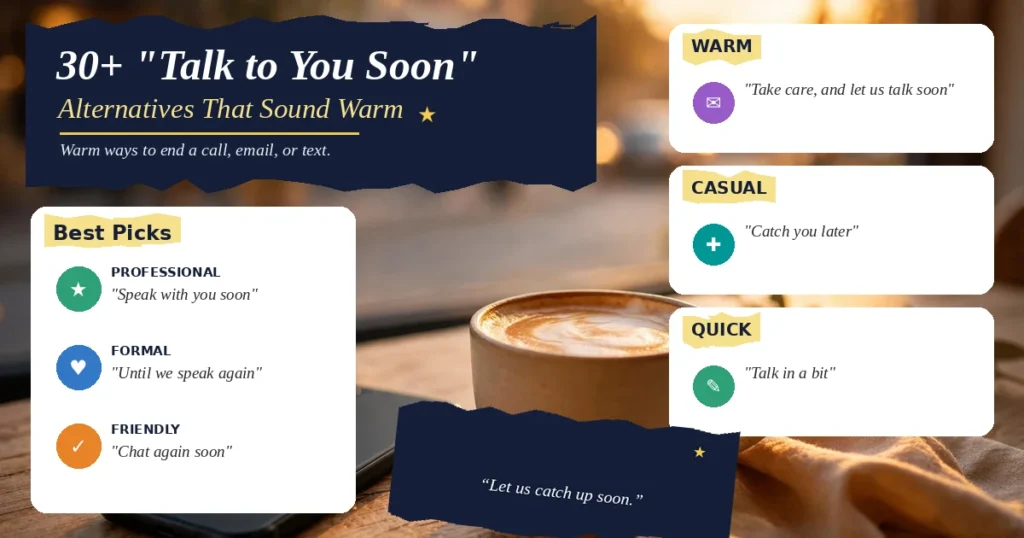
Best picks by tone: Professional — Speak with you soon, I will be in touch soon. Formal — I look forward to hearing from you, Until we speak again. Friendly — Let us catch up soon, Chat again soon. Warm — Take care, and let us talk soon, Sending love, talk soon. Casual — Catch you later, Talk in a bit.
Choose with care, and let kindness lead the way. Think about who will read your words, what channel you use, and what should happen next. Add one clear detail, keep your promise, and follow up when you say you will. The word soon itself leaves room for hope, so use that room wisely and keep every goodbye honest, gentle, and human.