Introduction
If you need another way to say i look forward to speaking with you, you are in the right place. This classic closing line sounds polite and warm, but it can start to feel flat when you use it in every email, message, or meeting invite. A small change in wording can make your note sound fresher, more personal, and better matched to the person you are writing to.
You can keep the same kind and positive meaning while you change the tone. You can sound formal for a job interview, warm for a new client, or relaxed for a coworker you already know well. You can also match your closing line to the next step, such as a phone call, a video meeting, or a face-to-face chat. That small detail helps the reader know what will happen next.
In this guide, you will find more than 35 ready-to-use alternatives grouped by tone. You will also see email examples, common mistakes to avoid, and simple tips for choosing the right phrase each time. By the end, you will have a set of lines you can copy, adjust, and use with confidence in your work and daily life.
Meaning
The phrase “I look forward to speaking with you” means you feel happy and positive about a future conversation. It shows interest, respect, and readiness. You expect the talk to happen, and you welcome it.
People use this phrase at the end of emails, cover letters, meeting invites, and follow-up notes. It works as a friendly close. It tells the reader that you value their time and that you are ready for the next step. It also keeps the tone open and polite without sounding pushy.
The phrase can cover many kinds of talks. It can mean a phone call, a video meeting, an interview, a sales call, or a casual catch-up. Because it is so broad, it fits many cases. Yet that broad meaning is also why it can feel vague. When you name the exact type of talk, your message becomes clearer. For example, “I look forward to our call on Thursday” tells the reader the day and the channel. That clarity builds trust and helps both sides prepare.
In short, the phrase expresses eager and polite anticipation. It says, “I care about this conversation, and I am ready for it.” The alternatives in this guide keep that core meaning while they add tone, detail, and warmth.
Professional usage
In professional writing, this phrase does more than close an email. It sets the tone for the next step and shows that you take the meeting seriously. Recruiters, managers, clients, and partners often read the last line first when they scan a message. A strong closing line leaves a good final impression.
Use a formal or polished version when you write to someone you do not know well. For example, in a job application, a client pitch, or a first outreach email, choose a line that sounds respectful and calm. You can write, “I look forward to discussing the role with you.” That line sounds focused and job-ready. It also shows that you have a clear reason for the talk.
Use a warm professional version when you already have a working bond. If you have met the person before, you can sound a bit more human. For example, “I look forward to catching up with you next week” feels friendly but still work-ready. It shows that you remember the bond and that you value the next talk.
Avoid a line that sounds too casual in formal settings. A phrase like “Can’t wait to chat” may feel too relaxed for a hiring manager or a senior leader. Save relaxed lines for peers, teammates, or clients who already use a casual tone with you. When in doubt, pick the slightly more formal option. You can always warm up later once the other person sets a relaxed tone.
Timing also matters. If the meeting is already booked, name the day or time. If the meeting is not yet booked, keep the line open. You can write, “I look forward to finding a time that works for both of us.” That line invites action without pressure. It keeps the door open and makes it easy for the reader to reply with a time.
Alternatives
Use this list to pick a line that fits your tone and your reader. Each option keeps the same warm meaning but changes the feel. Read the tone note, then copy the example and adjust the day, topic, or channel to fit your message.
Professional and polished
- I look forward to our conversation. Professional and calm; best for first meetings and interviews. Example: “I look forward to our conversation on Tuesday morning.”
- I look forward to discussing this with you. Focused and business-ready; best when you have a clear topic. Example: “I look forward to discussing this with you on our call.”
- I look forward to connecting with you. Modern and professional; best for networking and outreach. Example: “I look forward to connecting with you next week.”
- I look forward to speaking with you soon. Classic and safe; best for any formal email close. Example: “Thank you again, and I look forward to speaking with you soon.”
- I look forward to our discussion. Short and formal; best for agendas and planned talks. Example: “I look forward to our discussion about the project timeline.”
- I look forward to hearing your thoughts. Collaborative and respectful; best when you want input. Example: “I look forward to hearing your thoughts on the proposal.”
- I look forward to our meeting. Direct and clear; best when a meeting is already set. Example: “I look forward to our meeting on Friday at 10 a.m.”
Formal and respectful
- I eagerly await our conversation. Formal and refined; best for senior leaders and official letters. Example: “I eagerly await our conversation about the partnership.”
- I anticipate our discussion with pleasure. Very formal and gracious; best for invitations and high-level talks. Example: “I anticipate our discussion with pleasure.”
- I welcome the opportunity to speak with you. Formal and humble; best for interviews and applications. Example: “I welcome the opportunity to speak with you about the role.”
- I await our call with interest. Formal and precise; best for scheduled phone calls. Example: “I await our call with interest on Wednesday.”
- It will be a pleasure to speak with you. Warm but formal; best for first contact with clients. Example: “It will be a pleasure to speak with you next week.”
- I am keen to discuss this with you. Formal and keen; best for British English business writing. Example: “I am keen to discuss this with you at your convenience.”
- I look forward to the pleasure of speaking with you. Extra formal; best for ceremonial or very polite notes. Example: “I look forward to the pleasure of speaking with you at the event.”
Friendly and warm
- Looking forward to chatting with you. Friendly and light; best for peers and warm contacts. Example: “Looking forward to chatting with you on Monday.”
- I can’t wait to catch up with you. Warm and eager; best for people you already know. Example: “I can’t wait to catch up with you after the holidays.”
- I am excited to talk with you. Warm and upbeat; best when you share good news or plans. Example: “I am excited to talk with you about the new idea.”
- It will be great to speak with you. Friendly and positive; best for casual work emails. Example: “It will be great to speak with you tomorrow.”
- I am really looking forward to our chat. Warm and personal; best for friendly check-ins. Example: “I am really looking forward to our chat on Friday.”
- Looking forward to catching up soon. Relaxed and warm; best for ongoing contacts. Example: “Looking forward to catching up soon and hearing your update.”
- I am glad we will get to talk soon. Kind and calm; best for supportive or sensitive talks. Example: “I am glad we will get to talk soon about next steps.”
Casual and relaxed
- Talk soon. Very short and casual; best for quick messages to peers. Example: “Thanks for the update. Talk soon.”
- Catch you soon. Relaxed and friendly; best for informal chats. Example: “Catch you soon on our call.”
- Looking forward to it. Short and easy; best when the context is already clear. Example: “Thanks for setting this up. Looking forward to it.”
- Chat soon. Simple and casual; best for texts and short emails. Example: “Sounds good. Chat soon.”
- Can’t wait to talk. Eager and informal; best for close coworkers and friends. Example: “Can’t wait to talk and hear all about it.”
- See you on the call. Casual and direct; best for team meetings. Example: “See you on the call at 2 p.m.”
- Talk to you then. Relaxed and clear; best when the time is already set. Example: “Tuesday at 11 works for me. Talk to you then.”
Email-ready closers
- I look forward to your reply and our call. Clear and action-focused; best for emails that need a reply. Example: “I look forward to your reply and our call next week.”
- I look forward to speaking with you at your convenience. Polite and flexible; best when you wait for their schedule. Example: “I look forward to speaking with you at your convenience.”
- I look forward to our call on Thursday. Specific and helpful; best when you want to confirm the time. Example: “I look forward to our call on Thursday at 3 p.m.”
- I look forward to following up with you. Professional and next-step focused; best for sales and support. Example: “I look forward to following up with you after the demo.”
- I look forward to hearing from you soon. Polite and open; best for outreach and follow-ups. Example: “I look forward to hearing from you soon about the next step.”
- I look forward to our video meeting. Clear and modern; best for Zoom or Teams invites. Example: “I look forward to our video meeting on Monday.”
- I look forward to continuing our conversation. Warm and ongoing; best for second or third talks. Example: “I look forward to continuing our conversation next week.”
Quick comparison
Use this table to pick a line fast. Match the tone to your reader and the best use to your next step. When you want a safe choice, start with the professional group.
| Alternative | Tone | Best use |
|---|---|---|
| I look forward to our conversation | Professional | Interviews and first meetings |
| I look forward to discussing this with you | Professional | Topic-focused business talks |
| I look forward to connecting with you | Professional | Networking and outreach |
| I welcome the opportunity to speak with you | Formal | Job applications and official notes |
| It will be a pleasure to speak with you | Formal | First contact with clients |
| I am excited to talk with you | Warm | Friendly updates and good news |
| Looking forward to chatting with you | Friendly | Peers and warm contacts |
| Looking forward to it | Casual | Quick replies with clear context |
| Talk soon | Casual | Short messages to teammates |
| I look forward to our call on Thursday | Email-ready | Confirming a set call time |
| I look forward to hearing from you soon | Email-ready | Outreach and follow-ups |
| I look forward to continuing our conversation | Email-ready | Second or third talks |
Email examples
These full examples show how each closing line fits inside a real email. Copy the structure, then change the names, dates, and topics to fit your case. Keep your tone steady from the first line to the last line.
Example 1: Job interview follow-up
Subject: Thank you for your time today
Dear Ms. Rivera,
Thank you for meeting with me today to discuss the content writer role. I enjoyed learning about your team and your goals for the next quarter. I feel confident that my writing and research skills can support your content plan.
I look forward to our conversation next week about the next steps. Please let me know if you need any work samples or references before then.
Best regards,
Alex
Example 2: Client outreach
Subject: Quick intro and next steps
Hi Daniel,
Thank you for your reply and for sharing more about your project. I would love to help you build a clear content plan that brings in steady leads. Your goals sound like a great fit for the work I do.
I welcome the opportunity to speak with you about the timeline and budget. Please let me know two times that work for you this week.
Kind regards,
Sara
Example 3: Team check-in
Subject: Project update and call on Friday
Hi Team,
Thanks for the updates on the project board. We have made strong progress, and I think our Friday call will help us clear the last open items. I have added the agenda to the shared doc.
It will be great to speak with you on Friday. Please add any questions to the doc before the call.
Thanks,
Jordan
Example 4: Sales follow-up
Subject: Following up on your demo
Hi Priya,
Thank you for joining the demo yesterday. I hope the walkthrough gave you a clear view of how the tool can save your team time. I have attached the summary and the pricing options we discussed.
I look forward to following up with you after you review the details. I am happy to answer any questions on our next call.
Best,
Chris
Example 5: Networking message
Subject: Great to connect
Hi Omar,
It was a pleasure to meet you at the workshop. I enjoyed our talk about content strategy and small business growth. I would love to stay in touch and share ideas.
I look forward to connecting with you next week. Let me know if a short call works for you.
Warm regards,
Layla
When you write a follow-up, keep your closing line tied to the next action. If you wait for a reply, say so. If you wait for a call, name the day. This habit helps the reader know what to do next and keeps your email from feeling vague or unfinished. A clear closing line also shows respect for the reader’s time. For more ideas on how to open a polite note, you can learn how to say I am reaching out to you in a warm and professional way. If you need to ask for more time while you wait, you can use a line like please be patient without sounding rude.
Common mistakes
Many writers use this phrase with good intent, but small errors can make it sound stiff, vague, or even pushy. Watch for these common mistakes and fix them with a simple change.
Using the same line in every email. When you repeat the exact same closing line in all your emails, it starts to feel like a template. Readers notice the pattern, and your message loses warmth. Vary your closing line based on the person and the next step. Keep two or three favorites and rotate them.
Forgetting to name the next step. A vague line like “I look forward to speaking with you” does not tell the reader when or how you will talk. Add the channel or the day when you can. For example, “I look forward to our call on Thursday” is clearer and more helpful. If you do not yet have a time, say that you look forward to finding one.
Sounding too eager in formal settings. Lines like “I can’t wait to talk” can feel too strong for a job interview or a first client email. Eagerness is good, but the tone must fit the setting. In formal writing, choose a calm line such as “I look forward to our discussion.” Save eager lines for people who already know you.
Mixing tenses or grammar. Do not write “I am looking forward to speak with you.” The correct form is “I am looking forward to speaking with you” because “to” here acts as a preposition that needs a gerund. Also avoid “I look forward to speak with you.” The correct verb form after “look forward to” is always the -ing form. This small grammar point matters in professional writing.
Adding too many closers in one email. Some writers stack three closing lines at the end, such as “I look forward to speaking with you. I look forward to hearing from you. I look forward to your reply.” That repetition feels heavy. Pick one strong closing line and stop. You can add a separate call to action before it, such as “Please share two times that work for you.”
Using a casual line with a senior leader. A short line like “Chat soon” can feel too relaxed for a CEO, a professor, or a hiring manager. Match your tone to the reader’s role and to how they write to you. If they use formal language, stay formal. If they use a relaxed tone, you can relax a bit too.
Forgetting the human touch. A closing line should feel human, not robotic. Add one small personal detail when it fits. For example, “I look forward to hearing your thoughts on the launch” feels more real than a bare “I look forward to speaking with you.” The detail shows that you care about the topic, not just the meeting.
Related phrases
You can widen your word bank with related phrases that share the same warm and forward-looking feel. These lines help you open or close a message without repeating the same sentence.
- I look forward to hearing from you. This line focuses on a reply, not a live talk. Use it when you wait for an email answer rather than a call. It works well for outreach and follow-ups.
- I look forward to meeting you. Use this line when you will meet in person. It fits interviews, events, and first meetings. It sounds warm and respectful.
- I look forward to working with you. Use this line when a project or job is about to start. It shows teamwork and positive energy. It fits welcome notes and kickoff emails.
- I look forward to your feedback. Use this line when you share a draft or a proposal. It invites a reply and shows that you value the reader’s view. It works well after you send a document.
- I look forward to seeing you soon. Use this line for in-person or video meetings with people you already know. It feels friendly and natural.
- I am excited to connect. This short line works for networking and social messages. It sounds modern and upbeat. Pair it with a clear next step, such as a call time.
- Let’s talk soon. This simple line works for peers and teammates. It feels direct and relaxed. Use it when the context already makes the topic clear.
When you thank someone for their help or clarity, you can pair your closing line with a kind note. For example, after a helpful reply, you might write thank you for the clarification before your closing line. If a talk follows a hard moment, a line like I understand your frustration can add empathy. These small pairings make your message feel thoughtful and complete.
Phrase comparison
Not all closing lines mean the same thing. Some focus on a call, some on a reply, and some on a meeting. Picking the right one helps the reader know what to expect.
“I look forward to speaking with you” focuses on a live talk. It can mean a call, a video meeting, or an in-person chat. It does not promise a written reply. Use it when the next step is a real conversation.
“I look forward to hearing from you” focuses on a reply. It can mean an email, a message, or a call back. It does not set a live meeting. Use it when you wait for an answer and the channel is still open.
“I look forward to meeting you” focuses on meeting in person for the first time. It carries a warm and respectful tone. Use it when you plan to meet face to face, not just on a call. It fits interviews, events, and introductions.
“I look forward to working with you” focuses on a shared task or project. It looks beyond one talk and points to an ongoing bond. Use it when you start a job, a project, or a partnership. It shows commitment and team spirit.
“I can’t wait to talk” focuses on eagerness. It sounds very warm and personal. It fits friends, close coworkers, and warm contacts. Avoid it in formal first emails, where a calmer line works better.
“I look forward to our call on Thursday” is the most specific option. It names the channel and the day. It reduces back-and-forth and helps both sides prepare. When you can, choose a specific line over a general one. Specific lines sound more professional and more helpful.
In short, ask yourself one question before you close: what happens next? If the next step is a call, name the call. If the next step is a reply, ask for the reply. If the next step is a meeting, name the meeting. That one habit will make every closing line stronger. If you want to express thanks in the same note, a line like I appreciate it can add warmth without changing the focus. And when the other person has been kind or helpful, a simple my pleasure to help can close the loop with grace.
Cultural usage
English speakers around the world use this phrase, but the tone and the expected reply can differ by culture and workplace. Knowing these small differences helps you sound polite in any setting.
In the United States, the phrase is common in business emails and cover letters. People expect a direct and friendly tone. A line like “I look forward to speaking with you soon” feels normal and safe. Americans often pair it with a clear next step, such as a call time or a follow-up date.
In the United Kingdom, writers often use slightly more formal lines, such as “I look forward to speaking with you at your convenience.” The phrase “I am keen to discuss this with you” also appears often. British business writing values politeness and understatement. Avoid a line that sounds too eager or too loud in a first email.
In Canada and Australia, the tone sits between American and British styles. Writers sound warm and direct but still polite. Lines like “I look forward to catching up with you” work well in both places. Casual lines are more accepted once a bond exists.
In many parts of Asia, the Middle East, and Latin America, formal respect matters a great deal in first contact. Use a respectful line such as “It will be a pleasure to speak with you.” Add a title, such as Mr., Ms., or Dr., when you use a formal greeting. Once the other person uses a first name or a relaxed tone, you can match it.
In global remote teams, clarity matters more than style. Team members may read English as a second language. Keep your closing line short, clear, and specific. Name the day, the time zone, and the channel. For example, “I look forward to our video meeting on Monday at 10 a.m. PKT” leaves no doubt. Simple lines travel well across cultures.
No matter where your reader lives, kindness and clarity always work. Choose a line that is polite, specific, and easy to understand. If you are unsure, pick the formal option first. You can always warm up later as the bond grows. If you need to ask for help while you wait for a talk, you can write I need your help in a clear and respectful way.
Frequently asked questions
What is the best alternative to “I look forward to speaking with you” for a job interview?
For a job interview, use “I look forward to our conversation” or “I welcome the opportunity to speak with you.” Both lines sound professional, respectful, and focused. They show that you take the role seriously. Add the day or the next step when you can.
Can I use “Looking forward to speaking with you” without “I”?
Yes, you can. “Looking forward to speaking with you” is a short and common form. It sounds friendly and natural in emails and messages. It works best when the tone is warm or casual. In very formal letters, keep the full form with “I” for a more complete feel.
Is “I look forward to speaking with you” too formal for a coworker?
It can feel a bit formal for a close coworker, but it is still polite. For a teammate you know well, try “Looking forward to chatting with you” or “Talk soon.” These lines sound more relaxed. Match your tone to how your coworker writes to you.
What is a polite way to say it in a first email to a client?
For a first email to a client, use “It will be a pleasure to speak with you” or “I look forward to discussing this with you.” Both lines sound warm and business-ready. They show respect without sounding stiff. Add a clear next step, such as a call time or a reply request.
How do I say it when the meeting time is not set yet?
When the time is not set, keep the line open. You can write, “I look forward to speaking with you at your convenience” or “I look forward to finding a time that works for both of us.” Both lines invite the reader to suggest a time. They sound polite and flexible.
What is a short alternative for a text message?
For a text message, use “Talk soon,” “Chat Soon,” or “Looking forward to it.” These lines are short and easy to read on a phone. They work best when the topic is already clear. Avoid long formal lines in texts, where short lines feel more natural.
Is “I can’t wait to speak with you” professional?
“I can’t wait to speak with you” sounds eager and warm, but it is not ideal for formal emails. It can feel too strong for a hiring manager or a senior leader. Save it for warm contacts, friends, or close coworkers. In formal writing, choose a calmer line like “I look forward to our discussion.”
How do I end a follow-up email with this phrase?
In a follow-up, tie the phrase to the next action. For example, write, “I look forward to following up with you after you review the proposal.” That line reminds the reader of the next step. It also keeps your tone polite and helpful. You can add a thank-you line before it for extra warmth.
Can I use this phrase in a cover letter?
Yes, you can use it in a cover letter. A line like “I welcome the opportunity to speak with you about the role” works well at the end. It sounds confident and respectful. It also shows that you are ready for an interview. Keep the rest of the letter focused on your skills and fit.
What is a good alternative for a video meeting?
For a video meeting, use “I look forward to our video meeting” or “See you on the call.” Both lines name the channel and set clear expectations. Add the day and time for extra clarity. For example, “I look forward to our video meeting on Monday at 10 a.m.”
How do I say it in a warm way to a friend?
To a friend, you can write, “I can’t wait to catch up with you” or “I am really looking forward to our chat.” These lines sound warm, personal, and eager. They fit calls, meetups, and long chats. You can add a small personal detail, such as a shared memory or plan.
Is “I look forward to speaking with you soon” correct grammar?
Yes, it is correct grammar. The phrase uses the present simple tense with “look forward to” plus the gerund “speaking.” The word “soon” adds a sense of near time. It is one of the most common and safe closing lines in business English. You can use it in almost any formal email.
What should I write instead if I want a reply, not a call?
If you want a reply, use “I look forward to hearing from you” or “I look forward to your reply.” These lines ask for a written answer. They work well for outreach and follow-ups. If you want both a reply and a call, you can write, “I look forward to your reply and our call.”
How can I make the phrase sound less repetitive?
To avoid repetition, rotate a few closing lines and add specific details. For example, name the topic, the day, or the channel each time. You can also vary the sentence structure. Instead of starting with “I look forward,” try “It will be great to speak with you” or “Looking forward to our chat.” Small changes keep your writing fresh.
What is the most polite formal version?
The most polite formal version is “I look forward to the pleasure of speaking with you” or “I anticipate our discussion with pleasure.” Both lines sound refined and gracious. They fit official letters, invitations, and high-level talks. In most business emails, a simpler formal line will feel more natural and clear.
Conclusion
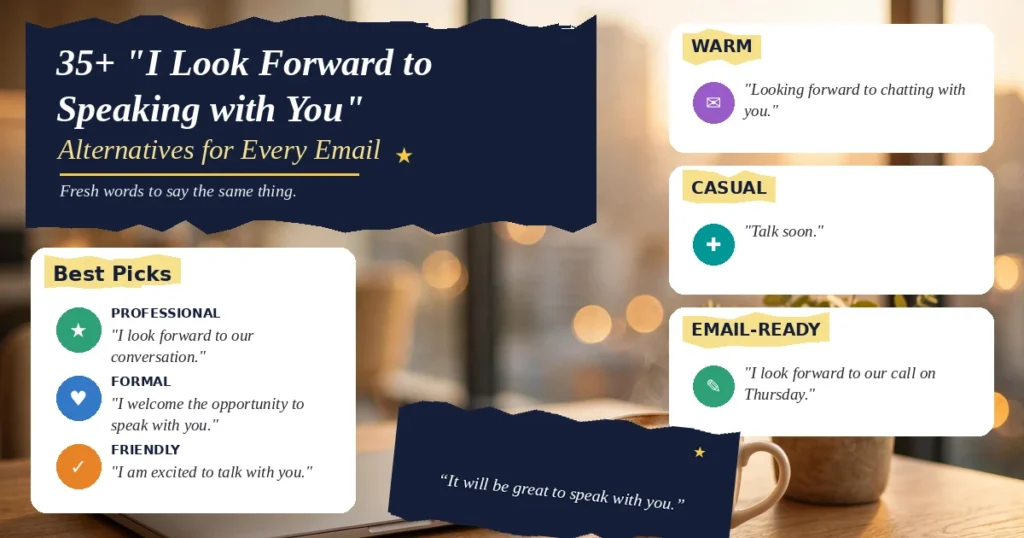
Best picks: For a professional tone, use “I look forward to our conversation” or “I look forward to discussing this with you.” For a formal tone, use “I welcome the opportunity to speak with you” or “It will be a pleasure to speak with you.” For a warm tone, use “I am excited to talk with you” or “Looking forward to chatting with you.” For a casual tone, use “Talk soon” or “Looking forward to it.” For an email-ready closer, use “I look forward to our call on Thursday” or “I look forward to hearing from you soon.”
Pick one line that fits your reader, your next step, and your bond. Add the day or the channel when you can, and keep your tone steady from start to finish. A thoughtful closing line does more than end an email. It shows respect, builds trust, and makes the next talk easier to start. For the exact meaning of the verb at the heart of this phrase, see speak.
Your words set the tone before the talk even begins. Choose a line that sounds like you, and let the conversation grow from there.