Introduction
If you want other ways to say when is a good time, you already understand something important about polite communication. The question itself is simple, but the way you ask it can change how the other person feels. A direct question can sound rushed, pushy, or careless, especially in a work email or a first message to a client. A softer version shows respect for the other person’s schedule, and it makes it easier for them to say yes.
Most people ask this question when they want to set up a meeting, a phone call, or a visit. They may need help, advice, feedback, or a quick decision. The timing matters because everyone has different work hours, family duties, and energy levels. When you ask politely, you give the other person room to choose a time that works well for them, instead of making them feel cornered.
This guide gives you 35 polite alternatives, grouped by tone, so you can pick the right one for each situation. You will find professional options for managers and clients, formal options for official letters, friendly options for colleagues you know well, email-ready lines you can copy, and casual workplace options for everyday chats. You will also find email examples, common mistakes to avoid, and answers to the questions people ask most often about this phrase.
The goal is not to make your message longer or fancier. The goal is to make it clearer and kinder. A good alternative keeps the meaning, removes the pressure, and helps the other person reply with confidence. By the end of this guide, you will know exactly which version to use, and why it works.
Meaning
The phrase “when is a good time” asks someone to name a time that suits them. It is a polite way to ask about availability. It does not demand a meeting at a fixed hour. Instead, it invites the other person to suggest a time, or to pick from times you offer.
In simple terms, the phrase means: “Please tell me when you are free, so we can talk or meet.” It works for a call, a video meeting, a visit, or a short chat. It also works when you want to discuss a project, solve a problem, or get feedback.
The word “good” is doing important work here. It does not mean “perfect” or “ideal in every way.” It means “suitable,” “workable,” or “not too disruptive.” When you ask when a good time is, you show that you care about the other person’s day, not just your own plan.
This phrase is common in English because it is soft and open. It does not assume the other person is free now. It does not push them to drop everything. It simply opens the door to a plan. That is why it appears so often in emails, messages, and phone calls at work.
It is also useful because it fits many levels of formality. You can use it with a boss, a client, a teacher, a colleague, or a friend. The basic meaning stays the same, but the exact words around it can change to match the relationship. That flexibility is one reason people look for fresh alternatives: the same question, asked the same way every time, can start to sound flat or automatic.
Professional usage
At work, “when is a good time” works best when you add context and choice. A short, bare question can leave the other person unsure about what you want. A professional version tells them the purpose, the length of time you need, and how you would like to meet. For example, “When is a good time for a 20-minute call about the report?” is much clearer than “When is a good time?” alone.
Professional usage also means giving the other person an easy way out. Phrases like “at your convenience,” “when it suits you,” and “if you have a free slot this week” all soften the request. They signal that you respect a busy schedule. They also make it less awkward for the other person to suggest a later date.
In a first email to a client or a senior manager, avoid sounding too casual. Do not write “When u free?” or “Got time now?” Those versions may be fine with a close friend, but they can look careless at work. Instead, use a full sentence, a polite greeting, and a clear subject line. The tone of the whole email should match the tone of your question.
Another professional habit is to offer two or three times. This saves back-and-forth messages. You can write, “Would Tuesday at 10 a.m. or Wednesday at 2 p.m. work for you, or is another time better?” This keeps control with the other person while still moving the plan forward. It also shows that you have thought about your own availability.
Finally, remember to thank the person for their time, even before they reply. A line such as “Thank you for making time for this” sets a respectful tone. It also makes the request feel like teamwork rather than a demand. Professional language is not about big words. It is about clarity, respect, and ease.
Alternatives
Here are 35 alternatives in five tone groups. Each entry gives you the phrase, a short note on tone and best use, and a short example. Pick the group that matches your relationship with the reader, then pick the line that fits the moment.
Professional alternatives
These lines suit managers, clients, and work contacts. They sound polished without sounding stiff.
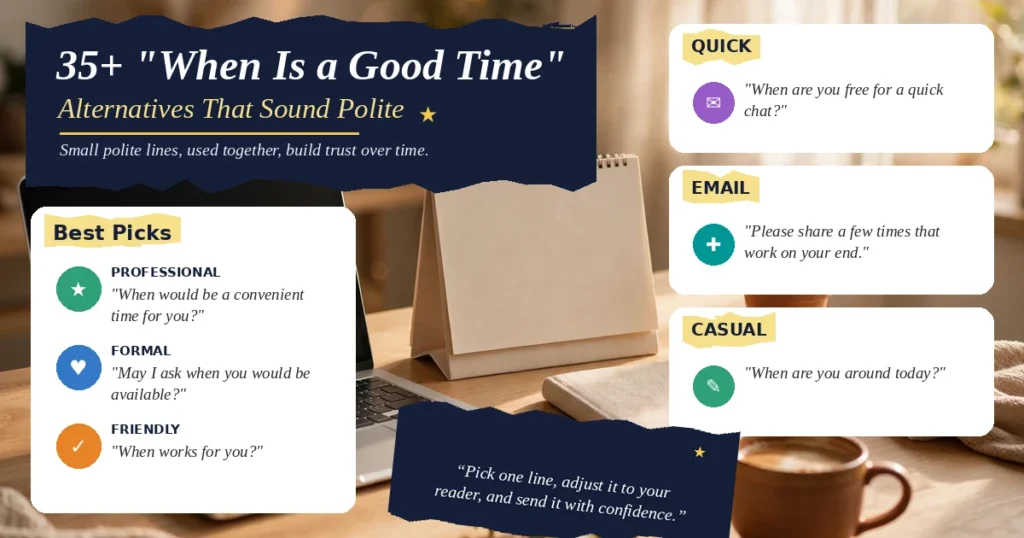
- When would be a convenient time for you? — Professional and widely safe; use it in a first work email. Example: “When would be a convenient time for you to review the proposal?”
- What time works best for you this week? — Professional and practical; it narrows the window without pressure. Example: “What time works best for you this week for a short call?”
- When are you available to discuss this? — Direct and professional; it names the purpose clearly. Example: “When are you available to discuss the budget update?”
- Could we find a time that suits us both? — Collaborative and polite; it frames the meeting as shared planning. Example: “Could we find a time that suits us both next week?”
- What does your schedule look like this week? — Professional and open; it invites the person to share real availability. Example: “What does your schedule look like this week for a 30-minute meeting?”
- When would you prefer to meet? — Simple and respectful; it hands the choice to the other person. Example: “When would you prefer to meet about the new project?”
- Is there a time that works well on your side? — Polite and team-friendly; it works well across departments. Example: “Is there a time that works well on your side for a quick check-in?”
Formal alternatives
These lines suit official letters, senior leaders, and first contact with an organisation. They are more careful and complete.
- At what time would it be convenient for you to meet? — Formal and complete; use it in official emails and letters. Example: “At what time would it be convenient for you to meet to discuss the contract?”
- May I ask when you would be available? — Very polite and formal; it softens the request with permission language. Example: “May I ask when you would be available for a brief meeting?”
- Please let me know a suitable time for a discussion. — Formal and courteous; it works well as a closing line. Example: “Please let me know a suitable time for a discussion about the report.”
- I would appreciate it if you could suggest a convenient time. — Formal and grateful; it shows respect for a senior person’s time. Example: “I would appreciate it if you could suggest a convenient time next week.”
- When might it be possible to arrange a meeting? — Formal and indirect; it avoids sounding demanding. Example: “When might it be possible to arrange a meeting with your team?”
- Kindly advise a time that suits your schedule. — Formal and businesslike; common in official correspondence. Example: “Kindly advise a time that suits your schedule for a call.”
- Would you be available at a time of your choosing? — Formal and generous; it gives the other person full control. Example: “Would you be available at a time of your choosing this month?”
Friendly alternatives
These lines suit colleagues you know well, regular clients, and warm work relationships. They sound human and relaxed.
- When works for you? — Friendly and short; it keeps the message light. Example: “When works for you to catch up on the project?”
- What time suits you best? — Warm and simple; it feels natural in a friendly email. Example: “What time suits you best for a coffee chat?”
- When are you free for a quick chat? — Friendly and low-pressure; it signals a short talk. Example: “When are you free for a quick chat about the slides?”
- Let me know when you have a moment. — Gentle and friendly; it lets the person reply in their own time. Example: “Let me know when you have a moment to look at the draft.”
- When is a good moment to catch you? — Warm and casual-professional; it works well with regular contacts. Example: “When is a good moment to catch you this afternoon?”
- What is the best time to reach you? — Friendly and practical; it fits calls and messages. Example: “What is the best time to reach you tomorrow?”
- When can we grab a few minutes? — Friendly and informal; it suits close colleagues. Example: “When can we grab a few minutes to go over the plan?”
Email-ready alternatives
These lines are built to drop straight into an email. They pair well with a subject line, a greeting, and a clear purpose.
- Would any of the following times work for you? — Email-ready and efficient; follow it with two or three options. Example: “Would any of the following times work for you: Monday at 11 a.m. or Tuesday at 3 p.m.?”
- Please share a few times that work on your end. — Email-ready and clear; it invites options, not just one answer. Example: “Please share a few times that work on your end this week.”
- I am happy to work around your schedule, so please suggest a time. — Email-ready and flexible; it removes pressure. Example: “I am happy to work around your schedule, so please suggest a time for our call.”
- Could you let me know your availability this week? — Email-ready and standard; it is polite and widely used. Example: “Could you let me know your availability this week for a meeting?”
- Would you be open to a call at a time that suits you? — Email-ready and soft; it asks permission first. Example: “Would you be open to a call at a time that suits you?”
- Feel free to pick a time that fits your day. — Email-ready and relaxed; it works with a booking link or a list of times. Example: “Feel free to pick a time that fits your day from the options below.”
- Let me know what time is easiest for you. — Email-ready and kind; it focuses on ease for the reader. Example: “Let me know what time is easiest for you to talk.”
Casual and workplace alternatives
These lines suit team chats, quick messages, and colleagues you talk to every day. They are short and natural.
- Got a free moment later? — Casual and quick; it suits a chat message. Example: “Got a free moment later to check this file?”
- When are you around today? — Casual and everyday; it fits office and remote teams. Example: “When are you around today for a quick sync?”
- What time is good on your side? — Casual and team-friendly; it works in messages and calls. Example: “What time is good on your side for a five-minute call?”
- Are you free at some point today? — Casual and open; it does not lock in a fixed hour. Example: “Are you free at some point today to review this?”
- When can we hop on a quick call? — Casual and modern; it suits remote work chats. Example: “When can we hop on a quick call about the update?”
- What works on your calendar? — Casual and practical; it fits teams that share calendars. Example: “What works on your calendar for tomorrow morning?”
- When is a good time to pop by? — Casual and in-person; it suits office visits. Example: “When is a good time to pop by your desk for two minutes?”
Quick comparison
A quick comparison helps you choose fast. The table below groups the question by situation, tone, and a sample line. Use it when you need to decide in seconds.
| Situation | Best tone | Sample line |
|---|---|---|
| First email to a client | Professional | When would be a convenient time for you? |
| Letter to a senior leader | Formal | May I ask when you would be available? |
| Message to a close colleague | Friendly | When works for you? |
| Follow-up email with time options | Email-ready | Would any of the following times work for you? |
| Quick team chat | Casual | When are you around today? |
| Request for a short call | Friendly | When are you free for a quick chat? |
| Meeting with a busy manager | Professional | What time works best for you this week? |
The main lesson from the table is simple. Match the tone to the relationship, not to the question. The same meeting can sound formal, friendly, or casual depending on the words you choose. A formal line to a close colleague can sound distant. A casual line to a new client can sound careless. Choose the row that fits the person, then adjust the words to fit the purpose.
Also note the length of the meeting in your message when you can. A person is more likely to say yes to “a 15-minute call” than to an open-ended “meeting.” Short, clear requests feel easier to accept. They also help the other person find a gap in a busy day. When you combine a polite question with a clear time length, you make the reply easy.
Email examples
Short examples show how these lines work in real messages. Each example below uses a polite opening, a clear purpose, and a soft question about time.
Example 1: First email to a client
Subject: Short call about the project plan
Dear Ms. Rao,
Thank you for sharing the project brief. I would like to discuss the next steps and confirm the timeline with you. When would be a convenient time for you for a 20-minute call this week?
Thank you for your time.
Best regards,
Ali
Example 2: Follow-up with time options
Subject: Meeting to review the draft
Hello Sarah,
I hope you are well. I have finished the first draft and would like your feedback before we share it with the team. Would any of the following times work for you: Wednesday at 10 a.m. or Thursday at 2 p.m.? If neither works, please suggest another time.
Thank you,
Ali
Example 3: Friendly message to a colleague
Subject: Quick chat about the slides
Hi James,
I have a couple of small questions about the slides for Friday. When are you free for a quick chat today? I only need about ten minutes.
Thanks,
Ali
Example 4: Formal email to a senior manager
Subject: Request for a brief meeting
Dear Mr. Khan,
I am writing to request a brief meeting to discuss the quarterly report. May I ask when you would be available next week? I am happy to work around your schedule.
Thank you for your consideration.
Kind regards,
Ali
Example 5: Short message after an introduction
When someone introduces you to a new contact, keep the message short and polite. You can borrow the tone of I am reaching out to you without copying its words, and then ask about time in a gentle way. For example: “Thank you for the introduction. I would love to learn more about your work. When would be a convenient time for you for a short call?” This approach thanks the person, states the purpose, and leaves the timing open.
Notice how each example answers three silent questions: Why are you writing? How long will it take? When can we talk? When all three answers are clear, the reader can reply in one short message. That is the mark of a good work email. It respects time, and it moves the work forward without extra rounds of messages.
Common mistakes
Many polite messages fail because of small mistakes, not bad intentions. The first mistake is asking about time without giving a reason. “When is a good time?” on its own can confuse the reader. They may wonder what the meeting is about, or how long it will take. Always add a short purpose, such as “to discuss the report” or “for a quick call about the design.”
The second mistake is sounding too vague. “Let me know sometime” gives no window at all. The reader may keep putting the reply off because no date feels urgent. A gentle window helps, such as “this week,” “next week,” or “before Friday.” It gives direction without pressure.
The third mistake is offering too many times. A list of ten slots looks helpful, but it can overwhelm the reader. Two or three options are enough. If none of them work, the reader can suggest another time. Keep the choice simple.
The fourth mistake is using the wrong tone. A very casual line in a formal email can look careless. A very formal line in a team chat can look cold. Read your message once as the other person. Ask yourself: Does this sound like me at my best, speaking to this person? If not, change one or two words until it does.
The fifth mistake is forgetting to be patient after you ask. If the person does not reply at once, do not send three follow-ups in one day. A single polite reminder after a few days is enough. A calm follow-up shows respect, and it keeps the door open. If you need help phrasing a gentle reminder, a guide on how to ask someone to please be patient can help you keep the tone soft rather than pushy.
The sixth mistake is asking at a bad moment. A message sent late at night, or just before a deadline, can add stress even if the words are polite. When you can, send work messages during work hours. If you must write outside those hours, you can add, “No need to reply until tomorrow,” to remove the pressure.
The seventh mistake is making the request only about you. Lines like “I need to meet today” or “I want a call now” focus on your urgency. Polite versions focus on shared timing: “What time works best for you?” or “Could we find a time that suits us both?” That small shift changes the whole feeling of the message.
Related phrases
“When is a good time” belongs to a family of polite scheduling phrases. Learning the neighbours helps you vary your language and avoid repeating the same line in every email.
“Are you available?” is the shortest neighbour. It asks about free time in a direct way. It works well when you already know the person, or when the meeting is short. “Do you have time this week?” adds a gentle window. It works well for a first request.
“Can we schedule a meeting?” moves from asking to planning. It is useful when both people already agree that a meeting is needed. “Can we set up a call?” does the same job for a phone or video call. These lines are clear, but they work best after you have explained the purpose.
“Let me know when you are free” is a soft closing line. It does not ask for a time at once. It invites a reply when the person is ready. It suits follow-up emails and friendly contacts.
“Would you be open to meeting?” asks permission before it asks for a time. It is useful with senior people and new contacts. It shows care, and it makes a “no” easy to give, which in turn makes a “yes” more likely.
Other useful phrases include “What is your availability?”, “When can we connect?”, and “Is there a good time to talk?” Each one keeps the same polite idea, but each one sounds slightly different. Variety matters because readers notice repetition. If every email asks the same question in the same words, the message starts to feel automatic. A small change keeps it human.
If you often need to soften a request, it also helps to know how to say that you understand the other person’s position before you ask for time. A line such as “I understand your week is busy, so please pick a time that suits you” combines empathy with a clear question, and it often gets a faster, warmer reply.
Phrase comparison
Some phrases look similar but feel different. Comparing them helps you pick with care.
“When is a good time?” and “When are you free?” are close cousins. The first sounds slightly softer because “good” suggests a suitable time, not just any empty slot. The second sounds a little more direct. Both are polite, but the first suits work emails a little better, while the second suits friendly chats.
“When would be a convenient time for you?” and “When is a good time for you?” differ in formality. “Convenient” sounds more professional and careful. It suits clients and managers. “Good time” sounds warmer and simpler. It suits everyday work messages and friendly contacts.
“Let me know when you have a moment” and “When can we talk?” differ in urgency. The first is slow and gentle. It suits a non-urgent request. The second is clearer and faster. It suits a request that needs an answer soon. Choose the first when the matter can wait, and the second when it cannot.
“What time works best for you?” and “What time suits you best?” are almost twins. The first is common in American work English. The second is common in British work English. Both are polite, and both are safe in most workplaces. Pick the one that sounds natural to you, and stay consistent in one email.
“Could we find a time that suits us both?” and “Please suggest a time” differ in control. The first shares control. It feels like teamwork. The second hands control to the other person. It feels generous, but it can also leave the other person with all the work of choosing. If you use the second, offer a window, such as “this week” or “next week,” to make choosing easier.
A final comparison worth noting is between asking and telling. “We should meet on Monday at 10 a.m.” tells the person what to do. “Would Monday at 10 a.m. work for you?” asks them. In most work relationships, asking gets a better response than telling, unless you are setting a fixed team meeting that everyone must attend. Polite questions protect the relationship while still moving the plan forward.
Cultural usage
Polite timing language changes across cultures, and a good writer notices the difference. In American workplaces, direct and friendly lines are common. “What time works best for you?” is normal, even in a first email. People often expect two or three time options, and they reply quickly with a choice.
In British workplaces, softer and more indirect lines are common. “When would be convenient for you?” and “Would it be possible to meet next week?” sound natural. People may add extra softeners, such as “just,” “perhaps,” or “whenever suits you.” These words are not filler. They signal respect and a wish not to impose.
In many South Asian workplaces, respectful titles and warm greetings matter a great deal. A message may open with “Dear Sir” or “Respected Madam,” and close with thanks. The question about time often comes after a clear purpose and a polite reason. Rushing straight to “When are you free?” without a greeting can feel abrupt, even if the words are polite on their own.
In some cultures, saying “no” directly feels rude, so a person may reply with a vague answer instead, such as “Maybe later” or “Let us see.” If you get a vague reply, do not push hard. Offer a later window, or ask, “Would next week be easier?” A gentle second option often works better than a repeated direct question.
Time zones add another layer. When you write to someone in another country, name the time zone, or give times in their local time. A line such as “Would Tuesday at 10 a.m. your time work for you?” avoids confusion and shows care. It also prevents a meeting booked at midnight by mistake.
The safest rule across cultures is the same: be clear, be warm, and give choice. A clear purpose, a short time length, and a question that lets the other person choose will work in most settings. When in doubt, pick the slightly more formal version. It is easier to warm up a formal message than to repair a message that sounded careless.
Frequently asked questions
Is “when is a good time” polite?
Yes, it is polite in most everyday and work situations. It asks about suitability rather than demanding a fixed hour, so it shows respect for the other person’s schedule. It becomes even more polite when you add a purpose, a short time length, and a friendly tone.
What is the most professional way to ask when someone is free?
The most professional version names the purpose, the length, and a window of time. For example, “When would be a convenient time for you this week for a 20-minute call about the report?” This version is clear, respectful, and easy to answer. It works well with clients, managers, and new contacts.
How do I ask for a good time in a formal email?
Use a complete sentence, a polite greeting, and a formal phrase such as “May I ask when you would be available?” Add the reason for the meeting and a note that you can work around their schedule. Close with thanks, and avoid short forms, slang, or overly casual language in the same message.
Can I use “when is a good time” with my boss?
Yes, you can, and it is often a good choice because it is respectful and open. Add context to help your boss reply fast, such as “When is a good time this week for a ten-minute update on the project?” If your boss prefers short messages, keep the whole email to a few lines and offer two time options.
What should I say instead of “when are you free” at work?
At work, softer options often sound better, such as “When would be a convenient time for you?” or “What time works best for you this week?” These lines keep the same meaning but sound more professional. They also invite the person to choose, which makes the request feel less demanding.
How do I ask about time without sounding pushy?
Give choice, add a gentle window, and avoid urgent words such as “now,” “today,” or “as soon as possible” unless the matter is truly urgent. Lines like “Please suggest a time that suits you this week” or “Feel free to pick a time that fits your day” remove pressure. A thank-you line also softens the request.
Should I offer specific times or leave it open?
Offering two or three times usually works best because it saves back-and-forth messages. An open question works well when you do not know the person’s schedule at all, or when the meeting can wait. You can combine both by writing, “Would Tuesday at 10 a.m. or Wednesday at 2 p.m. work, or is another time better?”
How do I follow up if no one replies about a meeting time?
Wait a few days, then send one short, polite reminder that repeats the purpose and offers a new window. For example, “Just following up on my earlier message. Would next week work for a short call about the report?” One calm reminder is enough, and it keeps the relationship warm while moving the plan forward.
Is it rude to ask “when is a good time to call”?
No, it is not rude, and it is often the most polite way to ask about a call. It shows that you do not want to interrupt the person at a bad moment. To make it even kinder, add the reason for the call and how long it will take, such as “for a five-minute update.”
What is a polite way to ask for a meeting with a client?
Start with thanks, state the purpose in one line, and ask with a professional phrase. For example, “Thank you for your time so far. When would be a convenient time for you to discuss the next steps?” If you know the client is busy, add that you are happy to work around their schedule.
How do I ask a busy person for their time?
Keep the message short, name the exact time you need, and make the reply easy. A line such as “I only need 15 minutes, and I am happy to work around your schedule” respects their workload. If you can, offer times outside their busiest hours, and thank them in advance for making time.
Can I say “let me know when you are free” in a work email?
Yes, you can, especially as a closing line in a friendly or follow-up email. It is gentle and open, and it suits non-urgent requests. For a first email to a client or a senior manager, a slightly more complete version, such as “Please let me know a suitable time,” may sound more professional.
What is the difference between “good time” and “convenient time”?
“Good time” sounds warm, simple, and everyday, while “convenient time” sounds more formal and professional. Both ask about suitability, and both are polite. “Convenient” suits official emails and senior contacts, while “good time” suits regular work messages and friendly colleagues.
How do I ask about time in a text message?
Keep it short and natural, such as “When are you free for a quick chat?” or “What time works for you today?” Add the purpose in a few words so the person knows what the chat is about. Avoid sending work texts late at night unless the matter is urgent and the person expects it.
How do I reply when someone asks me when a good time is?
Reply with two or three options, or name one time and offer an alternative. For example, “Tuesday at 11 a.m. works well, or Wednesday afternoon if that is easier.” If none of your free times fit, say so politely and suggest another week. A clear reply with options keeps the planning fast and friendly.
Conclusion
Asking about time is a small moment in a message, but it carries a large message about respect. When you ask well, you show that you value the other person’s day as much as your own plan. You make it easy for them to reply, easy for them to choose, and easy for them to say yes. That is why the right alternative matters more than it first seems.
The best habit is simple. Start with a clear purpose, name how long you need, and then ask with a line that fits the relationship. Use a professional line for clients and managers, a formal line for official letters, a friendly line for colleagues you know well, and a short line for quick chats. Offer two or three times when you can, and always leave room for another time. If the person is busy, thank them for their time and keep the tone calm. A gentle approach often gets a faster answer than a pushy one, because people reply more warmly to messages that respect them.
You can also build this habit into other polite messages. When you close a request with thanks, for example by learning how to say that you appreciate the help, you leave the reader with a warm feeling. When you look ahead to the meeting, a line about how you are looking forward to the call keeps the tone positive. And when plans change, a short note to thank someone for the clarification keeps the conversation smooth. Small polite lines, used together, build trust over time.
Keep this guide close the next time you write a work email. Pick one line, adjust it to your reader, and send it with confidence. A polite question about time is not just good manners. It is good teamwork, and it is one of the easiest ways to make work feel kinder for everyone involved. For the meaning of the word itself, see the Cambridge definition of time.