Introduction
The pair since vs sense trips up many English learners, and the reason is simple. The two words look alike, sound alike, and show up in everyday speech. Yet they mean very different things. If you swap them by mistake, your sentence can turn confusing or even funny. This guide clears up the confusion once and for all.
You will learn what each word means, how to use each one at work, and which substitutes fit each case. You will also see email examples, common mistakes, and quick memory tricks. By the end, you will pick the right word without a second thought.
Many learners mix up these two words for one main reason. They rush. They hear a word that sounds like “sins” and they type the first spelling that comes to mind. Slow reading fixes most of these slips. When you pause and ask what job the word does in the sentence, the answer usually becomes clear. Does the word point to a time or a cause? Then you need “since.” Does it point to a feeling, a meaning, or the act of noticing? Then you need “sense.”
This guide keeps every rule short and every example plain. You do not need grammar jargon to follow it. You only need to read each example aloud and notice how the word works. That habit alone will lift your accuracy fast.
Meaning
Let us start with crisp definitions.
Since works as a preposition, a conjunction, and an adverb. As a preposition, it marks the start of a time period. For example, “She has lived here since 2019.” As a conjunction, it means “because.” For example, “Since you asked, I will explain.” As an adverb, it means “from then until now.” For example, “He left in June and we have not seen him since.”
Sense works as a noun and a verb. As a noun, it can mean one of the five body senses, such as sight or hearing. It can also mean a feeling, an awareness, or a meaning. For example, “She has a good sense of direction.” As a verb, it means to perceive or notice something, often without clear proof. For example, “I sensed that he felt nervous.”
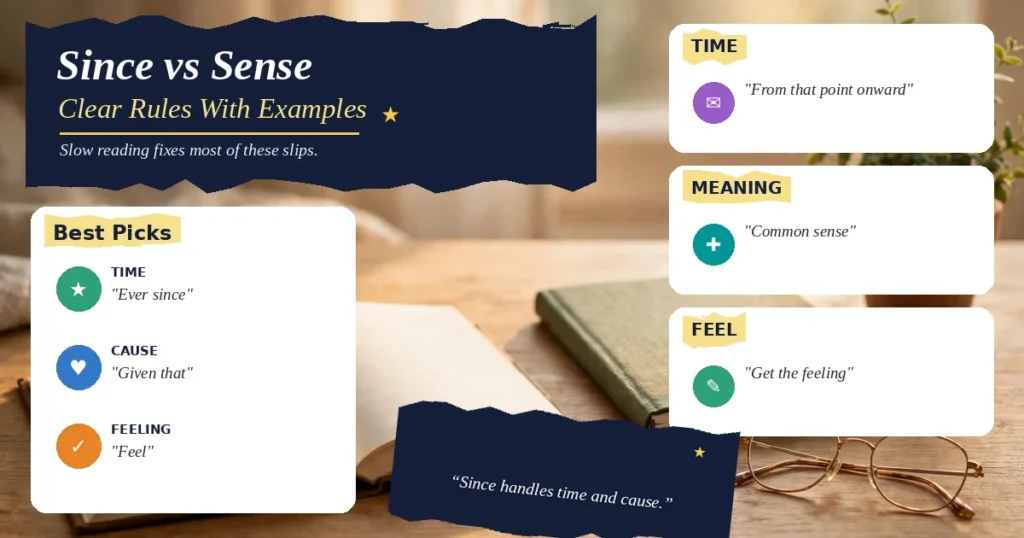
The core contrast is easy to hold in mind. “Since” deals with time and cause. “Sense” deals with feeling, meaning, and perception. If your sentence answers “from when?” or “why?”, you likely need “since.” If your sentence answers “what feeling?” or “what meaning?”, you likely need “sense.”
Pronunciation also helps. “Since” sounds like “sins,” with a short “i” sound. “Sense” sounds like “sens,” with a short “e” sound. The difference is small, but your ear can learn it with practice. Say both words slowly, then say them in full sentences. Your mouth will start to feel the gap between the two vowel sounds.
Spelling gives one more clue. “Since” ends with “nce” and hides the word “sin” inside it, which some learners link to the phrase “since” as in “from that sin-free point on” — but a simpler trick works better. Think “since = time,” because both words are short and plain. Think “sense = senses,” because the word “sense” contains the word “sens,” just like your five senses. These small links can save you in a timed test or a fast email.
Professional usage
At work, both words show up often, and each one carries a clear tone.
Use “since” in reports, updates, and project notes when you mark a start time. For example, “Sales have grown since March.” That sentence is clean, factual, and professional. Use “since” as “because” in polite explanations too. For example, “Since the client moved the deadline, we will adjust the plan.” This use sounds smooth and formal enough for most offices.
Use “sense” when you talk about judgment, awareness, or feedback. For example, “The team has a strong sense of ownership.” That sentence praises attitude without naming any single event. In feedback, “sense” softens claims that you cannot prove yet. For example, “I sense some concern about the new schedule.” That sentence opens a talk without accusing anyone.
When you write to a colleague for the first time, you may open with a line like “I am reaching out to you about the new project” and link readers to a guide on how to say I am reaching out to you. That kind of polite opening pairs well with “since” for background. For example, “I am reaching out to you because we have worked together since January, and I value that history.”
Patience also matters in professional writing. If a reply takes time, you can ask a client to please be patient while you check details, and then use “since” to set the timeline. For example, “Please be patient while we review the file, since the update arrived only this morning.” The two moves together sound calm and in control.
Empathy helps too. When a client feels upset, you can show that you understand your frustration is real, and then use “sense” to name the mood in the room. For example, “I understand your frustration, and I sense that a faster update would help.” That sentence pairs care with a clear next step.
After someone clears up a doubt, a short note of thanks fits well. You can thank them for the clarification and then use “since” to state what changed. For example, “Thank you for the clarification. Since the date moved, we will send a new invite today.” Short, warm, and precise wins at work every time.
Alternatives
The best way to master this pair is to learn substitutes for each side. When you know a good substitute, you can test your sentence. If the substitute fits, your word choice is right. If it sounds wrong, you likely picked the wrong word.
Formal substitutes for since
- Because — formal and safe in almost every “since means because” case. Example: “Because the shop closed early, we left at six.”
- As — formal and smooth when the cause is clear. Example: “As the rain grew heavy, we moved inside.”
- Given that — formal, best for reports and official notes. Example: “Given that costs rose, we revised the budget.”
- In view of the fact that — very formal and wordy, so use it rarely. Example: “In view of the fact that demand fell, we cut the order.”
- Due to the fact that — formal but wordy, best in official writing. Example: “Due to the fact that the hall closed, we changed the venue.”
- Seeing that — formal yet conversational, good for spoken updates. Example: “Seeing that you finished early, you can head home.”
- For the reason that — formal and clear, best when you stress the cause. Example: “For the reason that the file was late, we missed the slot.”
- Inasmuch as — highly formal, best for legal or academic writing. Example: “Inasmuch as the rule changed, we must follow the new steps.”
Time-based substitutes for since
- From the time that — clear and plain for marking a start point. Example: “From the time that she joined, the team improved.”
- Ever since — warm and natural for a span that still runs today. Example: “Ever since Monday, the shop has stayed busy.”
- Starting from — plain and direct for schedules and plans. Example: “Starting from Friday, we open one hour earlier.”
- As of — crisp and businesslike for dates and reports. Example: “As of today, the store stocks the new range.”
- After — simple and common, but it drops the “still true” sense. Example: “After June, we never saw him again.”
- From then on — story-like and smooth for a change point. Example: “From then on, she walked to work each day.”
- Since then — short and natural when the start time is already known. Example: “He moved in May. Since then, he has loved the street.”
- From that point onward — formal and precise for timelines. Example: “From that point onward, sales rose each month.”
Everyday substitutes for sense as feel or perceive
- Feel — plain and everyday for emotions and hunches. Example: “I feel that something changed in the room.”
- Perceive — formal and careful for noticing without proof. Example: “She perceived a shift in his tone.”
- Notice — plain and direct for clear observation. Example: “I noticed that he paused before he answered.”
- Detect — precise and slightly technical for small signs. Example: “The nurse detected a change in his breathing.”
- Pick up on — casual and friendly for social cues. Example: “I picked up on her worry at once.”
- Get the feeling — casual and warm for a hunch. Example: “I get the feeling that he wants to leave early.”
- Have a hunch — casual and honest for a guess. Example: “I have a hunch that the news is good.”
- Read — casual and vivid for judging a mood or a room. Example: “She read the room and changed her plan.”
Meaning and awareness substitutes for sense
- Meaning — plain and exact when “sense” means what a word means. Example: “The meaning of the line is clear now.”
- Understanding — warm and broad for grasping an idea. Example: “Her understanding of the topic grew fast.”
- Awareness — formal and useful for noticing a fact or risk. Example: “The campaign raised awareness of safe habits.”
- Judgment — formal and measured for good decision sense. Example: “His judgment in that deal was sound.”
- Appreciation — warm and formal for valuing a quality. Example: “She has a deep appreciation of good design.”
- Grasp — vivid and plain for firm understanding. Example: “He has a firm grasp of the new rules.”
- Feeling — plain and everyday for an inner state. Example: “A feeling of calm filled the hall.”
- Instinct — vivid and natural for gut-level knowing. Example: “Her instinct told her to wait one more day.”
Casual substitutes for both words
- Seeing as — casual and friendly for “since” as because. Example: “Seeing as you are here, let us start now.”
- ‘Cause — very casual, best for speech and texts only. Example: “‘Cause it rained, we stayed home.”
- Way back — casual and story-like for a long time span. Example: “Way back in June, we first met him.”
- Gut feeling — casual and vivid for a strong hunch. Example: “My gut feeling says the plan will work.”
- Vibe — very casual, best for mood talk with friends. Example: “The cafe has a calm vibe tonight.”
- Take on — casual and plain for a view of something. Example: “My take on the news is hopeful.”
- Way of seeing — plain and gentle for a point of view. Example: “Her way of seeing the problem helped us all.”
- As I see it — casual and honest for a personal view. Example: “As I see it, we should wait one more week.”
Use these lists as a test kit. If “because” fits your sentence, “since” is right. If “feel” or “meaning” fits, “sense” is right. That one test clears up most doubts in seconds.
Quick comparison
A side-by-side view makes the contrast stick.
| Feature | Since | Sense |
|---|---|---|
| Core job | Marks time or cause | Names feeling, meaning, or perception |
| Parts of speech | Preposition, conjunction, adverb | Noun, verb |
| Answers | From when? Why? | What feeling? What meaning? |
| Time example | “We have waited since noon.” | Not used for time |
| Feeling example | Not used for feeling | “I sense real joy in her voice.” |
| Test substitute | Because, from the time that | Feel, meaning, awareness |
| Common slip | “It makes since.” | “I sense last week.” |
Read the table once, then cover one column and quiz yourself. Can you fill the missing side from memory? That small drill beats re-reading the same page five times.
One more rule helps here. “Since” almost always pairs with a time marker or a clause that gives a reason. Look for words like “Monday,” “June,” “last year,” or a full clause such as “you called.” “Sense” almost always pairs with a person, a feeling, or an idea. Look for words like “humor,” “direction,” “danger,” or “relief.” The neighbors of the word often reveal its identity.
Email examples
Real email lines show both words in action. Read each one aloud and note how the word works.
Example 1: A project update
“Hi Sara,
Sales have grown since March, and the trend still looks strong. I sense real energy in the team this week. Let us keep the same pace through Friday.
Thanks,
Ali”
Here “since” marks the start time, and “sense” names a feeling. Both words do different jobs, and both fit.
Example 2: A polite delay note
“Hi Dan,
Since the supplier sent the file late, we need one more day. I know waiting is hard, and your patience means a lot. We will share the draft by noon tomorrow.
Best,
Mira”
In this note, “since” gives the cause. A short thanks for patience keeps the tone warm without over-apologizing.
Example 3: A friendly check-in
“Hi Ana,
We have not talked since the spring fair, and I miss our chats. I sense you have been busy, so no rush on a reply. Write back when you have a free moment.
Warmly,
Jon”
This note uses “since” for time and “sense” for a gentle guess about her schedule. The tone stays light and kind.
Example 4: A feedback note
“Hi Tom,
Since you joined the team, our reports read much better. You have a fine sense of detail, and it shows in every draft. Keep up the strong work.
Thanks,
Lena”
Here “since” marks the time span, and “sense of detail” praises judgment. That phrase, “sense of,” is one of the most useful patterns in English. You can pair it with many nouns: sense of humor, sense of time, sense of style, sense of duty.
Example 5: A short reply
“Hi Zoe,
It is my pleasure to help with the slides, and I will send them tonight. Since you asked for a simple version, I kept the text short. I sense the short form will suit the class well.
Best,
Omar”
This reply shows how to say my pleasure to help in a warm way, then uses both target words with ease. Notice the order: thanks first, cause next, feeling last. That flow reads as natural and polite.
Example 6: A closing line for a thank-you note
“Hi Ray,
I appreciate it when you flag these errors early. Since your note arrived, we fixed two pages already. That quick help made a real difference.
Thanks again,
Nina”
Here the writer shows how to say I appreciate it with warmth, then uses “since” to link the thanks to a result. Cause and thanks fit together well in short notes.
Common mistakes
Most slips with this pair fall into a few clear patterns. Learn them, and you will dodge the bulk of errors.
Mistake 1: “It makes since.”
The right phrase is “It makes sense.” “Make sense” means something is logical and clear. “Make since” has no meaning at all. If you catch yourself writing “makes since,” swap in “makes sense” at once.
Mistake 2: “I sense last week.”
“Sense” cannot mark time. For time, use “since.” Say “I have felt tired since last week.” The verb “feel” carries the state, and “since” carries the time. Each word does its own job.
Mistake 3: “Since of humor.”
The right phrase is “sense of humor.” “Since” never pairs with “of” in this way. If you see “of humor,” “of direction,” or “of style” nearby, the word is almost always “sense.”
Mistake 4: “I have known her from Monday.”
For a span that runs up to now, “since” beats “from.” Say “I have known her since Monday.” Use “from” for a span with a clear end, such as “from Monday to Friday.” The present perfect tense, as in “have known,” pairs with “since” in most cases.
Mistake 5: “Since you are tired, sense rest.”
Here the writer mixed the pair in one line. The right line is “Since you are tired, get some rest.” “Sense” as a verb needs a feeling or a sign as its object, such as “I sense worry.” It never acts as a plain command for rest.
Mistake 6: “My senses says no.”
The subject and verb must agree. “Sense” as a noun takes “senses” in the plural for the five body senses, but the verb form follows the subject. Say “My senses tell me to wait” or “My sense of danger says no.” Check the subject first, then pick the verb form.
Mistake 7: “Since then, I sense better.”
This line mashes two ideas. If you mean time, say “Since then, I have felt better.” If you mean perception, say “I sense things more clearly now.” Split the ideas, and each sentence turns clear.
Mistake 8: Spelling slips in fast typing
Fast typing turns “sense” into “sence” or “since” into “sence.” Both misspellings look close enough to slip past a quick glance. Slow down on these two words, and read the sentence once more before you send it. A spell checker may miss the error too, since “since” and “sense” are both real words. Your eye is the best checker here.
Related phrases
Both words anchor many useful phrases. Learn them as whole chunks, not as single words.
Ever since means from that time until now. Example: “Ever since the move, she walks to work.”
Since then means from that time onward. Example: “He quit in April. Since then, he sleeps better.”
Long since means a long time ago, often with a sense of finality. Example: “That shop has long since closed.”
Make sense means to seem logical or clear. Example: “Your plan makes sense to me.”
Common sense means sound, practical judgment that most people share. Example: “Common sense says to check the lock.”
Sense of humor means the ability to enjoy jokes and funny moments. Example: “Her sense of humor lifts the whole office.”
Sixth sense means a strong gut feeling beyond the five body senses. Example: “His sixth sense warned him to wait.”
In a sense means in one way of looking at it. Example: “In a sense, the delay helped us.”
Sense of direction means the ability to find your way. Example: “He has a poor sense of direction in new cities.”
Talk sense means to speak in a reasonable, practical way. Example: “Talk sense to him before he signs.”
Notice how each phrase keeps its word fixed. You cannot swap “since” into “common sense” or “sense” into “ever since” without breaking the phrase. Learn the chunk, and the word comes free with it.
Phrase comparison
Some pairs confuse learners even more than the main pair. This section sorts them out.
Since vs from: Use “since” for a span that runs up to now with the present perfect tense. Use “from” for a span with a stated end or a future plan. Compare “I have lived here since 2020” with “I will live here from June to August.” The first span is open. The second span is closed.
Since vs because: Both can give a cause, but “since” sounds softer and often comes first in the sentence. “Because” sounds stronger and can stress the cause. Compare “Since it rained, we stayed home” with “We stayed home because it rained.” Both are right. Pick “since” for a gentle lead-in and “because” for a firm stress.
Sense vs feel: Both can name inner states, but “sense” often hints at a sign or a cue, while “feel” names the emotion itself. Compare “I sense tension in the room” with “I feel tense.” The first reads a clue. The second states a state. Use “sense” when you read signals. Use “feel” when you state your own state.
Sense vs meaning: “Sense” as a noun can mean the meaning of a word, but “meaning” is plainer and clearer. Compare “The sense of this line is unclear” with “The meaning of this line is unclear.” The second version reads better for most readers. Save “sense” for feelings and judgment, and use “meaning” for word sense in most cases.
Common sense vs good sense: Both praise judgment. “Common sense” means practical wisdom most people share. “Good sense” means sound judgment in a choice. Compare “Common sense says to save water” with “She had the good sense to leave early.” The first appeals to shared wisdom. The second praises one person’s choice.
Make sense vs make since: Only “make sense” is correct. “Make since” is always a slip. If you remember one rule from this guide, make it this one. It is the most common error with this pair, and it is also the easiest to fix.
Cultural usage
These two words also carry cultural weight in English.
“Common sense” shows up in advice, politics, and daily talk as a praise word. When people say “Use your common sense,” they mean “Use plain, practical judgment.” The phrase feels warm and down to earth. It praises wisdom that comes from life, not from books. Writers use it to sound grounded and close to the reader.
“Since” shows up in stories and songs as a time marker. Phrases like “since you went away” or “since that day” open a tale of change. The word sets a before-and-after frame in a few letters. Storytellers love it because it packs a whole history into one small word.
“Sense” shows up in modern talk about mindfulness and feeling. People speak of a “sense of calm,” a “sense of purpose,” or a “sense of belonging.” These phrases name inner states that matter in health, work, and community life. They sound gentle and human, and they fit well in caring writing.
In humor, “sense of humor” is a high compliment. To say someone “has a great sense of humor” means they lift rooms and ease stress. In contrast, “no sense of humor” is a soft criticism. It means the person misses jokes or takes life too stiffly. The phrase is mild, but the meaning lands clearly.
In business culture, “sense of ownership” and “sense of urgency” praise attitude. Leaders use these phrases to describe people who care and act fast. If you write a praise note, these phrases give you ready, professional wording. Pair them with “since” for time, as in “Since she joined, her sense of ownership has shaped the team.” That one line praises both history and attitude.
Across cultures, learners from many languages face the same trap. Their home language may use one word for time and feeling, or may spell both ideas alike. English splits them. That split is a gift once you see it. It lets you say time and feeling with precision, and it marks you as a careful writer.
Frequently asked questions
What is the difference between since and sense?
“Since” marks time or cause, as in “since Monday” or “since you asked.” “Sense” names a feeling, a meaning, or the act of noticing, as in “a sense of calm” or “I sense worry.” If your sentence deals with time or cause, pick “since.” If it deals with feeling or meaning, pick “sense.”
Is since a verb?
No, “since” never works as a verb. It works as a preposition, a conjunction, and an adverb. You cannot say “I since the change.” For an action, use verbs like “feel,” “notice,” or “start.” The job of “since” is to link time or cause, not to act.
Can sense be a verb?
Yes, “sense” works as a verb that means to perceive or notice. For example, “I sensed that she felt tired.” The verb often takes a feeling, a mood, or a sign as its object. It does not take a time marker, so “I sensed last week” is wrong.
Do since and sense sound the same?
They sound close, but they do not sound the same. “Since” uses a short “i” sound, like “sins.” “Sense” uses a short “e” sound, like “sens.” The gap is small, so learners mix them by ear. Say both words slowly in full sentences, and your ear will learn the gap with practice.
Is make since ever correct?
No, “make since” is never correct. The right phrase is always “make sense,” which means something seems logical and clear. This slip is the most common error with this pair. If you write “makes since,” change it to “makes sense” at once.
When do I use since for time?
Use “since” for time when a span starts at a past point and runs up to now. Pair it with the present perfect tense in most cases. For example, “She has worked here since 2021.” Use a date, a day, or an event as the start point, and keep the span open.
When do I use since to mean because?
Use “since” to mean “because” when the cause is known or mild, and you want a smooth lead-in. For example, “Since the hall closed, we moved the class.” The cause clause often comes first in the sentence. For a strong stress on the cause, “because” may fit better.
What does common sense mean?
“Common sense” means sound, practical judgment that most people share. It praises wisdom from daily life rather than from books. For example, “Common sense says to wear a coat in snow.” The phrase sounds warm and grounded, and it fits advice, talks, and plain writing.
Can I say I sense tired?
No, that line is not correct. “Sense” as a verb needs a sign, a mood, or a feeling as its object, such as “I sense tension.” For your own state, use “feel” and say “I feel tired.” Keep “sense” for reading cues, and keep “feel” for stating your own state.
Is since formal or casual?
“Since” fits both formal and casual writing. In reports, it marks dates and causes with a clean tone. In chats, it marks time with ease, as in “since lunch.” The word itself is neutral. Your sentence around it sets the tone, not the word alone.
What does ever since mean?
“Ever since” means from that time until now, with stress on the full span. For example, “Ever since the move, he wakes early.” It sounds warmer and more story-like than plain “since.” Use it when you want to stress that the span never broke.
How do I remember the difference?
Use the test-substitute trick. If “because” or “from the time that” fits, pick “since.” If “feel,” “meaning,” or “awareness” fits, pick “sense.” Also link the spellings: “since” pairs with time, and “sense” pairs with your senses. One quick test clears most doubts.
Can sense mean meaning?
Yes, “sense” as a noun can mean the meaning of a word or a line. For example, “The sense of this poem is hope.” In most daily writing, though, “meaning” reads plainer and clearer. Save “sense” for feelings and judgment, and use “meaning” when you talk about word sense.
Is in a sense correct?
Yes, “in a sense” is correct and common. It means “in one way of looking at it.” For example, “In a sense, the delay helped us plan better.” The phrase softens a claim and shows that you see more than one side. It fits essays, talks, and polite debate.
Which is right: since yesterday or from yesterday?
For a span that runs up to now, “since yesterday” is right with the present perfect tense. For example, “I have waited since yesterday.” Use “from yesterday” only for a closed span, such as “from yesterday to today,” or for a future plan. The open span belongs to “since.”
Conclusion
The pair since vs sense looks tricky, but the rule is simple. “Since” handles time and cause. “Sense” handles feeling, meaning, and perception. Test each sentence with a substitute. If “because” fits, write “since.” If “feel” or “meaning” fits, write “sense.” That one habit will fix most slips for good.
Keep the key phrases close too. “Ever since” and “since then” mark time. “Make sense” and “common sense” mark clear thought and sound judgment. Learn each phrase as a whole chunk, and the right word will come with it. Read your sentences aloud before you send them, and let your ear catch what your eye may miss.
For one more check, you can look up the full dictionary entry for since and compare its time and cause uses with your own sentences. Steady practice with real examples will turn this pair from a trap into a strength. Soon you will pick the right word without a pause, in emails, essays, and everyday talk alike.