Introduction
“Yes” is the shortest complete sentence in English — and one of the most powerful. It closes deals, starts adventures, accepts invitations, and ends awkward silences. But if every answer you give is a plain “yes,” your words start to sound flat, even when your meaning is full of energy. That is why learning different ways to say yes is a small skill with a big payoff: the right yes can sound warm, confident, funny, or formal, depending on which one you pick.
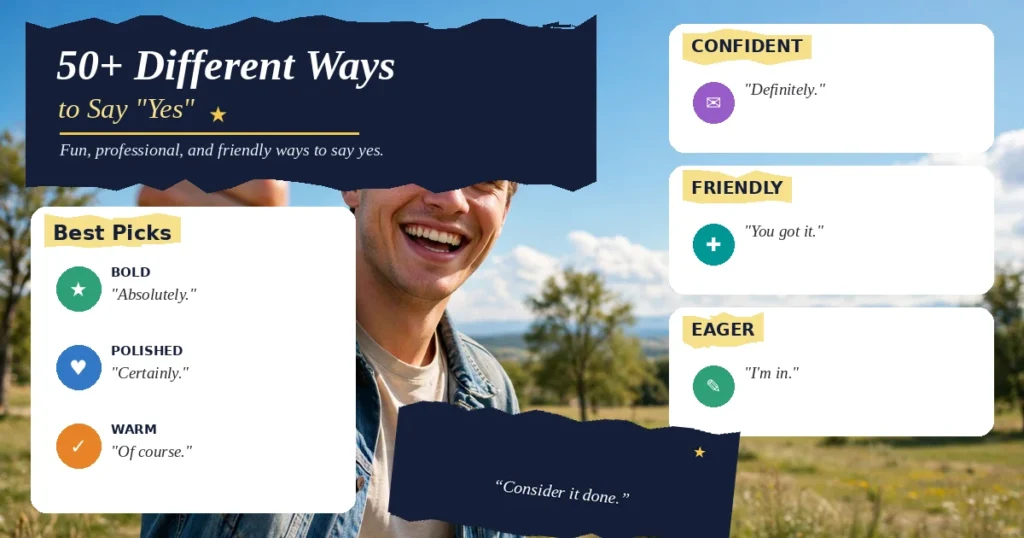
This guide gives you 55 alternatives to “yes,” grouped by tone and setting: professional, formal, friendly, email-ready, and workplace picks. Each one comes with a quick note on when it fits and a short example you can copy today. You will also find email examples, common mistakes to avoid, related phrases, and answers to the questions people ask most about this tiny-but-mighty word.
Why does the swap matter? Because agreement is not one-size-fits-all. A boardroom yes and a best-friend yes should never sound the same. The same care that goes into reaching out with the right tone applies when you accept: the final word is the one people remember, so make it count.
Meaning
“Yes” is an affirmative response word. It means you agree, accept, confirm, or are willing to do something. One syllable carries all of that — which is why it is the default answer in almost every conversation.
The literal meaning is simple: agreement. But the tone you wrap around it changes everything. “Yes.” with a firm period is final and decisive. “Yesss!” with three s’s is pure celebration. The word itself is neutral; the delivery is the message.
Emotionally, “yes” is warm by default. It says: I am with you, I agree, let’s go. That is why people rarely take offense at a yes — the risk is not the meaning, it is the monotony. Say it the same way fifty times a day and it starts to sound automatic, like you are agreeing on autopilot instead of actually listening.
Professional usage
A single yes can land very differently depending on the room. Here is how to match your yes to the setting.
Emails
In emails, “yes” can sound abrupt, especially standing alone. A bare “Yes” as a full reply can read as rushed or even annoyed, since the reader cannot hear your tone. Polished alternatives like “Confirmed” or “Happy to” carry the same agreement with a professional finish — and they make you look like someone who takes the message seriously.
The workplace
Spoken workplace settings — standups, one-on-ones, quick hallway check-ins — are friendlier territory for casual yeses. “Yep,” “You got it,” and “Sure thing” all sound natural here. Just remember that what works with your team may sound too loose in front of a client, so adjust your yes to your audience.
Client conversations
With clients, your yes should sound confident and considered. “Absolutely” and “Consider it done” tell the client their request is in good hands. A weak yes — “Yeah, I guess” — can quietly erode trust, even when you mean well. Clients pay attention to how certain you sound.
Networking
In networking, an enthusiastic yes builds momentum. “I’d love to” and “Count me in” turn a maybe into a real connection. People remember the yes that sounded like it meant something — and they forget the one that sounded like an obligation.
Customer service
Support conversations run on clear, reassuring yeses. “Of course” and “My pleasure” tell the customer their problem will be handled. And when a ticket takes longer than expected, it never hurts to remind them that it is my pleasure to help with anything else they need.
Alternatives
Here are 55 alternatives to “yes,” grouped by tone. Each entry gives the phrase, its tone and best use, and a short example.
Professional
- “Absolutely.” — Confident and warm; best for agreeing to requests. Example: “Can you send the report by Friday?” “Absolutely — you’ll have it by noon.”
- “Certainly.” — Polished and assured; best for formal workplace conversations. Example: “Will you join the call?” “Certainly. I’ll be there.”
- “Of course.” — Natural and reassuring; best for customer and client replies. Example: “Could you help me with this?” “Of course — happy to help.”
- “Definitely.” — Strong and upbeat; best for enthusiastic agreement. Example: “Are you in for the launch?” “Definitely. Wouldn’t miss it.”
- “You got it.” — Friendly-professional; best for team requests. Example: “Can you cover my shift?” “You got it.”
- “Consider it done.” — Committed and capable; best for taking on tasks. Example: “We need the slides by Thursday.” “Consider it done.”
- “Happy to.” — Willing and warm; best for offers of help. Example: “Could you review this draft?” “Happy to — send it over.”
- “Sounds good.” — Easy and agreeable; best for approving plans. Example: “Let’s move the meeting to Tuesday.” “Sounds good.”
- “Agreed.” — Crisp and decisive; best for meetings and decisions. Example: “So we ship on Monday?” “Agreed.”
- “I’m in.” — Casual-committed; best for projects and plans. Example: “We’re starting the redesign next week.” “I’m in.”
- “Works for me.” — Flexible and practical; best for scheduling. Example: “How about 2 PM?” “Works for me.”
Formal
- “Yes, please.” — Courteous and classic; best for offers and invitations. Example: “Would you like some coffee?” “Yes, please.”
- “Indeed.” — Refined and brief; best for formal agreement. Example: “The results were impressive.” “Indeed.”
- “Affirmative.” — Precise and military-crisp; best for official confirmations. Example: “Do you confirm the booking?” “Affirmative.”
- “Most certainly.” — Gracious and formal; best for high-stakes replies. Example: “Will you attend the gala?” “Most certainly.”
- “By all means.” — Generous and formal; best for granting permission. Example: “May I use your office?” “By all means.”
- “Undoubtedly.” — Certain and weighty; best for strong agreement. Example: “Was it the right call?” “Undoubtedly.”
- “With pleasure.” — Warm and formal; best for accepting invitations. Example: “Will you speak at the event?” “With pleasure.”
- “I concur.” — Professional and deliberate; best for boardroom agreement. Example: “The strategy needs a rethink.” “I concur.”
- “Very well.” — Composed and formal; best for accepting terms. Example: “We meet at dawn, then.” “Very well.”
- “Granted.” — Authoritative; best for approvals. Example: “Permission to proceed?” “Granted.”
Friendly
- “Yep.” — Casual and quick; best for friends and chats. Example: “Are you coming tonight?” “Yep!”
- “Yeah.” — Relaxed and natural; best for everyday conversation. Example: “Did you see the game?” “Yeah, what a finish.”
- “Yup.” — Light and breezy; best for texts. Example: “Still on for lunch?” “Yup.”
- “Sure.” — Easy and agreeable; best for small requests. Example: “Can I borrow your pen?” “Sure.”
- “Sure thing.” — Warm and casual; best for favors. Example: “Can you grab me a coffee?” “Sure thing.”
- “Totally.” — Enthusiastic and informal; best for agreeing with opinions. Example: “This movie is great.” “Totally.”
- “For sure.” — Confident and casual; best for promises. Example: “Will you be there?” “For sure.”
- “You bet.” — Cheerful and old-school; best for friendly favors. Example: “Can you help me move Saturday?” “You bet.”
- “Heck yes.” — Bold and fun; best for exciting plans. Example: “Road trip this weekend?” “Heck yes.”
- “Oh yeah.” — Playful and expressive; best for good news. Example: “We got the tickets!” “Oh yeah!”
- “A hundred percent.” — Emphatic; best for strong agreement. Example: “Are you sure about this?” “A hundred percent.”
- “No doubt.” — Casual and certain; best for confirming plans. Example: “You’re in, right?” “No doubt.”
- “Confirmed.” — Clean and professional; best for email replies. Example: “Meeting at 3 PM works.” “Confirmed — see you then.”
- “Agreed — let’s do it.” — Decisive; best for approving proposals. Example: “Shall we go with Option B?” “Agreed — let’s do it.”
- “That works.” — Practical; best for scheduling emails. Example: “Can we push to Thursday?” “That works.”
- “I’ll be there.” — Committed; best for meeting invites. Example: “Team lunch Friday?” “I’ll be there.”
- “Count me in.” — Enthusiastic; best for projects and events. Example: “We’re planning a team offsite.” “Count me in.”
- “Happy to help.” — Service-minded; best for support emails. Example: “Could you look into this issue?” “Happy to help.”
- “On it.” — Action-oriented; best for task assignments. Example: “Please update the dashboard.” “On it.”
- “Will do.” — Reliable and brief; best for instructions. Example: “Please update the dashboard.” “Will do.”
- “Gladly.” — Cheerful and willing; best for requests. Example: “Can you present at the review?” “Gladly.”
- “I’d be happy to.” — Warm and polite; best for client emails. Example: “Could you walk us through the data?” “I’d be happy to.”
- “Approved.” — Official; best for sign-offs. Example: “Here’s the final budget for sign-off.” “Approved.”
Workplace
- “Copy that.” — Clear and efficient; best for instructions. Example: “Finish the audit by Friday.” “Copy that.”
- “Roger.” — Brief and military-style; best for quick acknowledgments. Example: “Are you on the line?” “Roger.”
- “Got it.” — Simple and direct; best for task confirmations. Example: “Send the invoice today.” “Got it.”
- “Understood.” — Professional and calm; best for formal instructions. Example: “The deadline is non-negotiable.” “Understood.”
- “Let’s go.” — Energetic; best for kicking off work. Example: “Ready to start the sprint?” “Let’s go.”
- “I’m on board.” — Team-spirited; best for agreeing to plans. Example: “We’re changing the process.” “I’m on board.”
- “Deal.” — Punchy; best for quick agreements. Example: “You handle design, I’ll handle copy?” “Deal.”
- “Done and done.” — Playful-confident; best for accepting tasks. Example: “Can you finish both reports?” “Done and done.”
- “Say less.” — Modern and casual; best for instant agreement. Example: “Pizza for the team lunch?” “Say less.”
- “Bet.” — Ultra-casual; best for peer agreements. Example: “You good to present first?” “Bet.”
- “Aye.” — Nautical-crisp; best for team check-ins. Example: “All hands on deck?” “Aye.”
Quick comparison
| Alternative | Tone | Best use |
|---|---|---|
| “Absolutely” | Confident, warm | Agreeing to client requests |
| “Yep” | Casual, quick | Friends and everyday chats |
| “Of course” | Natural, reassuring | Customer service replies |
| “Count me in” | Enthusiastic | Projects, events, and invitations |
| “Affirmative” | Precise, formal | Official confirmations |
| “Sure thing” | Warm, casual | Friends and everyday chats |
| “I’d be happy to” | Warm, polite | Client emails and introductions |
| “Got it” | Simple, direct | Task confirmations at work |
| “By all means” | Generous, formal | Granting permission |
Email examples
Client email
Subject: Re: Revised proposal
Hi Daniel,
Thanks for sending the updated proposal. I’m happy to move forward with the new timeline — I’d be happy to walk your team through the changes on a call this week.
Best,
Anna
Manager email
Subject: Q3 planning session
Hi Mr. Thompson,
Count me in for Thursday’s planning session. I’ve reviewed the agenda and I’m on board with the priorities. Happy to take the lead on the budget review if that helps.
Thanks,
Rachel
Colleague email
Subject: Quick favor
Hi Priya,
Sure thing — I’ll cover your client call tomorrow. Send me the notes whenever you’re ready, and I’ll take it from there.
Cheers,
Leo
Customer email
Subject: Re: Your support ticket #4521
Hello,
Absolutely — we’ll look into this right away. Please be patient while we investigate the issue, and we’ll update you as soon as we have answers.
Warm regards,
Lisa
Networking email
Subject: Great meeting you at the summit
Hi Sofia,
It was a pleasure meeting you yesterday. I’d love to stay in touch — count me in for the workshop next month. Looking forward to your call on Thursday to discuss the partnership further.
Cheers,
Ben
Meeting follow-up email
Subject: Action items from today’s session
Hi team,
Thanks for a productive meeting. I’m on board with all three decisions, and at the end of the day, we’re aligned on the launch date. To recap: Ali owns the design mockups, Priya handles the client call, and we reconvene Friday.
Best,
Maya
Common mistakes
1. Saying yes to everything
The most common yes mistake has nothing to do with wording — it is saying yes too often. Agreeing to every request burns you out and teaches people that your yes means nothing. A thoughtful “let me check my schedule first” is better than an instant yes you will regret.
2. Using casual yeses with clients
“Yep” and “bet” are perfect for friends and terrible for first-time clients. Match your yes to the relationship — when in doubt, go one level more formal than you think you need. You can always relax later; you cannot un-send a too-casual yes.
3. Saying “yeah” when you mean “maybe”
“Yeah” sounds like agreement, so people treat it as a promise. If you are not sure, do not yes your way into a commitment — say “Let me think about it” instead. A honest pause beats a fake yes every time.
4. The bare “yes” email reply
Replying to a thoughtful email with a single “Yes” can feel dismissive, even when you are just busy. Add one line of context: “Yes — confirmed for Thursday, and I’ll bring the updated numbers.” The extra five seconds make the yes feel real.
5. Saying yes before you understand the question
Agreeing to something you did not fully grasp is how misunderstandings start. If the request is unclear, pause and thank them for the clarification before you commit. “Could you explain what you need?” is always smarter than a blind yes.
6. Using “yes” as filler
Some people say “yes,” “yeah,” and “uh-huh” on autopilot while barely listening. The listener can tell. Save your yeses for moments of real agreement — and when you are just keeping the conversation going, a nod works just as well.
Related phrases
- “Yes, please.” — Polite acceptance of an offer. Example: “More dessert?” “Yes, please.”
- “Yes, sir” / “Yes, ma’am.” — Respectful agreement, often military or service settings. Example: “Report to the front desk.” “Yes, sir.”
- “Yes way.” — Playful opposite of “no way”; enthusiastic agreement. Example: “Did we really win?” “Yes way!”
- “Hell yes.” — Bold, emphatic agreement. Example: “Are you coming to the concert?” “Hell yes.”
- “Oh yes.” — Warm, expressive agreement. Example: “Do you remember that summer?” “Oh yes.”
- “Yes indeed.” — Slightly formal, confident agreement. Example: “Was the trip worth it?” “Yes indeed.”
- “Say yes.” — To agree to something; the act of accepting. Example: “Just say yes and let’s go.”
- “Yes man.” — Someone who agrees with everything, often to please a boss. Example: “Don’t be a yes man — give your honest opinion.”
- “Yes or no.” — A demand for a clear answer. Example: “I need a yes or no by Friday.”
- “Yes, and…” — Improv rule: accept and build on the idea. Example: “Yes, and we could add live music too.”
- “Yes to…” — Agreement directed at a specific thing. Example: “Just say yes and let’s go.”
- “A soft yes.” — Tentative agreement, not fully committed. Example: “We got a soft yes from the sponsor.”
- “A hard yes.” — Enthusiastic, definite agreement. Example: “The team gave it a hard yes.”
- “The big yes.” — A major, celebrated agreement. Example: “She said the big yes to the proposal.”
- “Yes means yes.” — Clear consent; agreement must be explicit. Example: “Remember: yes means yes.”
- “Nod yes.” — To agree silently with a nod. Example: “He just nodded yes and kept working.”
Phrase comparison
“Yes” is the classic — neutral, clear, and safe everywhere. It works in every setting, which is exactly why it can sound dull: it carries no personality of its own. Use it when clarity matters more than warmth, like in official confirmations and quick factual replies.
“Yeah” is the casual cousin — warm but lightweight. It is what you toss into a chat with friends or a quick standup with your team. It signals easy agreement without ceremony. But it shrinks in formal rooms: “yeah” to a client can sound careless, even when you mean it sincerely.
“Absolutely” is the confident upgrade — a yes with a spine. It tells the listener you are not just agreeing, you are committed. It works beautifully with clients and managers because it sounds like a promise. Overuse it, though, and it starts to sound like a sales pitch.
“Sure” sits in the middle — agreeable but softer than “absolutely.” It is perfect for small requests and everyday favors. Its only weakness is that it can sound half-hearted: “Sure, I guess” is barely a yes at all. Keep the “I guess” off it, and “sure” does honest work.
“Of course” is the reassuring one — it says your request was never in doubt. It shines in customer service and hospitality because it makes the other person feel welcome rather than tolerated. When someone thanks you afterward, a simple note that you appreciate it keeps the goodwill going both ways.
The practical rule: match the yes to the room. Formal room, formal yes; friendly room, friendly yes. And when the stakes are high, pick the yes that sounds like a promise, not a reflex.
Cultural usage
United States
Americans say yes loudly and often — enthusiasm is the default. “Absolutely,” “heck yes,” and “a hundred percent” all thrive in US conversation, from boardrooms to barbecues. The casual “yeah” is everywhere, and even “bet” has gone mainstream among younger speakers. Directness is valued: a clear yes beats a polite maybe.
United Kingdom
British yeses lean more understated. “Yes, please,” “indeed,” and a dry “very well” carry the day, while the big American enthusiasm can feel like a lot. Brits also love the softening yes — “Yes, I suppose so” can be full agreement wearing a modest coat. Understatement is the local love language of agreement.
Corporate communication
Big companies run on decisive yeses. “Confirmed,” “approved,” and “agreed” dominate email threads because they create a paper trail of clear decisions. Vague yeses — “sounds okay, I think” — get flagged in reviews because nobody can tell what was actually decided. If the decision matters, write the yes down.
Customer service
Service scripts are built on reassuring yeses: “Of course,” “my pleasure,” “happy to help.” The customer is often anxious, so the yes needs to sound like relief, not routine. Never hedge with “I think so” — a customer hears uncertainty, and uncertainty kills trust.
Networking
Networking rewards the enthusiastic yes. “I’d love to,” “count me in,” and “let’s do it” turn introductions into relationships. A flat “yeah, maybe” ends the conversation before it starts. In networking, your yes is your brand — make it sound like you mean it.
Frequently asked questions
What’s the most professional way to say yes?
“Absolutely,” “certainly,” and “confirmed” are the safest professional picks. They sound confident and clear in emails, meetings, and client conversations. For written approvals, “approved” or “agreed” create the clearest record.
Is “yeah” rude?
Not with friends — it is warm and natural in casual conversation. But it can sound careless in formal settings, like client meetings or emails to executives. Match it to the room: fine for peers, risky for first impressions.
How do you say yes in a formal email?
Use “confirmed,” “agreed,” or “I’d be happy to.” These carry agreement with a polished finish. Avoid “yep” and “yeah” in email — without your tone of voice to soften them, they read as abrupt.
What’s a polite way to say yes to a client?
“Absolutely” and “I’d be happy to” both work well. They sound confident and willing without being stiff. Pair the yes with a next step — “Absolutely, I’ll send the draft by Thursday” — so the client feels taken care of.
Can I say “yep” at work?
With close teammates, yes — it is friendly and normal. With your manager’s manager or a client, switch to “yes,” “certainly,” or “got it.” The rule is simple: the more formal the audience, the more formal the yes.
What’s the difference between “yes” and “yeah”?
“Yes” is neutral and works everywhere; “yeah” is casual and fits relaxed settings. “Yeah” adds warmth with friends but loses polish with strangers. Think of “yes” as the suit and “yeah” as the jeans.
How do you say yes enthusiastically?
Try “absolutely,” “heck yes,” “a hundred percent,” or “I’d love to.” Exclamation points help in writing: “Yes!” reads as excitement while “Yes.” reads as a verdict. Match the energy to the moment so it sounds genuine, not forced.
What’s a formal alternative to “yes please”?
“Most certainly” and “with pleasure” are the formal upgrades. “Yes, please” is already polite, but these add ceremony for invitations and high-stakes offers. In very formal writing, “indeed” can stand alone.
Is it okay to say “sure” to my boss?
Usually, yes — “sure” is friendly and widely accepted at work. Just keep it clean: “Sure, I’ll have it by Friday” is perfect, while “Sure, I guess” sounds half-hearted. If the request is big, upgrade to “absolutely” or “consider it done.”
How do you say yes in a job interview?
Use “absolutely” or “I’d be happy to.” They sound confident and willing — exactly what interviewers want to hear. Avoid “yeah” and “yep” in interviews; the formality of the setting rewards the polished yes.
What does “bet” mean when someone says yes?
“Bet” is casual slang for “yes” or “agreed” — it means “you can count on it.” It comes from the phrase “you bet.” It is common among younger speakers and in texts, but keep it out of formal settings.
How do you agree without saying yes?
Nod, or use phrases like “sounds good,” “I’m on board,” “works for me,” or “let’s do it.” These all signal agreement without the word itself. In writing, “confirmed” and “approved” do the same job.
What’s the friendliest way to say yes?
“Of course,” “sure thing,” and “you bet” are the warmest casual picks. They make the other person feel welcome rather than tolerated. For a written message, “happy to” adds the same warmth to email.
Can “yes” sound rude?
A bare “yes” can sound curt in writing, where no tone of voice softens it. “Yes.” as a full email reply can read as annoyed or dismissive. Add a few words — “Yes, confirmed for Thursday” — and the same yes turns friendly.
How do you say yes in British English?
Brits favor “yes, please,” “indeed,” and “very well” in formal settings, with “yeah” and “yep” for casual ones. Understatement is common — “Yes, I suppose so” can be full agreement. When in doubt, the classic “yes, please” never goes wrong in the UK.
Conclusion
The shortlist, if you only remember a few:
- Professional: “Absolutely” and “Consider it done”
- Formal: “Most certainly” and “By all means”
- Friendly: “Heck yes” and “You bet”
- Email: “Confirmed” and “Count me in”
- Workplace: “Got it” and “I’m on board”
The real upgrade is not the vocabulary — it is the habit of matching your yes to the moment. A confident yes wins clients, a warm yes keeps friends, and a clear yes ends confusion. Pick the yes that fits the room, say it like you mean it, and watch a one-syllable word do heavy lifting.
For the dictionary definition of the core word, see Cambridge Dictionary’s entry on “yes”.