Introduction
If you need other ways to say looking forward to your feedback, you are in the right place. This phrase appears at the end of countless emails, proposals, reports, and job applications. It sounds polite, but it can also sound flat when you use it again and again. Readers notice repetition, and a tired closing can weaken an otherwise strong message.
The good news is that you have many warm, clear, and professional options. You can invite honest thoughts, ask for a quick review, welcome suggestions, or request a decision. Each choice sets a slightly different tone. Some sound formal and careful. Others sound friendly and relaxed. A few sound direct and confident. The best choice depends on who you are writing to, what you sent, and what kind of reply you want.
In this guide, you will find more than 35 ready-to-use alternatives, grouped by tone. You will also see full email examples, common mistakes to avoid, and simple tips for matching your closing to your goal. Whether you are writing to a manager, a client, a teacher, or a teammate, you will find a line that fits. By the end, you will know how to close with confidence instead of copying the same sentence every time.
When you are reaching out with a new idea, a fresh closing also helps your message stand out. A thoughtful ending shows care, respect, and attention to detail. It tells the reader that their time and opinion matter to you. That small touch can make a busy person more willing to reply.
Meaning
“Looking forward to your feedback” means you are waiting for the other person’s thoughts, opinions, or suggestions. You use it after you share something, such as a draft, a plan, a proposal, a design, or a report. You want the reader to read it, think about it, and tell you what they think. It is a polite way to ask for a response without sounding pushy.
The phrase has three parts. “Looking forward” shows positive expectation. “Your” makes it personal and direct. “Feedback” means comments, corrections, approval, or ideas for change. Together, the words say, “I value your view, and I am ready to hear it.” That is why it works so well in work emails and formal messages.
In simple terms, it can mean any of these ideas. Please review this and tell me what you think. I would like to hear your thoughts. Please let me know if this works for you. Please share any changes you would like. Each version carries the same core request, but the tone changes. One may sound warm. Another may sound formal. A third may sound direct and brief.
The phrase also signals that the work is not finished. It invites a conversation. It tells the reader that you are open to changes and that their input will shape the next step. That openness builds trust, especially in teams and client work. People respond better when they feel invited, not ordered.
At the same time, the phrase is very common. Because so many people use it, it can lose its force. A reader may skim past it without feeling any real urge to reply. That is why learning fresh options helps. When you understand what the reader needs, you can choose a closing that feels personal and clear, not copied.
You can also adjust the phrase for timing. If you need a fast reply, say so. If you want detailed thoughts, ask for them. If you only need approval, make that clear. A specific request gets a faster and more useful answer than a vague one. For example, “Please share your thoughts on the budget section by Thursday” is stronger than a general request for feedback. It tells the reader what to check and when to reply.
Professional usage
In professional writing, “Looking forward to your feedback” is a safe and polite closing. It works in emails to managers, clients, recruiters, teachers, and partners. It shows respect and keeps the door open for discussion. It fits after proposals, project updates, job applications, reports, and meeting summaries. It is formal enough for work, yet warm enough to feel human.
The key is to match the closing to the relationship and the task. If you are writing to a senior manager, choose a formal and respectful line. If you are writing to a close teammate, a friendly line feels more natural. If you are writing to a client, choose a line that is confident and helpful. The same message can feel stiff or careless if the tone does not fit the reader.
Professional usage also means being clear about the next step. Do you want approval? Do you want edits? Do you want a decision? Do you want a short yes or no? Say it plainly. A clear request saves time for both sides. For example, “Please let me know if you approve this plan” is clearer than a vague invitation. It helps the reader act without guessing.
You should also give a time frame when one exists. A deadline helps the reader plan. You can write, “Please share your thoughts by Friday so we can move ahead.” That line is polite, clear, and useful. It respects the reader’s schedule while keeping the work on track. If there is no deadline, you can still guide the reply by naming the part you most want reviewed.
In job applications and interviews, the phrase shows interest and professionalism. After an interview, you might write, “I welcome any feedback on my proposal.” After sending a work sample, you might write, “I would value your thoughts on my approach.” These lines show that you are open to learning and that you take the role seriously. They sound confident, not desperate.
When you thank someone for their time, the closing feels even stronger. A short line like “Thank you for reviewing this” before your feedback request adds warmth. If someone has already helped you, you can add a note of thanks and then ask for more input. For instance, after a reviewer explains a change, you can say you are grateful for the clear explanation before you invite further thoughts. That balance of thanks and request feels polite and complete.
Avoid using the same closing in every email to the same person. Variety shows care. It also helps your message feel fresh. If you email a client every week, rotate between two or three closings that fit. Keep a short list of favorites and choose the one that fits each message best.
Alternatives
Below you will find 40 alternatives in five tone groups. Each one includes a short note on tone and best use, plus a short example. Choose the line that matches your reader, your goal, and your relationship. You can copy any line as it is, or change a word or two to fit your message.
Professional alternatives
I welcome your thoughts on this. Polite and confident. Best for proposals, reports, and project updates. Example: I welcome your thoughts on this before we move to the next step.
I would value your input. Warm and respectful. Best for managers, mentors, and senior partners. Example: I would value your input on the plan before Friday.
I would appreciate your review. Clear and courteous. Best when you need a careful check. Example: I would appreciate your review of the attached draft.
Please share your thoughts when you have a moment. Gentle and patient. Best for busy readers. Example: Please share your thoughts when you have a moment this week.
I look forward to hearing your perspective. Thoughtful and open. Best for discussions and decisions. Example: I look forward to hearing your perspective on the new schedule.
Your thoughts would be most welcome. Gracious and formal-friendly. Best for clients and partners. Example: Your thoughts would be most welcome after you review the options.
I am keen to hear your views. Positive and engaged. Best for team updates and ideas. Example: I am keen to hear your views on the first draft.
Please let me know what you think. Simple and direct. Best for everyday work emails. Example: Please let me know what you think of the revised outline.
Formal alternatives
I would be grateful for your feedback. Very polite and formal. Best for senior leaders and official letters. Example: I would be grateful for your feedback on the final report.
Your feedback would be greatly appreciated. Formal and respectful. Best for formal requests and applications. Example: Your feedback would be greatly appreciated at your earliest convenience.
I await your considered response. Formal and patient. Best for official proposals and legal or academic writing. Example: I await your considered response to the proposal.
I would welcome any comments you may have. Formal and open. Best for reports and formal drafts. Example: I would welcome any comments you may have on the attached document.
Please advise of any changes you require. Formal and action-focused. Best for contracts and approvals. Example: Please advise of any changes you require before we proceed.
I remain open to your suggestions. Formal and cooperative. Best for long projects and partnerships. Example: I remain open to your suggestions as we refine the plan.
I invite your review and comments. Formal and clear. Best for official submissions. Example: I invite your review and comments on the draft policy.
Kindly share your observations at your convenience. Very formal and gentle. Best for senior officials and formal letters. Example: Kindly share your observations at your convenience.
Friendly alternatives
Let me know what you think! Warm and casual. Best for teammates and friendly clients. Example: Let me know what you think once you have had a quick look!
I would love to hear your thoughts. Warm and inviting. Best for creative work and ideas. Example: I would love to hear your thoughts on the new design.
Tell me what you think when you get a chance. Relaxed and easy. Best for peers and informal teams. Example: Tell me what you think when you get a chance today.
I am excited to hear what you think. Positive and warm. Best for new ideas and shared projects. Example: I am excited to hear what you think about the first version.
Feel free to share any ideas. Open and low-pressure. Best for brainstorming and early drafts. Example: Feel free to share any ideas, even small ones.
What do you think? Short and friendly. Best for quick messages and chats. Example: Here is the first draft. What do you think?
Your honest thoughts mean a lot. Warm and personal. Best for close colleagues and mentors. Example: Your honest thoughts mean a lot, so please be open.
Happy to hear your take on this. Relaxed and modern. Best for casual work messages. Example: Happy to hear your take on this when you are free.
Direct alternatives
Please send your edits by Thursday. Clear and direct. Best when you need a fast reply. Example: Please send your edits by Thursday so we can stay on schedule.
Let me know if this works for you. Short and action-focused. Best for approvals and simple decisions. Example: Let me know if this works for you and I will proceed.
Please confirm if you approve. Direct and formal. Best for approvals and next steps. Example: Please confirm if you approve the budget.
Share any changes you would like. Direct and practical. Best for drafts and documents. Example: Share any changes you would like and I will update the file.
Does this direction work for you? Question-based and clear. Best for plans and proposals. Example: Does this direction work for you, or should we adjust it?
Please flag anything that needs fixing. Direct and helpful. Best for reviews and quality checks. Example: Please flag anything that needs fixing before launch.
I need your go-ahead to proceed. Confident and clear. Best when a decision is required. Example: I need your go-ahead to proceed with the final version.
Your approval would help us move forward. Direct yet polite. Best for clients and managers. Example: Your approval would help us move forward this week.
Email-ready alternatives
I look forward to your reply. Short and classic. Best for general email closings. Example: I look forward to your reply once you have reviewed the details.
Awaiting your response. Brief and formal. Best for short business emails. Example: Awaiting your response before we confirm the date.
Eager to hear your feedback. Warm and professional. Best for job emails and proposals. Example: Eager to hear your feedback on my application.
Please share your feedback at your convenience. Polite and flexible. Best for clients and busy managers. Example: Please share your feedback at your convenience this week.
I would be glad to hear your thoughts. Warm and polite. Best for introductions and follow-ups. Example: I would be glad to hear your thoughts on the idea.
Do share your suggestions. Short and friendly. Best for team emails and casual work notes. Example: Do share your suggestions if you spot a better approach.
Looking forward to your thoughts. Slightly shorter and modern. Best for everyday emails. Example: Looking forward to your thoughts on the update.
Open to your feedback anytime. Relaxed and welcoming. Best for ongoing projects. Example: Open to your feedback anytime as we move ahead.
Quick comparison
Use this table to pick fast. It shows the tone and best use for ten strong choices. If you are short on time, start with one of these and adjust the ending to fit your message.
| Alternative | Tone | Best use |
|---|---|---|
| I welcome your thoughts on this | Professional | Proposals and reports |
| I would appreciate your review | Professional | Drafts that need a careful check |
| I would be grateful for your feedback | Formal | Senior leaders and official letters |
| Please advise of any changes you require | Formal | Approvals and contracts |
| Let me know what you think! | Friendly | Teammates and casual clients |
| I would love to hear your thoughts | Friendly | Creative work and ideas |
| Please send your edits by Thursday | Direct | Fast replies and deadlines |
| Let me know if this works for you | Direct | Simple approvals |
| I look forward to your reply | Email-ready | General business emails |
| Please share your feedback at your convenience | Email-ready | Busy clients and managers |
A table can guide you, but your reader should guide you more. Think about the person first. A formal line to a close friend can feel cold. A casual line to a senior client can feel careless. When in doubt, choose the slightly more polite option. It is safer to sound a little formal than too casual in work writing.
You can also mix tones. A warm opening with a clear request often works well. For example, “Thank you for your time. Please share your thoughts by Friday” combines warmth and clarity. It respects the reader and states the next step. That mix is useful in most business emails.
Email examples
Real examples make the choice easier. Below are five full closings you can copy and adapt. Each one fits a different goal. Change the names, dates, and details to fit your own message.
Example 1: Proposal to a client. Thank you for reviewing the proposal. I welcome your thoughts on this, especially on the timeline and budget. Please share your comments by Thursday so we can finalize the plan. I am happy to adjust any part to fit your goals.
Example 2: Draft to a manager. I have attached the first draft of the report. I would appreciate your review of the key findings. Please let me know if any section needs more detail. I can revise it right away.
Example 3: Job application follow-up. Thank you for considering my application. I would value your input on my portfolio and approach. I am eager to learn how I can best support your team. Please let me know if you need any more samples.
Example 4: Team update. Here is the updated plan for next week. Please share your thoughts when you have a moment. If you see a better order for the tasks, feel free to suggest it. I want us to start Monday with a clear plan.
Example 5: Friendly check-in. I have shared the first version of the design. I would love to hear your thoughts on the layout and colors. Tell me what you think when you get a chance. No rush if you need more time.
Notice how each example names what to review. That detail helps the reader. Instead of a vague request, the writer points to the timeline, the key findings, or the layout. The reader knows where to focus. That small change leads to better replies.
You can also link your closing to the next step. If you need a call, say so. If you are waiting for a call to discuss the details, mention it in the same paragraph. That keeps the message focused and saves an extra email. For example, “Please share your thoughts by Wednesday, and I will call you on Thursday to discuss them.” That line is clear, polite, and practical.
Keep your email closing short. Two or three sentences are enough. A long closing can bury the request. A short closing keeps the focus on the action. After your feedback line, add a simple sign-off such as “Best regards” or “Thank you,” then your name. That clean ending looks professional and is easy to read.
Common mistakes
Many writers use this phrase well, but a few common mistakes can weaken it. The first mistake is overuse. If you end every email with the same line, it starts to feel automatic. The reader may stop noticing it. Rotate your closings and choose one that fits each message.
The second mistake is being too vague. “Looking forward to your feedback” does not say what you want. Do you want edits, approval, or ideas? Do you want a reply today or next week? Add one clear detail. A vague request often leads to a vague reply, or no reply at all.
The third mistake is sounding demanding. A line like “Send me your feedback now” can feel rude. Even a direct request should stay polite. Add “please” and a reason. For example, “Please share your thoughts by Friday so we can meet the deadline.” That line is firm but respectful.
The fourth mistake is mixing tones. A very formal email with a very casual closing can feel off. A friendly email with a stiff closing can also feel odd. Keep the tone steady from start to finish. If your email is warm, choose a warm closing. If it is formal, choose a formal one.
The fifth mistake is adding too many requests at once. Asking for feedback, a meeting, a budget approval, and a referral in one email can overwhelm the reader. Pick one main request for the closing. If you need more, list them clearly in the body and repeat only the main one at the end.
The sixth mistake is forgetting to thank the reader. People give time when they read and reply. A short thank-you makes the request feel fair. You do not need a long speech. A simple “Thank you for your time” is enough. If you know the reply may take time, you can also show patience. You can note that you are willing to wait patiently for a thoughtful reply when the topic is complex. That patience builds goodwill.
The seventh mistake is using the phrase when you do not want feedback. If the decision is final, do not invite changes. Say so clearly. For example, “This is the final version for launch” is clearer than inviting edits you will not use. Honest wording prevents confusion.
Finally, watch your spelling and grammar. A closing with an error can undo a good email. Read the last two lines again before you send. Check names, dates, and links. A clean ending leaves a strong last impression.
Related phrases
“Looking forward to your feedback” belongs to a large family of polite closings. Knowing the related phrases helps you choose with more care. Some ask for thoughts. Some ask for approval. Some ask for a reply. Each one has a slightly different job.
Phrases that ask for thoughts include “Let me know what you think,” “I would value your input,” and “I welcome your perspective.” These work when you want ideas or honest opinions. Phrases that ask for approval include “Please confirm if you approve” and “Let me know if this works for you.” These work when you need a decision. Phrases that ask for a reply include “I look forward to your reply” and “Awaiting your response.” These work when you want any answer, not only feedback.
Other useful phrases include “Thank you for your time,” “I appreciate your help,” and “Please let me know if you need more details.” These lines support your feedback request. They show thanks and offer help. They make the closing feel complete.
You can also use softeners to make a request gentler. Words like “when you have a moment,” “at your convenience,” and “when you get a chance” reduce pressure. They work well with busy readers. Use them when there is no urgent deadline.
For follow-up emails, you can use lines like “Just checking in on my last message” or “I wanted to follow up on the draft I sent.” These lines remind the reader without sounding pushy. Pair them with a fresh feedback request. For example, “Just checking in on the draft I sent last week. Please share your thoughts when you have a moment.”
If your message is about a problem or a delay, choose a calm and kind closing. A line like “Thank you for your patience” can help. It shows that you understand the reader’s time is valuable. It also keeps the tone positive even when the news is hard.
Learning related phrases gives you flexibility. You can match the exact need without repeating the same line. Keep a small list of favorites in your notes. Over time, choosing the right closing will feel natural.
Phrase comparison
Many phrases sound alike, but small differences matter. This section compares “Looking forward to your feedback” with five close cousins. It shows when each one fits best.
Looking forward to your feedback vs. I look forward to your reply. The first asks for thoughts and opinions. The second asks for any reply. Use the first when you sent a document for review. Use the second when you are waiting for an answer, such as a yes, no, or date. The first is more specific. The second is more general.
Looking forward to your feedback vs. Please let me know what you think. The first is slightly formal and standard. The second is simple and direct. Both work in most emails. Use the first for formal clients and official messages. Use the second for teammates and everyday emails. The second feels a little warmer and more conversational.
Looking forward to your feedback vs. I would appreciate your review. The first invites any kind of feedback. The second asks for a careful review. Use the second when accuracy matters, such as reports, contracts, or technical drafts. Use the first when you want general thoughts. The second sounds more serious and focused.
Looking forward to your feedback vs. Your feedback would be greatly appreciated. The second is more formal and grateful. It works well when you are asking a senior person or someone outside your team. The first is neutral and common. The second adds extra politeness. Use the second when you want to show strong respect.
Looking forward to your feedback vs. Let me know if this works for you. The first invites open thoughts. The second asks for a decision. Use the second when you need approval to move ahead. Use the first when you want suggestions and discussion. The second often leads to a faster yes or no. The first often leads to a longer reply.
The best phrase is the one that matches your goal. Ask yourself three questions. What do I want the reader to do? How much time do they have? How formal is our relationship? Your answers will point to the right line. If you want ideas, choose an open line. If you want approval, choose a direct line. If you want a quick reply, add a date.
Cultural usage
English is used around the world, and tone norms vary. In the United States, direct closings are common. A line like “Let me know what you think” sounds normal and friendly. In the United Kingdom, polite softeners are common. A line like “I would be grateful for your feedback” may feel more natural. In both places, clarity and politeness matter.
In many formal business cultures, such as in parts of Asia and the Middle East, respectful and patient wording is valued. A line like “Please share your feedback at your convenience” shows respect for hierarchy and time. A very direct line like “Send your edits now” can feel rude in those settings. When you write across cultures, choose the more polite option. It is safer and kinder.
In casual startup and creative teams, friendly closings are normal. A line like “Happy to hear your take on this” fits well. In legal, academic, and government writing, formal closings are expected. A line like “I invite your review and comments” fits better. The setting shapes the tone.
Age and relationship also matter. With a teacher or senior manager, a formal line shows respect. With a peer or friend, a friendly line feels warmer. With a new contact, a polite and neutral line is safest. As the relationship grows, you can shift to a warmer tone.
Language learners should note one more point. “Feedback” is an uncountable noun in standard English. You do not say “a feedback” or “feedbacks” in formal writing. You say “some feedback” or “your feedback.” This small grammar point helps your email sound correct. It also shows care for detail.
Finally, remember that tone is hard to read in text. A short line can sound cold even if you mean it warmly. Add a thank-you or a warm word when you can. A line like “Thank you for your time. I would value your input” feels warmer than a bare request. When you show true thanks for help received, your closing feels human and kind. That warmth travels well across cultures.
Frequently asked questions
What does “looking forward to your feedback” mean?
It means you are waiting for someone’s thoughts, opinions, or suggestions. You use it after sharing a draft, plan, or idea. It asks the reader to review your work and tell you what they think.
Is “looking forward to your feedback” formal?
Yes, it is polite and suitable for formal and business writing. It works well with managers, clients, teachers, and partners. For a more formal tone, you can use “I would be grateful for your feedback.”
How do I say “looking forward to your feedback” in a formal email?
Use a respectful line such as “I would be grateful for your feedback” or “Your feedback would be greatly appreciated.” Add a thank-you and a clear next step. Keep the tone calm and polite throughout the email.
What is a polite alternative for a client email?
A good choice is “I welcome your thoughts on this” or “Please share your feedback at your convenience.” Both sound professional and respectful. They invite a reply without putting pressure on the client.
What is a short alternative to “looking forward to your feedback”?
Short options include “Let me know what you think,” “Your thoughts?” and “I look forward to your reply.” These work well in short emails and chats. They keep the request clear without extra words.
Can I use this phrase in a job application?
Yes, you can use it after sharing a portfolio, sample, or proposal. A line like “I would value your input on my approach” sounds confident and open. It shows that you welcome advice and take the role seriously.
How do I ask for feedback without sounding pushy?
Add soft words such as “when you have a moment” or “at your convenience.” Thank the reader for their time. Keep the request to one clear ask, and avoid adding many demands in the same email.
What should I write instead of “looking forward to your feedback” in a follow-up?
Try “Just checking in on the draft I sent” plus a fresh request. For example, “Just checking in on the draft I sent last week. Please share your thoughts when you have a moment.” This reminds the reader gently and restates the ask.
Is “I am looking forward to your feedback” correct?
Yes, it is correct and common. The form “Looking forward to your feedback” is a shorter version often used at the end of an email. Both forms are fine. The shorter form is more common in closings.
How do I ask for quick feedback with a deadline?
Be clear and polite. Write, “Please share your thoughts by Friday so we can stay on schedule.” Naming the date helps the reader plan. It also shows why the deadline matters.
What is the best closing for a feedback request?
The best closing names the action and thanks the reader. For example, “Thank you for reviewing this. Please share your thoughts by Thursday.” A clear request plus thanks feels professional and complete. Keep it to two or three sentences.
Should I use an exclamation mark in a feedback request?
You can use one in friendly emails, such as “Let me know what you think!” It adds warmth. Avoid it in very formal emails. In formal writing, a period looks more serious and calm.
How do I reply when someone asks for my feedback?
Thank them and be clear. You can write, “Thank you for sharing this. Here are my thoughts.” Then list your points in short, kind sentences. If you need more time, say when you will reply.
What is a friendly way to ask for feedback?
Friendly options include “I would love to hear your thoughts” and “What do you think?” These sound warm and open. They work well with teammates, friends, and creative partners. They invite honest answers without pressure.
Can I use “looking forward to your feedback” with friends?
Yes, but a casual line may feel more natural. With friends, try “Let me know what you think” or “Tell me what you think when you get a chance.” These sound relaxed and friendly. Save the formal phrase for work and official messages.
Conclusion
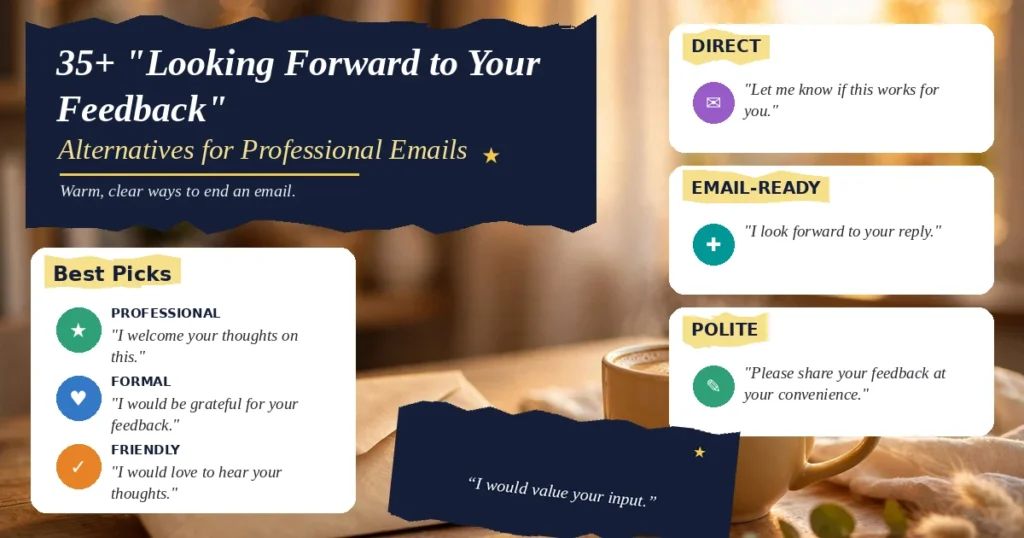
Best picks by tone: Professional — I welcome your thoughts on this, I would appreciate your review. Formal — I would be grateful for your feedback, Please advise of any changes you require. Friendly — I would love to hear your thoughts, Let me know what you think! Direct — Please send your edits by Thursday, Let me know if this works for you. Email-ready — I look forward to your reply, Please share your feedback at your convenience.
A strong closing does more than end an email. It guides the reader, shows respect, and makes a reply easy. Pick the line that fits your goal and your reader, add one clear detail, and keep the tone steady. That small choice can turn a quiet inbox into a helpful conversation. For the exact meaning of the word at the heart of this phrase, see the Cambridge definition of feedback. Use these options with care, and your messages will sound fresh, confident, and kind.