Introduction
If you want other ways to say that works for me, you are in the right place. The phrase “that works for me” is simple, polite, and clear, but it can start to feel repetitive when you use it in every meeting reply, email, and chat message at work. You may agree to a time, a plan, or a task, and you want your answer to sound fresh without changing your meaning. A small change in wording can make your reply sound warmer, more confident, or more formal, depending on who reads it.
This guide gives you 35 practical alternatives, grouped by tone, so you can pick the right one in seconds. You will learn what the phrase means, how to use it at work, which versions suit emails, and which ones fit casual team chats. You will also see full email examples, common mistakes to avoid, and answers to frequent questions. By the end, you will not need to repeat the same four words every time you agree to something. You will have a set of clear, natural options that still sound like you.
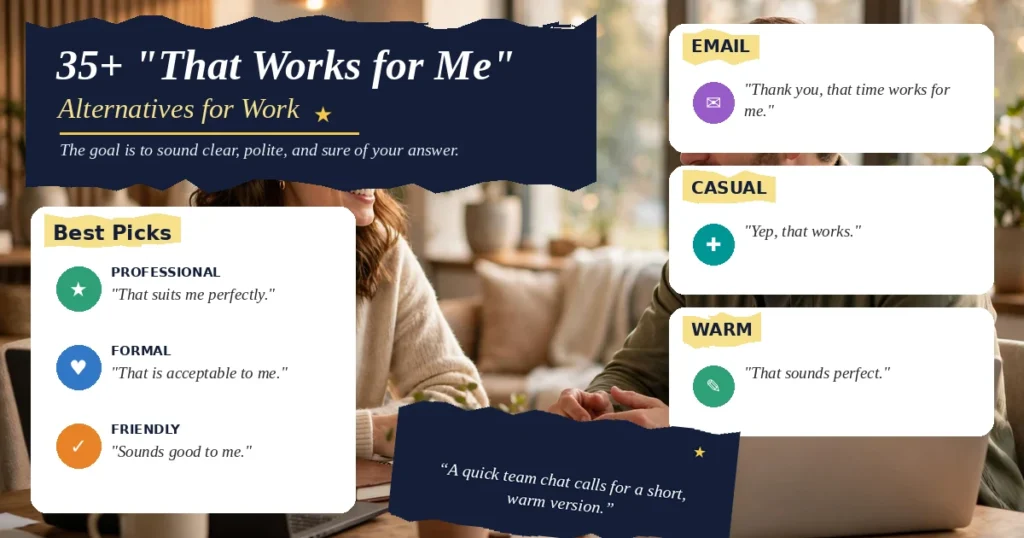
The goal is not to sound fancy. The goal is to sound clear, polite, and sure of your answer. When someone proposes a plan, they want to know one thing fast: do you agree, and can you follow through? Every alternative in this guide keeps that message intact. The only thing that changes is the tone, the level of formality, and the amount of warmth in your reply.
Meaning
“That works for me” means that a suggested plan, time, price, or arrangement is acceptable to you. It signals agreement and readiness. You use it when someone else makes a proposal and you want to accept it without adding new conditions. For example, if a colleague says, “Can we meet at 10 on Tuesday?” and you reply, “That works for me,” you confirm that the time suits your schedule and that you will attend.
The phrase is neutral and friendly. It does not sound stiff, and it does not sound overly casual. That balance is why it works so well in offices, schools, and everyday conversations. It also leaves room for a polite follow-up. You can add thanks, confirm a detail, or ask a short question after it, such as, “That works for me. Thank you for arranging it.”
In meaning, the phrase sits close to “I agree,” “That suits me,” and “I can do that.” The difference is small but useful. “I agree” focuses on your opinion. “That suits me” focuses on fit. “That works for me” focuses on practicality: the plan fits your time, your workload, and your plans. That practical focus makes it a strong choice for scheduling and task agreement.
Understanding the phrase also helps you understand its limits. It accepts a proposal, but it does not explain why you accept it, and it does not add enthusiasm on its own. If you want to show strong excitement, you need a warmer version. If you want to sound formal in a client email, you need a more polished version. The alternatives in this guide help you adjust that tone while keeping the same core meaning. If you often need to show that you follow a point before you agree, you can also learn other ways to say I understand and use them alongside your agreement.
Professional usage
At work, “that works for me” is a safe and respected reply. Managers, clients, and teammates all understand it at once. It shows that you are flexible, clear, and easy to work with. In a professional setting, short and direct agreement saves time. Long, vague replies can confuse people and slow down a project, while a clear acceptance moves the plan forward.
Use the phrase when you accept a meeting time, a deadline, a task split, or a project plan. Pair it with a small detail to make your reply even stronger. For example, write, “That works for me. I will send the draft by Thursday.” This confirms the plan and tells the other person what happens next. In a team chat, the short version alone is often enough. In an email to a client, add a polite opening and a clear next step.
Professional usage also means matching your tone to the relationship. With a close teammate, a friendly version sounds natural. With a new client or a senior leader, a formal version shows respect. You do not need to change your personality. You only need to pick a version that fits the setting. A formal client email might say, “That arrangement is acceptable to me, and I will confirm the booking today.” A teammate message might say, “Sounds good to me. See you then.”
One more professional habit matters: confirm the detail you accept. If someone proposes Tuesday at 10, repeat the day and time in your reply when the message is important. This avoids mix-ups across time zones and busy calendars. A reply such as, “That works for me. Tuesday at 10 is confirmed on my calendar,” is short, warm, and hard to misunderstand. When someone clears up a confusing point first, a short note of thanks also helps, and you can borrow the tone from thank you for the clarification to keep the exchange polite.
Alternatives
The alternatives below are grouped by tone. Each entry gives you a bold phrase, a short note on tone and best use, and a short example. Pick the group that fits your reader, then pick the phrase that sounds most natural for you. You do not need to learn all 40 at once. Start with two or three from each group, and add more as they become habit.
Professional tone
- That suits me perfectly. Professional and confident, best for agreeing to a solid plan. Example: “That suits me perfectly. I will join the call at 11.”
- That arrangement works well for me. Professional and clear, best for project plans and schedules. Example: “That arrangement works well for me, and I can start on Monday.”
- I am happy with that plan. Professional and warm, best for team decisions. Example: “I am happy with that plan. Let us move ahead.”
- That timing is ideal for me. Professional and specific, best for meeting times. Example: “That timing is ideal for me. I have no clash at 2.”
- I can make that work. Professional and flexible, best when you adjust your day slightly. Example: “I can make that work if we finish by 4.”
- That proposal meets my needs. Professional and direct, best for formal proposals. Example: “That proposal meets my needs, so I accept it.”
- I am comfortable with that option. Professional and calm, best for choices with trade-offs. Example: “I am comfortable with that option for this phase.”
- That schedule fits my plans. Professional and practical, best for calendars and rotas. Example: “That schedule fits my plans for the whole week.”
Formal tone
- That is acceptable to me. Formal and polite, best for client emails and official replies. Example: “That is acceptable to me. Please proceed with the booking.”
- I find that arrangement satisfactory. Formal and measured, best for written agreements. Example: “I find that arrangement satisfactory for both sides.”
- That proposal is agreeable to me. Formal and respectful, best for negotiations. Example: “That proposal is agreeable to me, subject to the final draft.”
- I have no objection to that plan. Formal and neutral, best for approvals in a group. Example: “I have no objection to that plan. You may go ahead.”
- That time is convenient for me. Formal and courteous, best for appointments. Example: “That time is convenient for me, and I will attend on time.”
- I am in agreement with that suggestion. Formal and clear, best for meetings and minutes. Example: “I am in agreement with that suggestion, and I support it.”
- That option is suitable for my schedule. Formal and precise, best for scheduling with senior staff. Example: “That option is suitable for my schedule this week.”
- I approve of that arrangement. Formal and decisive, best when your approval is needed. Example: “I approve of that arrangement. Please share the final version.”
Friendly tone
- Sounds good to me. Friendly and relaxed, best for teammates and everyday chats. Example: “Sounds good to me. See you at lunch.”
- That sounds perfect. Friendly and warm, best when you truly like the plan. Example: “That sounds perfect. I was hoping for Friday.”
- I am good with that. Friendly and easy, best for quick chat replies. Example: “I am good with that. Just send me the link.”
- That is fine by me. Friendly and simple, best for low-stakes choices. Example: “That is fine by me. Pick whichever room is free.”
- Perfect, that suits me. Friendly and upbeat, best for plans you welcome. Example: “Perfect, that suits me. I will bring the notes.”
- Great, I can do that. Friendly and energetic, best for tasks you accept gladly. Example: “Great, I can do that before the end of the day.”
- That works great for me. Friendly and positive, best for plans that help you. Example: “That works great for me, since I am free after 3.”
- Love it, let us go with that. Friendly and enthusiastic, best for creative plans with close colleagues. Example: “Love it, let us go with that idea for the post.”
Email-ready tone
- Thank you, that time works for me. Email-ready and polite, best for replying to invitations. Example: “Thank you, that time works for me. I look forward to meeting you.”
- That proposed time works well on my end. Email-ready and professional, best for scheduling emails. Example: “That proposed time works well on my end. I have blocked my calendar.”
- I confirm that this plan works for me. Email-ready and clear, best for confirming decisions in writing. Example: “I confirm that this plan works for me, and I will follow the steps shared.”
- That date works for my calendar. Email-ready and practical, best for booking replies. Example: “That date works for my calendar. Please send the invite.”
- I am available at that time, and it suits me. Email-ready and complete, best when availability matters. Example: “I am available at that time, and it suits me well.”
- Please proceed, as that option works for me. Email-ready and decisive, best for approvals. Example: “Please proceed, as that option works for me for this order.”
- That meeting time is good for me. Email-ready and simple, best for short replies. Example: “That meeting time is good for me. Thank you for checking.”
- I can confirm that arrangement works for me. Email-ready and formal, best for client confirmations. Example: “I can confirm that arrangement works for me in writing.”
Casual and workplace tone
- Yep, that works. Casual and quick, best for chat with close teammates. Example: “Yep, that works. Ping me when you are ready.”
- Cool, I am in. Casual and upbeat, best for informal team plans. Example: “Cool, I am in. Count me in for Thursday.”
- All good on my end. Casual and reassuring, best for confirming no problem exists. Example: “All good on my end. Go ahead with the change.”
- Sure thing, that fits. Casual and agreeable, best for small favours at work. Example: “Sure thing, that fits. I can cover your shift.”
- Works for me, let us do it. Casual and action-focused, best for moving fast. Example: “Works for me, let us do it before lunch.”
- I am down for that plan. Casual and modern, best for informal teams. Example: “I am down for that plan. Just share the details.”
- That is doable for me. Casual and honest, best when a task needs effort but is possible. Example: “That is doable for me if I get the files today.”
- Count me in for that time. Casual and committed, best for events and meetings. Example: “Count me in for that time. I will be there.”
Quick comparison
A quick comparison helps you choose fast. The table below shows how the same agreement changes with tone. Use the formal row for clients and official mail. Use the friendly row for teammates you know well. Use the professional row when you want a safe middle ground that works almost anywhere.
| Situation | Best choice | Why it fits |
|---|---|---|
| Client email | That is acceptable to me | Polite, formal, and clear |
| Team meeting | That suits me perfectly | Confident without sounding stiff |
| Quick chat | Sounds good to me | Short, warm, and natural |
| Scheduling email | That proposed time works well on my end | Confirms time and availability |
| Casual team plan | All good on my end | Relaxed and reassuring |
| Formal approval | I approve of that arrangement | Shows a clear decision |
Notice that the core message never changes. In every row, you accept the plan. Only the level of warmth and formality shifts. That is the key skill here: keep the meaning steady and adjust the packaging. If you are unsure which row fits, choose the professional version. It is polite enough for clients and warm enough for teammates, so it rarely sounds wrong.
Email examples
Email examples show the phrases in real context. Notice how each reply opens politely, accepts the plan, and ends with a clear next step. You can copy the structure and change the details to fit your own message.
Example 1: Accepting a meeting time
Subject: Re: Meeting on Thursday
Hi Sarah,
Thank you for sharing the options. That proposed time works well on my end. Thursday at 10 suits my calendar, and I will join on time.
Please send the meeting link when it is ready.
Best regards,
Alex
Example 2: Accepting a project plan
Subject: Re: Project timeline
Hi Team,
I confirm that this plan works for me. The two-week timeline is clear, and I can deliver my section by the agreed date.
Thank you for putting the plan together. I will share my first draft on Monday.
Kind regards,
Alex
Example 3: Accepting a client proposal
Subject: Re: Proposal for May
Dear Ms. Lee,
That is acceptable to me. Please proceed with the proposal as shared, and I will review the final draft when it arrives.
Thank you for your work on this.
Best regards,
Alex
Example 4: A short, friendly reply
Subject: Re: Lunch on Friday
Hi Dan,
Sounds good to me. Friday at 1 works perfectly, and I will meet you at the usual place.
See you then,
Alex
Example 5: Accepting with a small condition
Subject: Re: Call next week
Hi Priya,
I can make that work if we keep the call to 30 minutes. That timing is ideal for me, and I will prepare the notes in advance.
I am looking forward to your call on Wednesday, and I will share the agenda before then.
Thanks,
Alex
Each example keeps the same pattern: thanks, agreement, detail, next step. That pattern builds trust because the reader never has to guess what you mean. Even a short reply can follow it. A one-line chat message can still include thanks and a detail, such as, “Thanks, that works for me. See you at 10.”
Common mistakes
Common mistakes make a good phrase sound weak or confusing. The first mistake is agreeing without confirming the detail. A reply that only says “Works for me” to a long email with three times and two venues leaves the reader unsure which option you picked. Always repeat the key detail when the message has more than one option.
The second mistake is sounding unsure when you mean to agree. Phrases such as “I guess that works” or “That kind of works” signal doubt. If you agree, say so clearly. If you have a concern, state it plainly instead of hiding it inside a weak agreement. Clear language respects both your time and the reader’s time.
The third mistake is using a casual phrase in a formal setting. “Yep, that works” may sound fine to a close teammate, but it can sound careless in a first email to a client. Match the tone to the reader. When in doubt, move one step more formal. A slightly formal reply rarely causes harm, while a too-casual reply can weaken a first impression.
The fourth mistake is overusing the same phrase in one thread. If you reply “That works for me” five times in one email chain, your messages start to feel automatic. Rotate through two or three alternatives from this guide. Variety shows that you read each message and thought about it, rather than pasting the same reply.
The fifth mistake is adding an apology where none is needed. You do not need to write, “Sorry, but that works for me.” Agreement is not an apology. A simple thanks is enough. If a delay happened and you need patience from the other side, keep that message separate and polite, and learn how to say please be patient without sounding demanding. Keep your agreement clean, direct, and free of unnecessary apologies.
Related phrases
Related phrases expand your range beyond simple agreement. They help you agree, thank, clarify, and move a plan forward in the same message. Learn them in small groups so you can mix them naturally.
Phrases for agreement include “I agree,” “That suits me,” “I am on board,” and “Let us go with that.” Each one accepts a plan, but each carries a slightly different energy. “I am on board” sounds like team support. “Let us go with that” sounds like a decision. Choose the one that matches how strongly you want to back the plan.
Phrases for thanks pair well with agreement. “Thank you for arranging this” and “I appreciate your help” add warmth to a plain acceptance. A short thanks at the start of your reply changes the whole tone. You can express this well with I appreciate it when someone adjusts a plan to fit your schedule, and the thanks makes your agreement feel personal rather than automatic.
Phrases for confirming next steps include “I will follow up,” “I will send that today,” and “Consider it done.” These phrases turn agreement into action. They tell the reader that you will not only accept the plan but also carry it out. Use them when your reply needs to reassure a client or a manager.
Phrases for softening a change include “Would it be possible to move it to 11?” and “Could we try Thursday instead?” These are useful when a plan almost works but needs one small change. They keep the tone polite while you ask for an adjustment. Agreement phrases and adjustment phrases work as a pair: agree to the parts that work, then ask clearly about the part that needs a change.
Phrase comparison
Phrase comparison helps you see small differences that matter. “That works for me” and “That suits me” look alike, but they stress different ideas. “Works” stresses practicality and feasibility. “Suits” stresses fit and preference. If a time fits your calendar but you do not love it, “works” is honest. If you genuinely like the plan, “suits” sounds warmer.
Compare “I agree” with “That works for me” next. “I agree” stresses opinion and support. “That works for me” stresses personal feasibility. In a vote, “I agree” fits better. In scheduling, “That works for me” fits better. In many work messages, you can use both: “I agree, and that works for me.” The pair covers opinion and feasibility in one short sentence.
Compare “Sounds good” with “That is acceptable to me” as well. “Sounds good” is warm and casual, and it fits chats and friendly emails. “That is acceptable to me” is formal and measured, and it fits contracts, client approvals, and official records. The gap between them shows why tone groups matter. The same yes can sound like a friend’s reply or a formal approval, depending on the words you choose.
When a proposal needs a small clarification before you fully agree, do not force a yes. Ask the question first, then agree. You can frame the question politely with other ways to say just to clarify so the exchange stays smooth. Once the detail is clear, your agreement will be stronger because it rests on facts, not guesses.
| Phrase | Focus | Best setting |
|---|---|---|
| That works for me | Practicality | Meetings and schedules |
| That suits me | Fit and preference | Plans you genuinely like |
| I agree | Opinion and support | Decisions and votes |
| Sounds good to me | Warmth | Chats and friendly emails |
| That is acceptable to me | Formal approval | Clients and official replies |
| I can make that work | Flexibility | Plans needing adjustment |
Cultural usage
Cultural usage shapes how direct agreement sounds. In American and British workplaces, “that works for me” is common and well understood. It sounds polite without sounding distant. People use it in offices, in customer service, and in everyday planning. It is a standard, safe phrase that rarely causes confusion across regions.
In more formal business cultures, a direct “that works” can feel too short on its own. Adding a polite frame helps. A greeting, a thank-you, and a clear next step turn a short agreement into a complete professional message. For example, “Thank you for the proposal. That is acceptable to me, and I will confirm the details today” sounds respectful in almost any formal setting.
In friendly and informal work cultures, short agreement is welcome. Teams that chat all day prefer quick replies such as “Sounds good” or “All good on my end.” Long formal replies in a fast chat can feel slow and out of place. Match the speed of the channel. Email allows more polish. Chat rewards brevity.
Across cultures, one rule stays steady: be clear about what you accept. Vague agreement creates extra emails, missed meetings, and repeated questions. A clear reply with the day, time, or task named saves everyone time. Politeness styles differ, but clarity is valued everywhere. When you write to someone from another country, keep your sentence simple, avoid slang, and confirm the detail in plain words.
Frequently asked questions
Is “that works for me” polite?
Yes, it is polite and widely accepted at work. It sounds friendly without being casual, and it shows respect for the other person’s proposal. You can make it warmer by adding thanks at the start. You can make it more formal by choosing a version such as “That is acceptable to me” for client emails.
Can I use “that works for me” in a formal email?
Yes, you can, but a slightly more formal version often fits better. In a first email to a client, write “That arrangement works well for me” or “That is acceptable to me.” These versions keep the same meaning and sound more polished. Save the short version for teammates and people you already know well.
What is the most professional alternative?
“That arrangement works well for me” is one of the most professional alternatives. It sounds clear, calm, and businesslike without sounding stiff. “That proposal meets my needs” is another strong choice for formal proposals. Pick the one that matches the document or email you are answering.
How do I agree to a meeting time in an email?
Start with thanks, state your agreement, and repeat the time. For example, write, “Thank you, that time works for me. I will join on Thursday at 10.” This pattern removes doubt and confirms your attendance. Add the meeting link or location if you need it, and close with a polite line.
What should I say instead of “that works for me” in a chat?
In a chat, short replies work best. Try “Sounds good to me,” “All good on my end,” or “Yep, that works” with close teammates. These replies are fast and natural in a chat window. Keep the formal versions for email, and keep chat replies short so the conversation moves quickly.
Is “sounds good to me” too casual for work?
No, it is fine for most workplaces, especially with teammates. It sounds friendly and positive, and most managers accept it in chats and informal emails. For a first message to a senior leader or a new client, choose a more formal version instead. Tone should follow the relationship, not a fixed rule.
How do I agree but add a small condition?
State your agreement first, then state the condition clearly. For example, write, “I can make that work if we finish by 4.” This keeps your reply positive while protecting your time. Avoid hiding the condition in vague words such as “maybe” or “kind of,” because vague conditions cause confusion later.
Can I say “that works for me” to a client?
Yes, you can say it to a client, and many clients will find it friendly and clear. For a more polished client message, add thanks and a next step, such as, “Thank you, that time works for me. I will send the summary after our call.” This version sounds professional and keeps the warmth of the original phrase.
What is a good reply when a plan almost works?
Agree to the parts that work, then ask for one clear change. For example, write, “That mostly works for me. Could we move it to 11 instead of 10?” This reply is honest and helpful. It shows that you want the plan to succeed, and it gives the other person one simple choice to make.
Should I repeat the detail I am agreeing to?
Yes, repeat the key detail when the message has more than one option. If an email offers three times, name the one you accept. This small habit prevents mix-ups and extra emails. In a simple one-option message, a short reply alone is enough, because there is nothing else to confuse.
Is “that works for me” the same as “I agree”?
They are close, but not identical. “I agree” stresses your opinion and support for an idea. “That works for me” stresses that a plan fits your schedule and situation. In scheduling, the second phrase fits better. In a decision or a vote, the first phrase fits better. You can use both together when both meanings matter.
How do I sound enthusiastic without sounding unprofessional?
Add a warm word before your agreement, such as “Perfect” or “Great,” and keep the rest of the sentence simple. For example, write, “Perfect, that suits me. I look forward to it.” This sounds enthusiastic and still professional. Avoid overused excitement words and long praise, because they can weaken a business message.
What should I avoid when agreeing at work?
Avoid vague replies, weak agreement words such as “I guess,” and casual slang in formal emails. Avoid agreeing without naming the detail when several options exist. Avoid apologising for agreeing, since agreement needs no apology. Clear, direct, and polite replies build the strongest professional impression.
Can I use these alternatives in job interviews?
Yes, but choose the formal and professional versions for interviews. Phrases such as “That time is convenient for me” and “That arrangement works well for me” sound polished and confident. Avoid very casual versions such as “Cool, I am in” in an interview setting, because the tone may sound too relaxed for a first impression.
How many alternatives should I learn first?
Start with five or six that cover different tones. Learn one professional, one formal, one friendly, one email-ready, and one casual version. Practice them for a week until they feel natural. Then add more from this guide as you need them. A small set used well beats a long list that you never use.
Conclusion
You now have 35 practical alternatives to “that works for me,” plus email examples and tone guidance you can use today. The best reply is the one that fits your reader, your channel, and your relationship. A formal client email calls for a polished version. A quick team chat calls for a short, warm version. A scheduling email calls for a version that repeats the time and confirms your attendance. Keep the meaning steady, adjust the tone, and your agreement will always sound clear.
Start small. Pick one professional phrase, one friendly phrase, and one email-ready phrase, and use them this week. Notice how people respond when your reply includes thanks and a clear next step. Over time, these phrases will feel natural, and you will stop repeating the same four words in every message. Clear agreement is a small skill with a large payoff, because it saves time, prevents mix-ups, and makes you easy to work with.
For a precise sense of the word behind many of these phrases, see the definition of suitable in the Cambridge Dictionary, which captures the idea of a plan that fits a person or a situation well. Keep this guide nearby, choose the tone that fits, and agree with confidence.